Private Equity: The Silent Shock of Higher Rates
Private equity: how a durable rise in rates strains valuations, liquidity and exits, and why the shock remains partly underestimated.

Private equity: how a durable rise in rates strains valuations, liquidity and exits — and why the shock remains partly underestimated.
TL;DR
Private equity was built on fifteen years of cheap money; with real policy rates back in positive territory and likely to persist, its value-creation model enters a different regime.
- The model depends structurally on debt leverage and high valuation multiples, which durably higher rates mechanically compress while lengthening holding periods.
- What changes is less the absolute level of rates than their persistence — funds can no longer simply 'wait out the storm' for a return to 0–1%.
- Consensus fixes on past reported performance; the real issue is future exit liquidity, where the cost of capital bites and official marks still lag.
Since mid-2022, real policy rates have moved back into positive territory across most developed economies, with 10-year sovereign yields around ≈3–4% in 2024–2025 depending on the region. This new cost of capital is gradually diffusing through private equity, an industry built on fifteen years of abundant and cheap money.
What is changing without making noise is less the absolute level of rates than their persistence. As long as markets expected a swift return to 0–1%, funds could “wait out the storm”. With many forecasters now pencilling in moderately positive real rates through 2026–2027, the private equity value-creation model is entering a different regime.
To understand this shift, it is useful to place private equity within the broader frame of the credit cycle and monetary policy, examined for instance in the general framework on real policy rates and the cost of money.
The impact of higher rates on private equity does not depend solely on financial parameters (leverage, valuations, liquidity), but above all on investors’ ability to maintain a stable decision framework when the regime shifts.
This dimension is developed in the reference study on investment discipline, which serves as an anchor for all strategies analysed on Eco3min.
Why higher rates hit the core of the private equity model
Classical private equity rests on three pillars: leverage (LBO), multiple expansion at exit, and operational improvement (revenue growth, margins). Between 2010 and 2021, this model was carried by policy rates close to 0% and 10-year sovereign yields often below 2% in G7 economies.
With LBO debt financing rates often below 4% over the 2015–2019 period, modest leverage was enough to boost internal rates of return (IRR). This regime produced a massive capital inflow: global private equity assets under management rose from roughly $2tn in 2010 to an estimated $8tn-plus in 2024. It is that climb, repeated across credit, infrastructure and real assets, that adds up to the tripling of private-market assets in a decade.
The current shock comes from the combination of two facts:
- The cost of LBO debt has often doubled in a few years (≈7–9% coupons on some 2024 deals against ≈3–4% a few years earlier).
- Multiples paid at entry in 2018–2021 (often >12x EBITDA for high-quality assets) are difficult to justify in a world where investors demand a higher return on risk assets.
Rates do not only make debt more expensive: they also reshape the comparison between private equity and liquid alternatives, such as investment-grade bonds or some equity ETFs, examined on the pillar page on investment strategies.
A shock not yet fully reflected in official figures
Part of the consensus considers private equity “resilient”, relying on smoothed performance: many funds still report attractive annualised IRRs on 2015–2019 vintages, and valuations reported to investors for 2023–2024 have only moderately declined.
This reading rests on two accounting mechanisms:
- valuations are often based on comparable transactions or listed-index multiples, with a time lag;
- assets are marked to “fair value” each quarter, but without any obligation to instantly reflect the worst market conditions as long as no transaction takes place.
This suggests that the rate shock is partially masked by the absence of exit transactions. The real test comes at sale (IPO, trade sale, secondary buyout), when a market price must be accepted by an actual buyer.
Some signals are already visible: IPO volumes remain well below the 2020–2021 peaks, and several deals have been postponed or restructured since 2023 due to unsatisfactory valuations. Aggregate estimates from many houses point to a 30–50% decline in exit volumes versus the 2015–2019 average.
Historical perspective: from free money to relative scarcity
Historically, private equity has gone through stress phases: the bursting of the TMT bubble in the early 2000s, then the 2008–2009 financial crisis. But these episodes unfolded in a context where central banks rapidly cut policy rates, pulling the cost of capital down to restart credit.
Between 2009 and 2021, the real yield on sovereign bonds (nominal rate minus inflation) was often close to 0%, sometimes negative. In that frame, institutional investors hunted for higher yields in illiquid assets: private equity, unlisted real estate, infrastructure.
The 2023–2025 regime is a different beast: inflation surprised to the upside in 2021–2022, leading the main central banks to raise policy rates by more than 400 basis points in roughly 18 months. Even though inflation receded toward 2–3% in several advanced economies between 2024 and 2025, nominal rates remained elevated, leaving real rates positive.
Dominant scenarios now expect policy rates to ease, but without systematically returning to the ultra-low levels of the 2010s. The analysis proposed here diverges on a precise point: even if rates fall by 100–150 basis points, private equity will have to deal with a structurally higher cost of capital than in the previous cycle, weighing on multiples and on the use of leverage. Related framing: our analysis of reading the economic cycle.
What investors are really trying to understand
The real question is not so much whether private equity remains broadly profitable, but whether the combination “current valuations + cost of debt + exit horizon” remains coherent in a higher-rate environment. Behind this lies a simple concern: capital tied up longer than expected, or exits priced below implicit expectations. It is that lengthening, more than the headline return, that reopens the illiquidity premium once taken for granted in buyout returns.
The precise mechanics of the shock: valuations, cash flow and holding period
1. Compression of valuation multiples
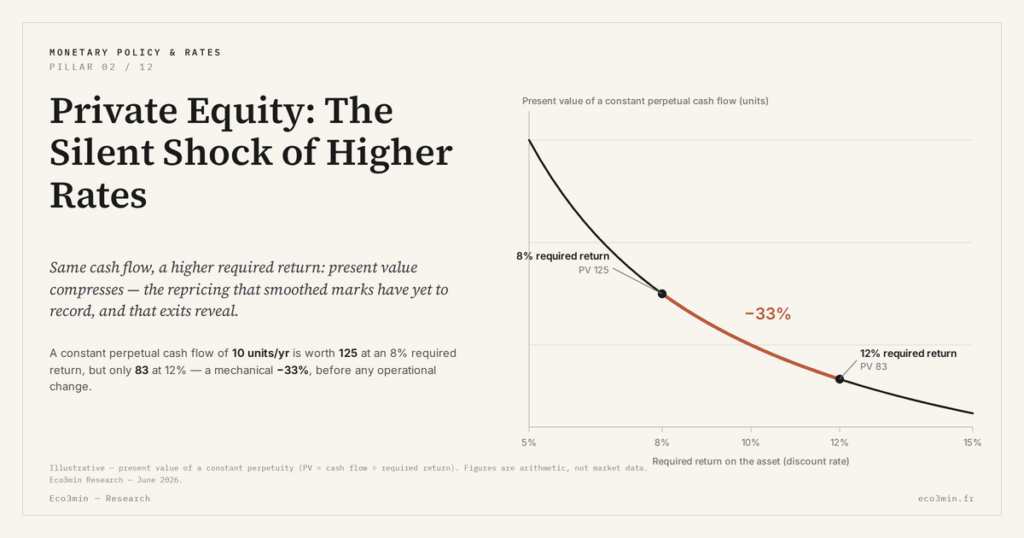
On listed markets, the rise in rates translated into multiple compression for many non-tech sectors between 2021 and 2023. In the unlisted space, the move is slower, but the logic is identical: if the return required by investors moves from 8 to 12%, the present value of the same cash flow declines.
Simplified illustration: an asset generating 10 units of cash flow per year is theoretically worth ≈125 units at an 8% discount rate, but only ≈83 units at 12%. Even with no operational change, the rise in the required return mechanically compresses theoretical value.
2. Higher cost of debt and LBO fragility
In a classical LBO, a large share of the acquisition price is funded by bank or bond debt. With coupons rising from 3–4% to 7–9%, the share of cash flow earmarked for debt service rises sharply.
Possible consequences:
- less room to invest in growth (capex, R&D, acquisitions);
- greater sensitivity to revenue declines in case of an economic slowdown;
- more frequent renegotiations with lenders if covenants come under pressure.
3. Longer holding periods and the dry-powder pile-up
When exit conditions deteriorate, funds tend to hold assets longer. Many vehicles plan a 10-year life (5 years of investment, 5 years of divestment), but a portion of pre-2017 vintages is reaching the end of that horizon in 2025–2026 with assets still in portfolio.
At the same time, dry powder — capital already raised but not invested — remains elevated, often estimated above $1.5–2tn globally. If new transactions slow and exits drag on, the ecosystem ends up with capital stuck both upstream and downstream.
Macro parameters to track around private equity
Private equity does not exist in a vacuum. Three macro dimensions directly shape its equilibrium:
- Real interest rates: a swift return below 0% would ease pressure on valuations, while a durable level between 1 and 2% continues to weigh.
- Nominal GDP growth: real growth around 3–4%, combined with reasonable inflation, helps portfolio companies grow revenue and absorb part of the rate shock.
- Flows toward listed markets: if equity volatility — tracked regularly in the macroeconomic barometer — stays contained and stock-market valuations normalise, the IPO window can reopen more widely.
A scenario in which central banks turn out more restrictive than expected — for example to counter renewed inflation above 3–4% — would further complicate matters by making buyout debt even more expensive.
Key indicator to watch
A particularly telling KPI is the ratio of exit volumes to entry volumes (investments) in private equity, measured on a rolling one-year basis. When that ratio falls clearly below 1 — as observed approximately since 2023 — it means more capital is going in than coming out, building growing pressure on overall system liquidity.
What many still underestimate
Common misreadings
- Confusing smoothed valuations with actual transaction prices: taking quarterly valuations as an exact reflection of the market can mislead, since they incorporate adjustments with a lag. A more cautious reading observes prices effectively paid in the rare comparable transactions.
- Over-extrapolating the historical performance of top funds: applying 2010–2015 vintage IRRs to the new rate regime ignores the change in the cost of capital. Past results do not predict future performance in a different macro context.
- Ignoring sectoral heterogeneity: lumping all private equity into a single risk profile masks very different realities between regulated infrastructure, mid-cap buyout and early-stage venture capital. Each segment reacts differently to the level and volatility of rates.
Three possible trajectories for private equity
Scenario 1 – Slow but managed normalisation
This scenario assumes that policy rates ease gradually by 50 to 150 basis points between 2025 and 2027, while inflation stays close to 2–3%. Multiples remain below the 2020–2021 peaks, but without a brutal shock.
Exits resume, first via trade sales, then via more frequent IPOs. Median fund returns remain decent, though less spectacular than over the previous decade. This scenario is close to the one favoured by many current forecasts.
Scenario 2 – Prolonged pressure and secondaries under stress
If real rates remain durably higher than expected (for instance above 2% on long maturities), multiples compress further and LBO debt becomes harder to refinance. Exits stay rare, holding periods lengthen, and the secondary market for fund stakes (secondaries) acts as a release valve.
In this frame, sharper discounts emerge on the secondary market, which could materialise the “silent shock” in institutional investor reporting more visibly.
Scenario 3 – Strong recovery in equity markets
Conversely, a scenario in which productivity (notably via AI) accelerates growth and supports corporate margins could lift equity markets despite still-relatively-high rates. Stock indices would reconnect with more generous multiples, reopening the IPO window broadly.
In that case, private equity would benefit from better exit liquidity, but with sharper selection between assets the market deems strategic or not.
This is not necessarily today’s central scenario, but markets do not always fully price in the possibility of prolonged pressure on exits. This risk is less visible than others — it does not show up as a brutal crash — and therefore easier to ignore.
This case illustrates less a specific opportunity than a robustness test for investment strategies in the face of a new rate regime. In this kind of environment, the consistency of the decision framework often matters more than the search for marginal optimisation.
Concrete implications for investors, companies and individuals
Without ever constituting advice or an incentive to invest, several reading frameworks can help interpret this new regime for different actors:
- Institutional investors: the issue is to assess the consistency between illiquid commitments and liquidity constraints, particularly in case of unexpected cash needs. The balance between liquid assets (listed equities, bonds) and private equity becomes more structuring.
- Companies targeted by funds: understanding the real cost of debt and funds’ exit expectations helps to better negotiate equity entry conditions and investment plans, especially in a context of more volatile inflation.
- Individuals exposed via structured products or life-insurance contracts: the main issue is grasping the investment horizon and the illiquid nature of these vehicles relative to more liquid instruments.
For those tracking macro-financial dynamics broadly, private equity emerges as a revealer of the new rate regime: it reacts more slowly than listed markets, but it deeply records changes in the cost of money and the risk premium.
Questions readers often ask
- How can one tell whether private equity valuations truly reflect the new level of rates?
One approach is to compare the implicit multiples of portfolios with multiples observed in recent comparable transactions, rather than only with stock-market indices. Persistent gaps may signal an adjustment that is still incomplete. - Are pre-2020 vintages structurally more exposed to the rate shock?
They often paid higher prices in the low-rate era and counted on rapid exits. If they have to extend the holding period with more expensive debt, their risk-return profile becomes more sensitive to the macro cycle and to refinancing conditions. - Can the secondary market for fund stakes absorb a wave of sellers?
It has gained depth in recent years, but excessive supply could trigger sharper discounts. This does not necessarily imply a systemic crisis, but a visible transfer of the cost of illiquidity. - If rates eventually fall, would private equity return to its previous regime?
That would depend on the level of real rates reached, on confidence in inflation stability, and on equity markets’ capacity to absorb new IPO flows. A mechanical return to the excesses of 2015–2021 is not guaranteed.
- Key takeaways
- Higher rates act on private equity mainly via exit liquidity and holding period, more than via still-flattering past performance.
- The exits-to-entries ratio in private equity is becoming a macro-financial indicator to track on par with credit spreads.
- The main risk is discreet: a slow normalisation of returns and horizons, rather than a spectacular and immediate shock.
Last updated — 23 July 2026
Disclaimer – Financial Information: The analyses, commentary, and content published on eco3min.fr are provided for informational and educational purposes only. They do not constitute investment advice or a solicitation to buy or sell financial instruments. Past performance is not indicative of future results. All investment decisions involve risk and are the sole responsibility of the reader.
Read next
Full pillar →Beneficiary Designations, the Step-Up in Basis, and the 10-Year Rule: How US Accounts Transfer at Death
At death, most US financial accounts pass outside the will, straight to a named beneficiary, under tax rules…
The Fee Stack in Variable Annuities: M&E Charges, Riders, and Subaccount Costs
A variable annuity does not carry one fee, but a stack of them. Mortality and expense charges, subaccount…
The Conventional 401(k)-Match-First Funding Order: Where It Comes From, How It Works
The question of what order to fund accounts in usually draws a fixed list, presented as a rule…