Does a Risk-Free Rate Really Exist? Three Hidden Risks
The risk-free rate is a theoretical convention, not an absolute guarantee. Three structural risks — inflation, residual sovereign risk and liquidity stress — remain obscured by the label.

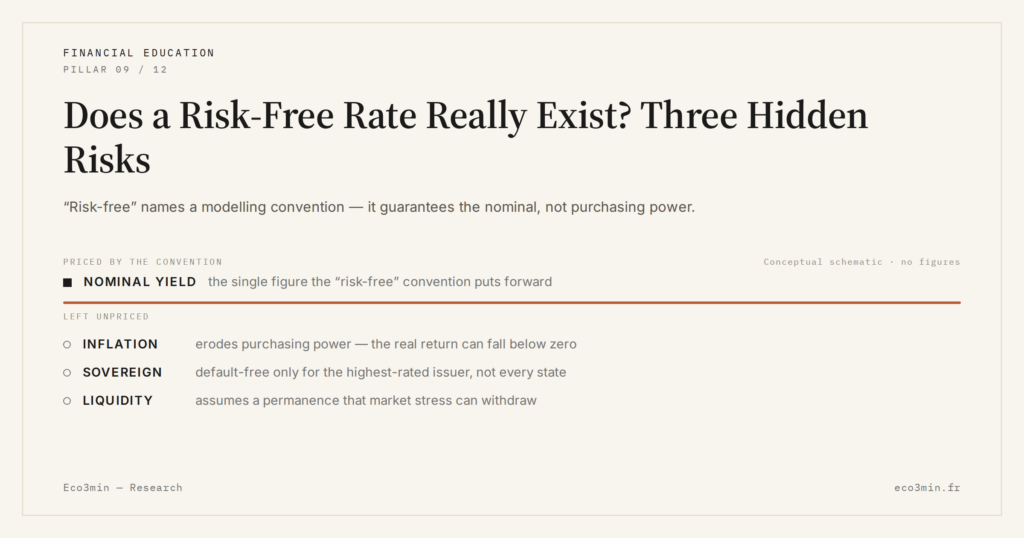
The risk-free rate is a theoretical convention, not an absolute guarantee. Inflation risk, sovereign risk, liquidity risk: what investors need to understand.
TL;DR
The risk-free rate guarantees a nominal yield, not purchasing power; behind the convention sit three unpriced risks: inflation erosion, residual sovereign default, and liquidity stress.
- Inflation erodes the real return: a 3% nominal T-bill against 2.5% inflation leaves 0.5% real, and short-dated Bunds earning roughly 2.1% against eurozone core inflation near 2.4% (Eurostat, Q4 2025) delivered a negative real yield.
- Residual sovereign risk persists even for top issuers: the 2012 Greek crisis showed partial eurozone default was possible, and the Italy–Germany 10-year spread sat near 120 basis points in early 2026, already pricing modest credit risk.
- Even sovereign bonds can turn temporarily illiquid under stress, as the September 2022 UK gilt episode showed; the “risk-free” label assumes a permanence of liquidity that is not always there.
The “risk-free rate” is one of the most widely used concepts in finance — and one of the most misleading. In theory, it refers to the yield an investor can obtain without exposure to any uncertainty, typically through short-dated sovereign bonds. But this convention rests on fragile assumptions: it ignores inflation risk, residual sovereign risk and liquidity conditions. Treating a yield as “guaranteed” often means forgetting that the guarantee itself carries a cost. Related discussion: our account of the decision-stress simulators.
Why the current equilibrium is less stable than it appears: after a decade of near-zero rates, the rise in policy rates has temporarily restored a visible nominal yield to “risk-free” assets. This visibility creates the illusion that “risk-free” has become attractive again — even though the risks it conceals have not disappeared.
A theoretical convention, not a market reality
In academic finance, the risk-free rate serves as a reference point: it is the floor from which the risk premium of any asset is calculated. It is generally identified with the yield on short-dated sovereign bonds — three-month US Treasury bills (T-bills) or German Bunds. The implicit assumption: these issuers will never default. The argument is developed step by step in whether the risk-free rate is truly risk-free.
That assumption is debatable. According to BIS data (Quarterly Review, December 2025), public debt across G7 advanced economies averaged more than 120% of GDP at end-2025. While the probability of sovereign default remains low for the highest-rated issuers, it is not zero — and crucially, the risk does not reduce to default alone. Restructuring risk, financial repression and debt monetisation are real, even for AAA issuers.
Three risks the “risk-free” label ignores
The first is inflation risk. A Treasury bill yielding 3% in nominal terms in a 2.5% inflation environment delivers only 0.5% in real terms. According to Eurostat data (Q4 2025), eurozone core inflation stood at around 2.4%. An investor in short-dated Bunds was earning a nominal yield of roughly 2.1% — a negative real return. “Risk-free” guarantees the nominal, not purchasing power.
The second is residual sovereign risk. The 2012 Greek crisis showed that partial default on eurozone sovereign debt was possible. The spread between Italian and German 10-year bonds hovered around 120 basis points in early 2026, according to market data — a level that already incorporates credit risk, however modest. “Risk-free” is risk-free only for the highest-rated issuer, not for all sovereigns.
The third is liquidity risk. In periods of market stress, even sovereign bonds can become temporarily illiquid — as the September 2022 UK gilt episode demonstrated. The notion of “risk-free” assumes permanent liquidity that is not always available. Recognising these limits brings us back to the three functions of capital: absolute safety is an accounting convention, not an intrinsic property of any asset.
Market consensus treats the risk-free rate as a settled technical input — a model parameter, not an object of inquiry. This approach is operational within a portfolio management framework, but it can become misleading for a saver who reads “risk-free” literally. The distinction between professional convention and household reality is rarely made explicit.
Equating “risk-free rate” with “guaranteed return without possible loss”. The risk-free rate is a modelling convention that protects neither against inflation, nor residual sovereign risk, nor liquidity stress episodes. The nominal is guaranteed; the real is not.
What would invalidate this critical reading is a sustained return to inflation near zero combined with massive sovereign deleveraging — a scenario that would restore the “risk-free” framing as a reliable approximation. Neither IMF projections (October 2025) nor OECD projections retain this scenario over a five-year horizon.
The risk-free rate exists as a calculation convention, not as a household reality. Several rate and inflation paths remain open, but none of them removes the risks the convention conceals. The relevant question is not “what is the risk-free rate”, but “what risks are implicitly accepted by treating it as safe” — a framing that applies to understanding everyday financial choices.
- The “risk-free rate” is a modelling convention, not an intrinsic property of assets — it guarantees the nominal, not purchasing power.
- Three risks are systematically obscured: inflation, residual sovereign risk and liquidity risk during stress episodes.
- Higher nominal rates have restored visibility to “risk-free” assets, but have not eliminated the real risks the label conceals.
Last updated — 12 July 2026
Disclaimer – Financial Information: The analyses, commentary, and content published on eco3min.fr are provided for informational and educational purposes only. They do not constitute investment advice or a solicitation to buy or sell financial instruments. Past performance is not indicative of future results. All investment decisions involve risk and are the sole responsibility of the reader.
Read next
Full pillar →Series I and EE Savings Bonds: Locked Formulas in a Moving Rate World
US savings bonds lock a rate formula at the moment you buy them, for the life of the…
Where the Livret A’s Money Goes: The Caisse des Dépôts Circuit and Social-Housing Finance
The savings held on Livret A accounts do not sit idle. A regulation-set share is centralised at the…
France’s LEP vs the Livret A: A Means-Tested Higher Rate, Explained
France’s Livret d’épargne populaire is often described as "the Livret A, only better". The description misleads: the LEP…