Series I and EE Savings Bonds: Locked Formulas in a Moving Rate World

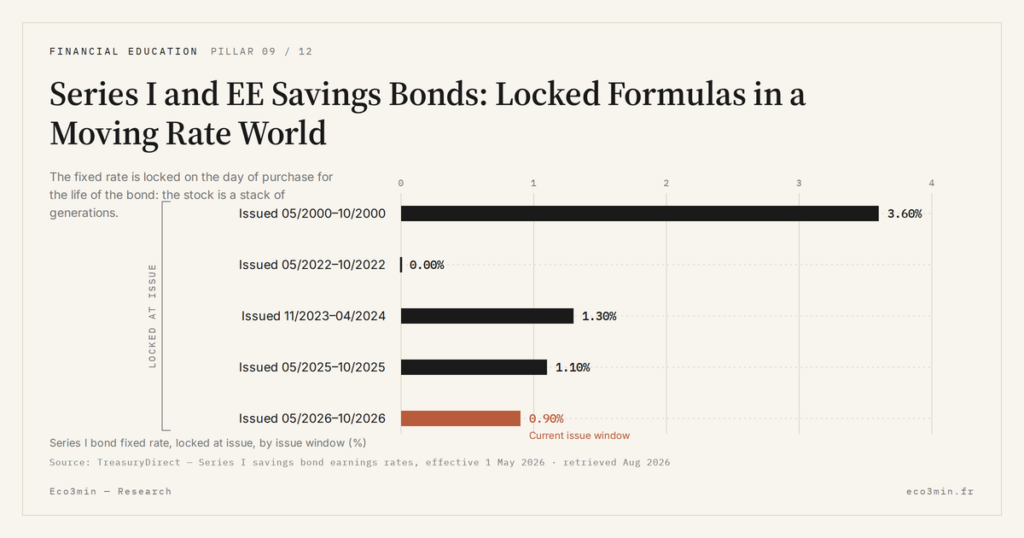
US savings bonds lock a rate formula at the moment you buy them, for the life of the bond. Like a fixed-rate savings contract, they come in generations, each frozen at the terms of the day it was purchased, whatever the rate world does next.
Series I and EE savings bonds are the American analog to a government product whose rate is set at purchase, not revised over time. That single feature produces generations of bonds.
A Series I bond issued from May 2026 earns a composite 4.26%, and a Series EE bond 2.40%, each locking a formula on the day it is bought.
- The I bond combines a fixed rate of 0.90%, locked for 30 years, with an inflation rate of 3.34% that resets every six months.
- The EE bond pays a flat 2.40% but is guaranteed to double in value if held 20 years, an implied yield near 3.5%.
- Like a fixed-rate savings plan, the stock of bonds carries generations, each frozen at the terms of its purchase date.
Two locked formulas: I bonds and EE bonds
Where an administered savings rate is set by the state and revised over time, as examined in the trade-off in an administered rate, a US savings bond fixes its formula on the day of purchase.
The I bond’s return is a composite of two parts. The fixed rate is set at purchase and never changes for the bond’s 30-year life; the inflation rate is reset every six months, on 1 May and 1 November, from the non-seasonally adjusted Consumer Price Index for all urban consumers. The two combine into a composite rate that applies for six months and then adjusts as the inflation component is reset. For bonds issued from May 2026 through October 2026, the fixed rate is 0.90% and the annualised inflation rate is 3.34%, producing a composite of 4.26%, up from 4.03% for the previous six-month window. The composite is not simply the sum of the two: it adds the fixed rate, twice the semiannual inflation rate, and the small product of the two, and it can never fall below zero, so deflation cannot push the return negative. This inflation link is what makes the I bond behave differently from a fixed savings account, a point that connects to the real return on safe savings over long horizons.
The EE bond works on a purer fixed logic. A bond issued from May 2026 through October 2026 earns a fixed 2.40%, and every EE bond issued since May 2005 carries a guarantee that it will be worth at least twice its purchase price at 20 years, even if the Treasury has to make a one-time adjustment to get there. That doubling implies an annualised return of roughly 3.5% for a holder who keeps the bond exactly 20 years, which is above the stated 2.40% fixed rate; the guarantee, not the headline rate, is the real value of an EE bond held to that mark. Both series keep earning interest for 30 years. Each bond, in other words, is frozen at the rate of the day it was bought.
The consequence: generations of bonds
Because each bond keeps the fixed rate set at its purchase, the outstanding stock is a stack of generations. A sister question is raised in the article on France’s LEP vs the Livret A: A Means-Tested Higher Rate, Explained. The most vivid example is recent: I bonds bought in the second half of 2021 and in 2022 rode the inflation surge to headline composite rates that peaked at 9.62% for bonds issued in May 2022, even though their fixed component was zero. Those buyers locked a 0% permanent fixed rate but captured a large, temporary inflation payout. More recent vintages reverse the mix, pairing a higher fixed rate, 0.90% or above, with a smaller inflation component. Older I bonds issued before 2008, some with fixed rates above 3%, remain especially valuable to the holders who still own them, precisely because that fixed rate persists for the full life of the bond. Two I bonds bought a few years apart can earn very different returns for no reason other than the regime in which each was purchased. Worth reading alongside: where to park cash net of taxes and inflation.
The same generational logic applies, in muted form, to EE bonds and to any purely fixed government savings instrument. The rate, or the doubling guarantee, is frozen at issuance, so the value of owning a given vintage is really the value of a dated commitment made under past conditions. This is the same structure that governs how a government sets a savings rate in the first place, whether through how an administered rate is set or through a fixed formula locked at purchase.
The lock as a free option
The cleanest way to read these vintages is to treat the fixed component as a free option handed to the buyer at purchase. That option gains value when newly issued fixed rates fall below the one you already hold, and loses relative value when new issues offer more. A holder of an older I bond with a 3% fixed rate keeps an advantage that no new bond can match while fixed rates stay low; a holder who bought at a 0% fixed rate depends entirely on the inflation component to carry the return. The I bond adds a second layer of protection that a purely fixed product lacks: because its inflation rate resets every six months and can never drag the composite below zero, the bond keeps pace when inflation rises rather than being eroded by it. This is where the American instrument diverges from a purely fixed lock, a difference the next section takes up directly. A related read: the mechanics of holding bonds.
Where the US analog diverges from a pure fixed rate
The divergence is worth stating plainly, because it is the point. A purely contractual fixed-rate savings plan, of the kind common in Europe, locks a single rate at opening and keeps it for the life of the plan; when inflation surges, that fixed rate can fall below the rise in prices and the saver loses real value even while nominally earning interest. The I bond is built to avoid exactly that outcome: its inflation component tracks consumer prices, so in an inflationary regime the composite rises rather than lagging. The EE bond, by contrast, sits on the pure-fixed side of the family, with a stated rate and a doubling guarantee but no inflation link. The lesson is that the locked-formula family splits in two: pure fixed products, whose real value is exposed to inflation, and inflation-linked products like the I bond, whose real value is protected by design. Comparing either to a plain savings account is a matter of after-inflation return, the same lens applied to cash and savings after inflation.
The tax treatment reinforces the buy-and-hold logic. Interest on savings bonds is exempt from state and local income tax, and federal tax can be deferred until the bond is redeemed or reaches its 30-year maturity, so a holder controls the year in which the income is recognised. Bonds used to pay qualified higher-education expenses may even escape federal tax entirely, subject to income limits. This deferral means the headline yield understates the after-tax return for many holders, and it rewards holding over trading, since redeeming early both forfeits future interest and recognises the deferred tax. The instrument is built to be kept, not chased.
Rules and constraints
Both series carry practical limits that shape how they are used. A bond must be held at least one year, and a bond redeemed before five years forfeits its last three months of interest. Interest is exempt from state and local income tax, and federal tax can be deferred until the bond is redeemed or reaches maturity. Electronic purchases are capped at 10,000 dollars per person per calendar year for each series. Rates are announced on 1 May and 1 November, interest accrues monthly and compounds semiannually, and the date on which a given bond’s rate actually changes is every six months from its own issue date, not on the announcement dates. These features make the I bond function, for many holders, as a secondary reserve that adjusts to inflation, and the EE bond as a long-horizon commitment that pays off mainly at the 20-year doubling mark.
Treating “the I bond rate” as a single fixed number is a mistake. The headline composite, 4.26% for bonds issued through October 2026, applies for only six months and changes as the inflation component resets; only the fixed part, 0.90% for this vintage, is locked for the life of the bond. Each issue window carries its own fixed rate, so the return on an I bond depends as much on when it was bought as on the current headline. Reading the composite as a guaranteed yield, or assuming all I bonds earn the same, misses the generational structure entirely.
The overall read
Series I and EE savings bonds lock a formula at purchase and pay it out over decades, which turns the outstanding stock into a stack of generations, each frozen at the terms of its issue window. The fixed component is the permanent lock, valuable in proportion to how far new-issue rates have fallen below it; the I bond’s inflation component is what separates it from a pure fixed product and shields its real value when prices rise. Describing this mechanism prescribes nothing about whether to buy, hold, or redeem; it only makes visible why two savings bonds are never quite the same, and why the value of a locked formula can only be judged against the regime that came after it. In depth: our analysis “Investment Vehicles Explained”.
Last updated — 1 August 2026
Disclaimer – Financial Information: The analyses, commentary, and content published on eco3min.fr are provided for informational and educational purposes only. They do not constitute investment advice or a solicitation to buy or sell financial instruments. Past performance is not indicative of future results. All investment decisions involve risk and are the sole responsibility of the reader.
Read next
Full pillar →Where the Livret A’s Money Goes: The Caisse des Dépôts Circuit and Social-Housing Finance
The savings held on Livret A accounts do not sit idle. A regulation-set share is centralised at the…
France’s LEP vs the Livret A: A Means-Tested Higher Rate, Explained
France’s Livret d’épargne populaire is often described as "the Livret A, only better". The description misleads: the LEP…
France’s Livret A Ceiling: What Happens Mechanically When a Capped Savings Account Is Full
France’s Livret A ceiling, €22,950, is one of the best-known figures in French saving and one of the…