France’s LEP vs the Livret A: A Means-Tested Higher Rate, Explained

France’s Livret d’épargne populaire is often described as “the Livret A, only better”. The description misleads: the LEP is not a better account open to everyone, but a means-tested anti-inflation transfer, reserved for households below an income threshold and funded by the public purse.
The Livret d’épargne populaire (LEP) is often presented as “the Livret A, only better”. The reality is more precise: it is a targeted anti-inflation transfer, reserved for households whose reference tax income does not exceed a threshold. Its rate is, by construction, set above the Livret A, a gap that is not a commercial perk but a social-policy choice, funded collectively. This article describes the mechanics of the rate gap between the LEP and the Livret A, the LEP’s own deposit ceiling, and the eligibility condition based on reference tax income. The artefact: the LEP framed as a targeted transfer rather than a “good deal”, with the quantified mechanics of the gap. A strictly statistical comparison: no recommendation to “open” or “favour” one or the other.
In short. The LEP pays 2.5% net since 1 February 2026, against 1.5% for the Livret A, a one-point gap. That gap is not commercial: the rule requires the LEP rate to be at least equal to ex-tobacco inflation over the prior semester and at least 0.5 point above the Livret A. The LEP is capped at €10,000 in deposits and reserved for households below a reference-tax-income threshold (around €23,000 for a single person in 2026, revised each year). It is a targeted transfer toward lower-income households, funded collectively, and widely under-claimed: a large share of eligible households do not hold one.
A targeted scheme, not a better Livret A
The difference in nature between the two accounts matters more than their similarity in form. The Livret A is universal: anyone is entitled to it, with no condition. The LEP is selective: access depends on the household’s reference tax income, and it explicitly aims, under France’s monetary and financial code, to help lower-income households place their savings on terms that preserve their purchasing power. The LEP’s higher rate is therefore not a market advantage won by a better product, but a social-policy expense: the community funds an enhanced return for a population defined by its income. On this point: what happens mechanically when a capped savings account fills up.
This reading follows from the political choice behind the administered rate. If the Livret A rate results from a trade-off between rewarding the saver and the cost of the funding it feeds, the LEP rate adds a redistributive dimension: it transfers to eligible households a protection against inflation that the Livret A itself provides only conditionally. Comparing two regulated vehicles therefore means looking not only at their rates, but at the different logic that sets them.
The mechanics of the rate gap
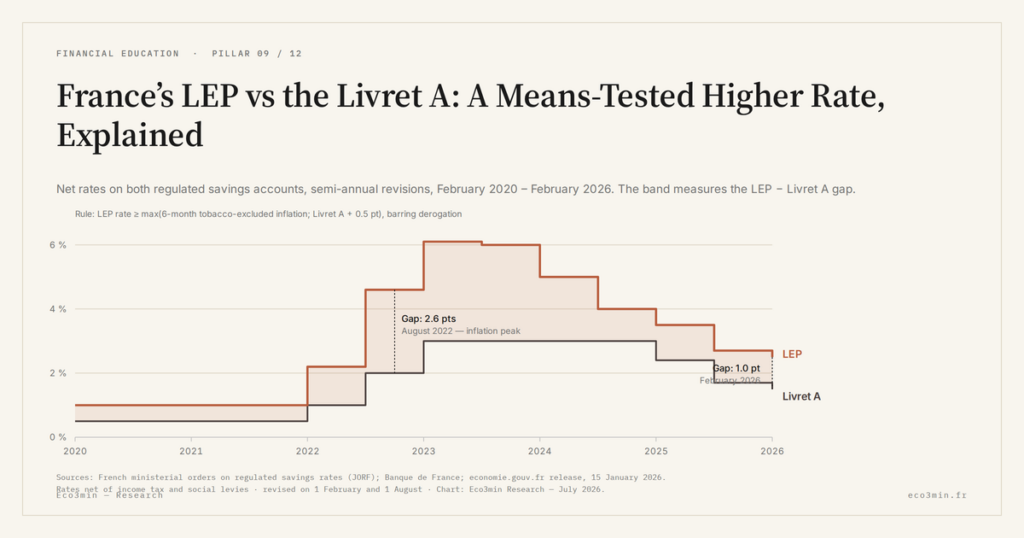
The gap between the LEP and the Livret A is not left to chance: it follows a rule. The LEP rate cannot be lower than ex-tobacco inflation measured over the prior semester, nor lower than the Livret A rate plus 0.5 point. The higher of these two floors applies, after rounding. In practice, the gap has been held at around one point: on 1 February 2026, the LEP stands at 2.5% net while the Livret A is at 1.5%, after a spell at 2.7% from 1 August 2025 to 31 January 2026. Like the Livret A, the LEP is revised twice a year, on 1 February and 1 August, and its interest is computed by fortnight and then capitalised at year-end. For more detail: our analysis of short-term parking options.
The structure of the rule has a consequence: the LEP tracks inflation more closely than the Livret A. When inflation accelerates, the LEP’s “ex-tobacco inflation” floor pulls it up more directly than the Livret A formula, which depends only half on inflation. The gap between the two accounts therefore tends to widen in inflationary phases, precisely those in which the Livret A protects least. The LEP thus works as a reinforced shield for eligible households in the very regimes where ordinary administered savings lose the most purchasing power.
An order of magnitude makes the gap tangible. On a full LEP at €10,000, the 2.5% rate produces €250 of net interest over the year, against €150 for the same sum placed at 1.5% in a Livret A, a €100 annual difference at the current level. The gap has been far wider in the recent past: in August 2022, at the height of the inflation surge, the LEP paid 4.6% while the Livret A was at 2%, a differential of 2.6 points. These figures illustrate a statistical fact, not an instruction: the size of the advantage depends on the inflation regime and on the level at which the LEP rate is set.
The ceiling and the income condition
The LEP is capped at €10,000 in deposits, an amount raised on 1 October 2023 and lower than the Livret A ceiling. As with the Livret A, this ceiling applies to cumulative deposits, not to the balance: capitalised interest can carry a full LEP above €10,000 without any rule being broken. Holding is individual, with a limit of two LEPs per tax household, one per taxpayer and one for a partner; an adult fiscally attached to their parents’ household cannot hold one.
The access condition is the centrepiece of the scheme. Eligibility depends on the reference tax income shown on the tax notice, which must not exceed a threshold revised each year and indexed to the income-tax schedule. For an opening in 2026, that threshold stands, in mainland France, at around €23,000 for a single person (one share of the family quotient), and rises with the number of shares in the household. The check is made at opening and over time: exceeding the threshold in one year does not trigger closure if income falls back below it the following year, but exceeding it for two consecutive years leads to closure. Because the threshold is indexed, its annual increase can bring into eligibility households that were excluded the year before.
The thresholds vary with the composition of the household. As a benchmark, in 2025 they stood, in mainland France, at €22,823 for one share, €35,013 for two shares (a couple) and €41,109 for two-and-a-half shares (a couple with one dependent child), before the 0.9% uprating applied in 2026. The income taken into account is that of the available tax notice, in practice the reference tax income of the last or second-to-last known year. Since 2021, banks can query the tax administration directly to check eligibility, without the holder having to supply their tax notice.
A transfer that is widely under-claimed
The most striking feature of the LEP is not its rate but its take-up rate. According to the Banque de France, the number of LEPs open exceeds 12 million, while more than 30 million people are eligible. A large share of households entitled to the scheme therefore do not hold one. The contrast is sharper still for the most fragile households: at the end of 2024, among clients identified as financially fragile, the banking inclusion observatory recorded several times more Livret A accounts than LEPs, even though the latter is better paid and intended for them. The transfer exists, it is funded, yet it remains largely unclaimed by its target population.
The scheme’s individual design adds to the gap. A LEP is held per person, with a maximum of two per tax household, so that an eligible couple can hold one each, up to €20,000 in combined deposits. Yet eligibility is assessed on the household’s reference tax income, not on individual income, which means a single higher earner in a couple can lift the household above the threshold and close access for both. The interaction of an individual holding limit with a household income test shapes who, in practice, ends up holding the transfer.
This gap ties the LEP back to the rest of regulated savings. The LEP and the Livret A both feed the shared funding circuit centralised by the Caisse des dépôts, and share the function of regulated savings: a liquid, guaranteed and tax-free reserve. The LEP stands apart by its target and its rate, but sits within the same institutional architecture.
Common misreading
Seeing the LEP as simply a “better-paid Livret A” available to anyone who asks. It is a means-tested scheme: its higher rate is a targeted social transfer, not a commercial product. The return gap is not a banking promotion but a public expense reserved for a population defined by its reference tax income.
The overall read
The comparison between the LEP and the Livret A comes down to three measurable facts. The rate: the LEP is, by rule, above the Livret A, by at least 0.5 point and in practice by around one point, with a gap that widens in inflationary regimes. The ceiling: €10,000 in deposits, below the Livret A’s, with the same compounding mechanics beyond it. Access: conditioned by a reference-tax-income threshold, revised annually, which excludes households above the threshold and leaves, paradoxically, a large fraction of eligible households without a LEP. Describing these facts recommends no opening and no trade-off. The LEP is, statistically, the best-paid and most targeted of the regulated accounts, and one of the least claimed relative to its eligible population. Ranked on the same scale, the PEL occupies a different position, and its monthly rate series since 2012 shows a level fixed once and held.
Last updated — 10 September 2026
Disclaimer – Financial Information: The analyses, commentary, and content published on eco3min.fr are provided for informational and educational purposes only. They do not constitute investment advice or a solicitation to buy or sell financial instruments. Past performance is not indicative of future results. All investment decisions involve risk and are the sole responsibility of the reader.
Read next
Full pillar →Series I and EE Savings Bonds: Locked Formulas in a Moving Rate World
US savings bonds lock a rate formula at the moment you buy them, for the life of the…
Where the Livret A’s Money Goes: The Caisse des Dépôts Circuit and Social-Housing Finance
The savings held on Livret A accounts do not sit idle. A regulation-set share is centralised at the…
France’s Livret A Ceiling: What Happens Mechanically When a Capped Savings Account Is Full
France’s Livret A ceiling, €22,950, is one of the best-known figures in French saving and one of the…