Where the Livret A’s Money Goes: The Caisse des Dépôts Circuit and Social-Housing Finance

The savings held on Livret A accounts do not sit idle. A regulation-set share is centralised at the Caisse des Dépôts, which turns it into very-long-term loans to build and renovate social housing. This circuit is why the Livret A rate is not a market rate.
The savings held on Livret A accounts do not sit idle in an account. A share, fixed by regulation, is centralised at the savings fund of the Caisse des Dépôts, which transforms it into very-long-term loans to social-housing landlords to build and renovate social housing. It is this circuit that explains why the Livret A rate is not a market rate: raising it mechanically increases the cost of financing social housing, which places the government in a permanent trade-off between the saver and the landlord. This article describes the circuit end to end: collection by the banks, centralisation at the CDC, deployment as loans, and the non-centralised share left with the banking networks. The artefact: the full institutional plumbing, which mass-market pages sum up in a sentence and almost no one explains rigorously. A factual description sourced to the Caisse des Dépôts, with no judgement on the scheme’s efficiency.
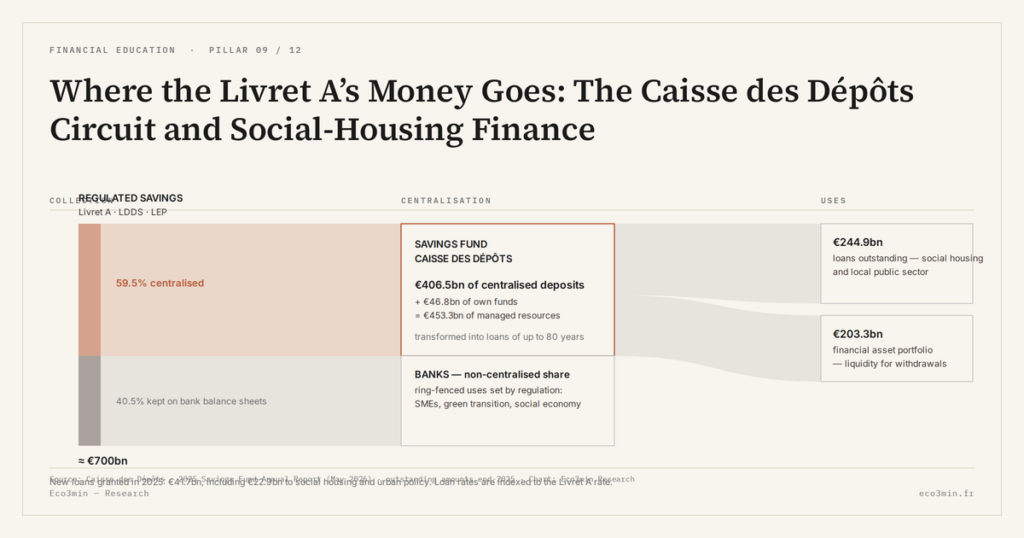
In short. Of roughly €700 billion held in 2025 on regulated accounts (Livret A, LDDS, LEP), close to 59.5% is centralised at the Caisse des Dépôts savings fund, that is €406.5 billion, the rest staying on the banks’ balance sheets. The savings fund transforms these liquid resources into very-long-term loans, up to 80 years, to social-housing landlords and local authorities, at rates indexed to the Livret A. In 2025 it granted €41.7 billion of new loans, of which €22.9 billion to social housing. Because these loans are indexed to the Livret A rate, that rate is a permanent trade-off between rewarding the saver and the cost of financing social housing.
The savings do not sleep: the principle of the circuit
Contrary to a widespread belief, the sums placed on the Livret A do not stay inactive. The model, which the Caisse des Dépôts describes as unique in Europe, rests on a simple principle: transforming highly liquid savings, available at any moment and short-term from the saver’s point of view, into very-long-term loans serving the public interest. It is this maturity transformation that defines the circuit’s role. The saver keeps immediate access to their money, while the aggregated, stable resource they form together with millions of others finances commitments that unfold over several decades.
This mechanism explains why this rate is a trade-off, rather than a price that would adjust freely on a market. It also follows from the nature of a regulated vehicle: a product whose remuneration and uses are set by the public authorities, because it serves a function that goes beyond the relationship between a bank and its client.
Collection and centralisation
The circuit starts with the banks, which collect deposits on Livret A, LDDS and LEP accounts from individuals. Each month, they transfer a share of these deposits to the Caisse des Dépôts. In 2025, of nearly €700 billion of regulated savings, about 59.5% was centralised at the Caisse des Dépôts savings fund, that is €406.5 billion of deposits, to which €46.8 billion of own funds is added, bringing managed resources to €453.3 billion. The remaining 40.5%, close to €292 billion, stays on the banks’ balance sheets.
The centralisation rate is not left to the discretion of the institutions: it is set by regulation and calibrated so that centralised resources comfortably cover loans to social housing. The rule requires, in particular, that the centralised share stays above a multiple of the loans granted by the Caisse des Dépôts to social housing; if it falls below that level, the centralisation rate rises automatically to cover the needs. In return for collection and management, the banks receive a commission, on the order of 0.3% on average since the 2009 reform.
Within the savings fund, the bulk of resources finances social housing and local authorities. In 2025, about 54% of managed amounts, close to €245 billion, were lent to social housing and the local public sector; the remaining 46%, a little over €203 billion, were placed in financial assets to preserve the liquidity needed for savers’ immediate withdrawals. This pocket of liquid assets is the condition that allows lending over the very long term while guaranteeing that every saver can retrieve their money at any moment.
The loans themselves are of exceptional duration, reaching up to 80 years, and are indexed to the Livret A rate, on terms below the market. In 2025, the savings fund granted €41.7 billion of new loans, a record level, of which €22.9 billion to social-housing landlords and €15.7 billion to the ecological and energy transition. The Caisse des Dépôts estimates that one social-housing unit in three in France is financed by this resource, and that nearly all of the sector’s debt depends on it. Understanding this circuit is also understanding who pays for financial repression: when the rate paid stays below inflation, the gap indirectly funds subsidised public-interest loans, whose beneficiaries are social-housing landlords and, through them, their tenants.
The pricing of these loans is itself a policy instrument. They are granted on identical terms regardless of the borrower’s size or financial health, and their rate varies with the purpose and the social or ecological character of the project: the greener and the more social the operation, the lower the rate. The savings fund also does not lend out the entire centralised resource, because the cost of that resource, the Livret A rate plus the banks’ commission, can at times exceed the rate it can charge on its loans. The share placed in financial assets therefore plays a double role, providing both the liquidity buffer for withdrawals and a recurring return that helps balance the fund.
The roughly €292 billion that is not centralised is not freely available to the banks either. Regulation frames its use: these resources must serve the financing of small and medium-sized enterprises, ecological projects and the social and solidarity economy. The Livret A circuit thus extends beyond social housing alone, even if that remains its main use and the priority stated by the Caisse des Dépôts. This is one of the reasons why the account’s role as a reserve is never a mere holding account: the entire collection, centralised or not, is directed toward uses defined by the public authorities.
Why this circuit makes the rate a trade-off
Closing the circuit returns to the starting point. Because loans to social housing are indexed to the Livret A rate, any change in that rate feeds directly into the cost of social-housing landlords’ debt. France’s economy ministry made this explicit in July 2025: the cut in the Livret A rate to 1.7% was set to return nearly one billion euros of investment capacity to social-housing actors over two years, precisely because of this indexation. Raising the rate rewards the saver but increases landlords’ burden; lowering it does the reverse. The government therefore arbitrates permanently between two public interests, the remuneration of popular savings and the cost of financing social housing, which makes it impossible to treat the Livret A rate as a simple market price. Related reading: how horizon reshapes the short-term choice.
One last piece completes the structure: the State guarantee. The accounts centralised at the savings fund benefit from the public guarantee, which assures savers the return of their savings if their bank fails. In return, the savings fund paid €1.215 billion to the State in 2025 to remunerate this guarantee. The saver, the social-housing landlord, the bank and the State are thus bound by a single circuit, of which the Livret A rate is the central parameter.
Key takeaways
- In 2025, close to 59.5% of the ~€700 billion of regulated savings is centralised at the Caisse des Dépôts savings fund, that is €406.5 billion.
- These resources finance very-long-term loans, up to 80 years, indexed to the Livret A rate, on terms below the market.
- In 2025, €41.7 billion of new loans were granted, of which €22.9 billion to social housing; one social-housing unit in three in France is financed by this circuit.
- The non-centralised share (~€292 billion) must finance SMEs, the ecological transition and the social and solidarity economy.
- Indexing the loans to the Livret A rate makes that rate a trade-off between the saver and the social-housing landlord.
The overall read
The Livret A circuit is a transformation machine: it converts liquid, guaranteed, tax-free savings into very-long-term loans serving social housing and other public-interest uses. This institutional plumbing, most often summed up in a sentence, is what sets the Livret A apart from an ordinary investment. It explains why its rate is set by public decision rather than by the market, why each revision is a trade-off between conflicting interests, and why an individual’s savings finance, without their being aware of it, the construction of a social-housing unit at the other end of the country. Describing this circuit prejudges nothing about its efficiency; it merely makes visible the real mechanics behind the most widely held account in France.
Last updated — 25 July 2026
Disclaimer – Financial Information: The analyses, commentary, and content published on eco3min.fr are provided for informational and educational purposes only. They do not constitute investment advice or a solicitation to buy or sell financial instruments. Past performance is not indicative of future results. All investment decisions involve risk and are the sole responsibility of the reader.
Read next
Full pillar →Series I and EE Savings Bonds: Locked Formulas in a Moving Rate World
US savings bonds lock a rate formula at the moment you buy them, for the life of the…
France’s LEP vs the Livret A: A Means-Tested Higher Rate, Explained
France’s Livret d’épargne populaire is often described as "the Livret A, only better". The description misleads: the LEP…
France’s Livret A Ceiling: What Happens Mechanically When a Capped Savings Account Is Full
France’s Livret A ceiling, €22,950, is one of the best-known figures in French saving and one of the…