
High-Yield Savings Accounts vs Money Market Funds: The After-Tax, After-Teaser Comparison

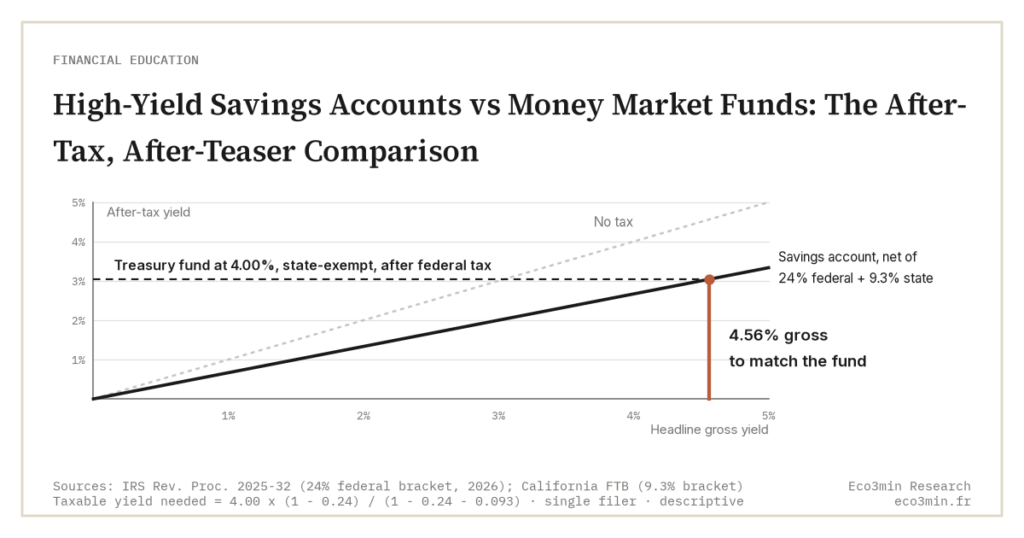
A high-yield savings account and a money market fund cannot be compared on their headline yield alone. The comparison holds only after tax and after the teaser expires, and the two differ on a point the yield hides: one is insured, the other is not.
High-yield savings accounts and money market funds hold cash at similar headline yields. But savings rates are often teasers that revert, and the two are taxed differently: only the after-tax figure compares.
High-yield savings accounts pay many times the FDIC national savings average (0.37% on September 21, 2026), and government money market funds earn just under Treasury bill yields (4-week bill: 3.88% on October 2, 2026), but a fund’s state-tax exemption can beat a higher savings rate after tax.
- Many savings-account rates are teasers that revert to a lower standard, and every rate is variable and can be cut without notice.
- The Treasury portion of a government money market fund is exempt from state income tax, decisive for savers in high-tax states.
- Savings accounts are FDIC-insured to 250,000 dollars; money market funds are not insured, however safe they are in practice.
A high-yield savings account is a bank deposit that pays far more than a traditional account, often ten times the national average, which the FDIC put at 0.37% on September 21, 2026. The headline APY, however, is frequently a promotional rate: a new-customer bonus, or a boost conditioned on direct deposit, that reverts to a lower standard rate after an introductory window. Even the standard rate is variable and tied to the federal funds rate, so the bank can lower it at any time, without notice, unlike the fixed rate of a certificate of deposit. Some accounts pay their top rate only up to a balance cap, above which a lower tier applies. The stated 4.5% or 5% is therefore a starting figure, not a rate locked for the year, and the number that matters is the rate the account actually pays once the promotion ends. Also relevant: the asset map across macro conditions.
What the savings account does guarantee is the deposit itself. Balances at an FDIC-member bank are insured up to 250,000 dollars per depositor, per bank, for each ownership category, so there is effectively no risk of capital loss within that limit even if the bank fails. The rate can fall, but the principal does not. A headline rate, in short, is not an after-tax rate.
The mechanics of these accounts add further caveats. Some pay their headline rate only up to a balance cap, above which a lower tier applies, so a large deposit earns a blended rate below the advertised figure. A saver with more than 250,000 dollars can extend FDIC coverage by splitting balances across banks or using a multi-bank sweep program that discloses its partner banks. And for cash with a known horizon, a non-callable brokered certificate of deposit locks a rate the bank cannot cut, trading liquidity for certainty. None of these details show up in the headline APY. Directly related: our framework for picking an online broker.
Money market funds: a yield that tracks the Fed
A money market fund is not a bank deposit but an SEC-registered fund holding short-term Treasury securities, repurchase agreements, and, for prime funds, commercial paper, priced at a stable one-dollar net asset value. A government fund earns what its Treasury bills and repo earn, minus fees: the 4-week Treasury bill yielded 3.61% at the end of June 2026 and 3.88% on October 2, 2026, after the Federal Reserve raised its target range to 3.75%–4.00% on September 17, 2026, so seven-day fund yields sit just below those levels, comparable to the best savings accounts but inside a brokerage account, where the cash can settle into a stock or bond purchase the same day. Their yield is not a teaser: it floats with short-term rates, which means it tracks the federal funds rate closely, though it lags on the way up and down as the fund’s holdings mature and reset. This is the same short-rate logic that runs through the logic of an administered savings rate, seen from the market side rather than the policy side. Over a longer horizon, what a saver keeps is the real return on that yield once inflation is netted out, the pattern traced across decades by the real return on safe cash over time.
The trade-off is the guarantee. Money market funds are not FDIC-insured. Held at a brokerage, they carry protection from the Securities Investor Protection Corporation, and government funds drew inflows in September 2008 and March 2020, when runs hit prime funds (the Reserve Primary Fund broke the buck on September 16, 2008), before SEC reforms in 2010, 2014 and 2023, but they are investment securities, not insured deposits, and in rare conditions their value can move. The yield comparison with a savings account is therefore never complete without the guarantee comparison. Worth reading alongside: our study “Investment Vehicles Explained”.
The tax layer: where the comparison actually happens
As in any cash comparison, the decisive figure is after tax. Interest from a savings account is taxed as ordinary income at both the federal and state level. A money market fund’s dividends are also ordinary income federally, but the portion derived from US government obligations is exempt from state income tax, a treatment that applies most cleanly to Treasury-focused government funds. The exempt share varies by fund and by year and is reported on the annual tax form. For a saver in a state with no income tax, this changes nothing; for a saver in a high-tax state, it can be decisive. The exemption is worth roughly the fund’s yield multiplied by the state rate: on a 3.6% yield, about 25 basis points at a 7% state rate and 33 at California’s 9.3% bracket, before any federal deduction for state taxes. The right way to compare is the after-tax yield, the same lens applied to what a regulated savings account is for in other systems.
The tax comparison can be made precise. A saver computes the tax-equivalent yield of a Treasury money market fund by adjusting its yield for the state tax it avoids, then compares that with a savings account taxed in full; the fund comes out ahead whenever its yield gap to the savings account is smaller than that state-tax saving. For a single filer in the 24% federal and 9.3% California brackets, a fully taxable account needs 4.56% to match a 4.00% state-exempt yield. Prime money market funds, which hold commercial paper as well as government debt, yield slightly more but are fully taxable and carry marginally higher credit risk, so the after-tax ranking depends on the saver’s state as much as on the headline yield. For the broader picture: the review of everyday market misconceptions.
When the duel inverts
Neither instrument wins outright. The savings account wins on simplicity and certainty: an FDIC guarantee up to the limit, a single account, and, when a genuine promotional rate is running, a headline yield a fund cannot match for a few months. It also wins for savers in low-tax or no-tax states, where the fund’s state-tax exemption is worth nothing. The money market fund wins on the tax layer for savers in high-tax states, on larger balances, and on horizons long enough that the exemption compounds; it also wins for cash held inside a brokerage, where it can move into investments the same day without a bank transfer, and it spares the saver the work of chasing and rotating teaser offers. The comparison, once again, resolves on after-tax yield rather than headline rate, the same discipline behind reading the real yield on cash and savings.
Timing matters too. Under Regulation DD, a US bank must compute interest on the full balance every day, starting no later than the business day the deposit counts for funds availability, so deposit timing costs little; what matters is when the promotional rate starts and stops.
Two different guarantees
The guarantee difference deserves to be stated on its own, because the yield never shows it. A savings account at an FDIC-member bank is insured up to 250,000 dollars per depositor, per bank; a saver with more than that can spread balances across banks or use a multi-bank sweep to extend coverage. A money market fund carries no FDIC insurance at all. Its brokerage-level protection covers the failure of the brokerage, not a loss in the fund, and while government money market funds are among the safest instruments available, safety is not the same as insurance. A saver choosing between the two is not only choosing between two yields but between an insured deposit and a very safe, uninsured security, a distinction that matters most precisely when it is least expected to. Companion analysis: the trade-offs across brokerage accounts.
- A high-yield savings account’s headline APY is often a teaser that reverts to a lower standard rate, and every savings rate is variable and can be cut without notice.
- Government money market funds yield just under Treasury bills (4-week bill: 3.88% on October 2, 2026) and track the federal funds target, raised to 3.75%–4.00% on September 17, 2026, with a lag as holdings reset.
- Savings-account interest is fully taxable; the Treasury portion of a government money market fund is exempt from state income tax, which can decide the comparison in high-tax states.
- The money market fund wins on the state-tax exemption, larger balances, and brokerage access; the savings account wins on FDIC insurance, simplicity, and a live promotional rate.
- Savings accounts are FDIC-insured to 250,000 dollars per depositor per bank; money market funds are not FDIC-insured, however safe they are in practice.
The overall read
Comparing a high-yield savings account with a money market fund is not a contest of headline yields but a calculation made after tax and after the teaser expires. Two adjustments restore the real picture: strip the promotional rate down to what the account pays over a full year, and apply each instrument’s tax treatment, where a government fund’s state-tax exemption can tip a saver in a high-tax state. The guarantee sits underneath it all, an insured deposit against a very safe but uninsured security. Describing this arithmetic prescribes nothing about where to hold cash; it only makes visible why a 5% teaser can earn less over a year than a government fund yielding just under the Treasury bill rate, and why the question resolves only once tax, teaser, and guarantee are counted together. Related coverage: our horizon-by-horizon short-term map.
Last updated — 8 October 2026
Disclaimer – Financial and Legal Information: The analyses, commentary, and content published on eco3min.fr are provided for informational and educational purposes only. They do not constitute investment advice or a solicitation to buy or sell financial instruments. Past performance is not indicative of future results. All investment decisions involve risk and are the sole responsibility of the reader. Data, charts and calculated series are provided as is and may contain errors or lag behind their source: check any figure against the primary source cited before relying on it. Content describing laws, regulations or contracts reflects the law as of its publication date and does not constitute legal or tax advice; applying it to a specific situation requires a qualified legal or tax professional.
Read next
Full pillar →Administered Savings Rates: Why France’s Livret A Is the Cleanest Case of Financial Repression
France’s Livret A pays a rate that is not a market price but the outcome of a political…
How Much Cash American Households Hold: Deposits, Money Funds, and the Savings Mix
The Federal Reserve’s accounts show American households holding nearly 14.9 trillion dollars in deposits and currency and 5.3…
Series I and EE Savings Bonds: Locked Formulas in a Moving Rate World
US savings bonds lock a rate formula at the moment you buy them, for the life of the…