Central Bank Independence: Economic Myth or Reality
Legal status, fiscal constraints and financial stability shape the actual room for manoeuvre of central banks. Formal independence does not guarantee complete economic autonomy.

Central bank independence is often presented as an unshakeable pillar of macroeconomic stability. Yet behind this institutional principle, real room for manoeuvre appears more constrained, more conditional and more context-dependent than it seems.
TL;DR
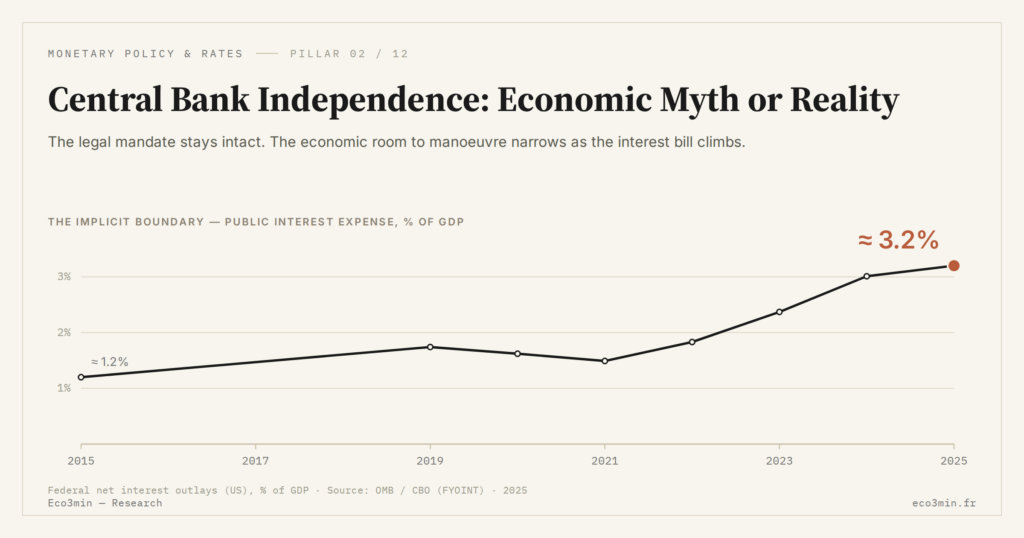
Interest expense climbing toward ≈3% of GDP in major developed economies by end-2025 narrows central bank room for manoeuvre even when the legal mandate stays untouched.
- Interest expense reached ≈3% of GDP in several major developed economies at end-2025, up from ≈1% in the mid-2010s, after policy rates rose between 2022 and 2024.
- Rapid 2023–2024 tightening surfaced stress on the most rate-sensitive balance sheets, from banks holding long-duration assets to bond funds and non-bank institutions, where the line between monetary policy and financial support blurs.
- Real autonomy shows up in public interest expense as a share of GDP, in sovereign spreads, and in the frequency of interventions outside rate policy, rather than in the legal mandate alone.
The key mechanism is institutional. A central bank holds a formal mandate, monetary tools and legal autonomy from political power. But it operates within an ecosystem where public debt, financial stability, sovereign bond markets and agents’ expectations interact. This interaction creates theoretical independence, but often only relative economic autonomy.
When Independence Is Tested by Fiscal Constraint
Confusing formal independence with real autonomy.
The fact that a central bank is legally independent does not mean it enjoys complete economic freedom. Fiscal, financial and market-stability constraints can limit its scope for action without any direct political interference.
In advanced economies, the rapid rise in policy rates between 2022 and 2024 revealed a structural friction point: the sensitivity of public finances to the cost of debt. At end-2025, interest expenses represent ≈3% of GDP in several major developed countries, against ≈1% in the mid-2010s. This drift is not neutral.
Formally, the central bank targets neither the deficit nor the debt. But when monetary tightening weakens the fiscal trajectory, the decision space narrows. The dominant consensus holds that independence remains intact as long as the legal mandate is not modified. The analysis diverges on this point: the constraint does not arise from direct interference, but from an environment in which every decision has immediate systemic effects. Worth reading alongside: Our analysis of how corporate margins track the rate cycle.
This logic fits within the broader framework of monetary policy transmission to the real economy, but with a specific angle: autonomy is not only a question of status, it depends on the system’s capacity to absorb the shocks induced by monetary policy.
This tension between formal independence and economic constraints fits within the broader framework of monetary policy and interest rates, whose effects extend well beyond the institutional mandate alone. It connects in particular with the analysis of the real autonomy of central banks, which shows that monetary credibility depends as much on fiscal and financial equilibria as on the legal rules officially in place.
Financial Stability: An Implicit Limit to Autonomy
Another, less commented channel concerns financial stability. When rates rise rapidly, tensions emerge first on the most sensitive balance sheets: banks exposed to long-duration assets, bond funds, non-bank institutions. In 2023–2024, several stress episodes showed that monetary tightening could collide with the financial-stability objective.
The central scenario adopted by many participants assumes that these tensions remain manageable through targeted macroprudential tools. This reading is coherent on paper. In practice, the boundary between monetary policy and financial support becomes blurred when tensions multiply. Independence subsists legally, but the prioritisation of objectives becomes more complex.
Why the Question Has Become More Sensitive Now
After an extended tightening phase, advanced economies are entering a zone where the cumulative effects of past decisions continue to spread. In early 2026, policy rates are stabilised at high levels while growth slows and deficits remain structural. This gap between theoretical framework and concrete constraints makes the notion of independence more fragile in public debate.
What the Reader Is Actually Trying to Understand
Behind the question of independence, the central concern is whether central banks can still act freely in the face of adverse shocks, or whether their decisions are increasingly conditioned by pre-existing fiscal and financial equilibria. The issue is not intent, but the effective capacity to maintain a coherent trajectory.
Observable Economic Impacts
For sovereigns, constrained monetary autonomy means greater sensitivity to market conditions, even without an official change of course. For firms, this translates into reduced visibility on the medium-term rate trajectory. For financial markets, this situation explains certain phases of volatility in which monetary communication appears cautious despite inflation still above target.
Households, finally, feel these trade-offs indirectly: through credit, employment and taxation, rather than through readable, immediate monetary decisions.
What Could Invalidate This Reading
This analysis rests on the assumption of persistent fiscal imbalances and a financial environment sensitive to rates. Credible fiscal adjustment, more robust growth or a rapid drop in inflation could restore broader manoeuvring room for central banks. Conversely, an exogenous financial shock would further reinforce the implicit constraint.
Useful Indicators for Tracking Real Autonomy
- Public interest expense: evolution as a percentage of GDP, indicator of rate sensitivity.
- Sovereign spreads: signal of tension between monetary policy and fiscal sustainability.
- Financial support measures: frequency and scale of interventions outside rate policy.
What This Dynamic Concretely Implies
- Formal independence does not guarantee complete economic autonomy.
- Fiscal and financial constraints act as implicit boundaries to monetary policy.
- This is not the central scenario today, but real manoeuvring room is narrower than during past cycles.
Last updated — 12 July 2026
Disclaimer – Financial Information: The analyses, commentary, and content published on eco3min.fr are provided for informational and educational purposes only. They do not constitute investment advice or a solicitation to buy or sell financial instruments. Past performance is not indicative of future results. All investment decisions involve risk and are the sole responsibility of the reader.
Read next
Full pillar →Real Rates: The True Cost of Capital Is Repricing
Why real rates are reasserting themselves as markets' anchor and how to recalibrate investment and financing decisions facing…
Real Interest Rates: The Quiet Signal Reshaping Markets
Real interest rates: why their persistence in positive territory in 2026 is reshaping the rules for bonds, equities,…
OAT-Bund Spread: A Quiet Gauge of French Sovereign Risk
OAT-Bund spread: how this yield gap has become a key signal on French sovereign risk, fiscal policy and…