Variable Mortgage Rates: Quiet Link in Monetary Transmission
Variable mortgage rates continue to transmit prior rate hikes long after central banks pause. How this delayed channel reshapes consumption, default risk and monetary room for maneuver.

Variable mortgage rates: how their rapid rise reshapes real estate risk, monetary policy and financing trade-offs.
TL;DR
Variable mortgage rate resets pass 2022–2024 policy hikes into household budgets with a lag, so monetary restriction keeps tightening even if central banks stop raising rates.
- Indexed on 3-month Euribor, many euro-area borrowers saw rates climb from roughly 2.0–2.5% in early 2023 to 4.5–5.0% by November 2025; UK adjustable loans now exceed 6%, against about 2% in 2021.
- On a €250,000 loan over 25 years, the move from near-zero to ~3.5–4.0% Euribor lifts the monthly payment from about €950 to over €1,400, roughly €450 of monthly purchasing power with no offsetting income gain.
- The payment-to-income ratio for variable-rate borrowers is the channel's gauge: when it sustainably approaches 35–40%, the historical risk of a consumption contraction rises sharply.
Variable mortgage rates: the trigger many underestimate
Since autumn 2025, a discreet but massive movement has accelerated: variable mortgage rates in the euro area and the United Kingdom are being recalculated on the basis of policy rates that have stayed elevated longer than expected. In November 2025, a homebuyer indexed on 3-month Euribor often sees their rate move from ≈2.0–2.5% in early 2023 to ≈4.5–5.0% today. In the United Kingdom, many adjustable-rate loans now exceed 6%, against ≈2% in 2021 according to national credit statistics.
This shift is not just a real estate matter: it is a key channel for the transmission of monetary policy to the real economy. It conditions consumption, defaults, the labor market and, ultimately, the room for maneuver of central banks. This transmission dynamic informs the reading of financial markets in a restrictive regime — see our study on rising markets despite an inverted yield curve.
What the market is gradually beginning to price in: the sensitivity of households to variable mortgage rates could make the next phase of monetary policy more uneven than smoothed projections on policy rates alone suggest.
Why variable mortgage rates are becoming central for central banks
Part of the consensus still focuses on the level of short-term policy rates to judge whether monetary policy is “restrictive” or not. In practice, what weighs on activity is the rates at which households and companies actually finance themselves.
To decode this channel, the framework on real policy rates as a monetary policy indicator provides a comprehensive view. Variable mortgage rates are one of its most direct relays:
- Fast indexation: these loans are often reset every 3, 6 or 12 months on market rates (Euribor, SONIA, etc.).
- Significant macro weight: in some Nordic countries and in the United Kingdom, more than half of mortgage stocks are variable or quasi-variable (very short fixed-rate periods).
- Consumption elasticity: a 200-basis-point rise on a monthly payment can absorb several hundred euros per month, reducing consumption by the same amount.
Between 2015 and 2021, with rates close to zero, this channel was almost neutral. The rapid rise in rates since 2022 has now turned it into an amplifier of monetary policy: decisions taken 12 to 18 months ago continue to feed through household budgets today as their loans are repriced.
To place this movement in a broader framework, the category page Monetary Policy & Rates details how policy rates flow through the economy and markets.
The concrete mechanism: from policy rate to monthly payment
The transmission from monetary policy decisions to variable mortgage rates relies on a chain that is simple in theory but very hard in practice for borrowers:
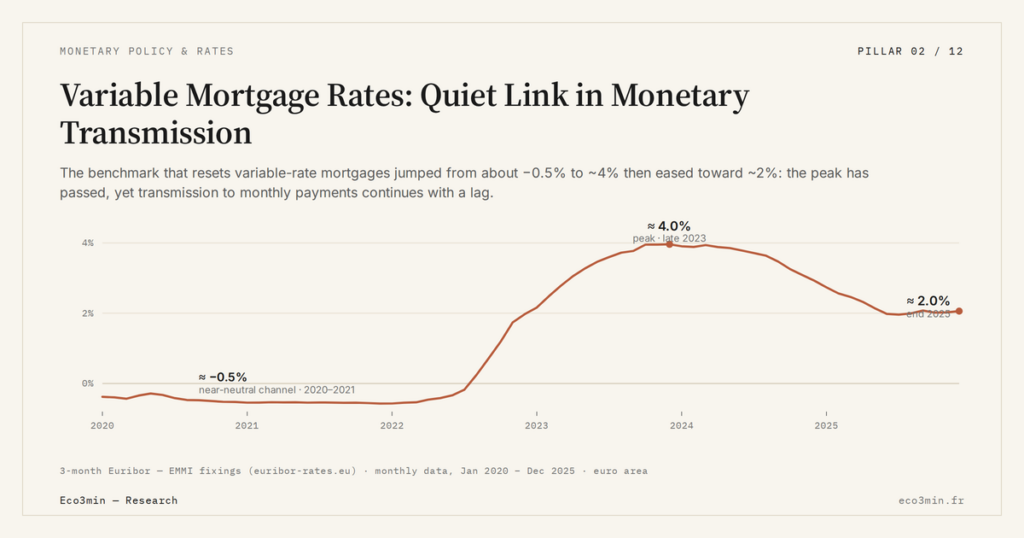
- The central bank raises its policy rates (for example from 0% to ≈4% between 2022 and 2024 in the euro area).
- Interbank rates (Euribor, SONIA) rise in parallel, generally around the corridor set by the central bank.
- Banks periodically recalculate variable loan rates by adding a fixed commercial margin to these reference rates.
- The rate paid by the household rises, the monthly payment follows, or the loan duration is extended, depending on the contract structure.
Simplified numerical example:
- €250,000 mortgage over 25 years, fixed bank margin of 1.0%.
- When 3-month Euribor was close to 0% (2016–2021 period), the rate paid was around 1%.
- With Euribor at ≈3.5–4.0% at end-2025, the total rate climbs to around 4.5–5.0%.
The result: a monthly payment that can move from around €950 to more than €1,400 depending on the loan profile — roughly €450 of purchasing power taken every month, with no offsetting income increase.
What the reader is really looking for behind this topic
The real question is not only whether variable mortgage rates have already peaked, but whether the wave of resets ahead can still shift the balance between real estate risk, consumption and banking system stability. In other words: how active does this transmission channel remain, and how far can it go before forcing a change in monetary direction?
Macro reading: a delayed brake on growth rather than an instant shock
This delayed transmission of rate hikes to monthly payments is not an isolated phenomenon: it fits into a broader shift in the real estate regime, where sensitivity to rate cycles becomes central. The framework laid out in our page on real estate cycles and interest rate analysis explains why adjustments first come through credit and financing flows, well before showing up in headline prices.
Between 2022 and 2024, rate hikes were rapid, but not all monthly payments moved at the same time. A large share of households on long fixed rates felt almost nothing in the short term, while others, exposed to variable rates, absorbed the rise immediately.
In 2025, the issue shifts: a growing number of short-fixed-rate loans reaching maturity are being renegotiated at much higher rates, and a new wave of resets on variable loans is materializing. The result:
- Time lag in the impact: 2023 monetary policy continues to weigh on 2025–2026, even if policy rates stabilize or start to come down.
- Diffuse slowdown: gradual decline in discretionary consumption, weaker appetite for residential investment, tighter budget trade-offs.
- Pressure on employment: sectors sensitive to domestic demand (retail, renovation, construction) adjust their hiring.
Dominant projections often bet on a soft landing, assuming that the toughest effects of rate hikes are already behind. The analysis presented here rests on a different assumption: as long as the share of loans exposed to variable rates or upcoming resets remains significant, monetary restriction continues to mechanically tighten, even without further policy rate hikes.
Key indicators for tracking variable mortgage rate pressure
To assess the strength of this transmission channel, a few indicators provide finer signals than policy rates alone:
- Share of variable loans in new credit: a recent rise signals that new households are exposing themselves to future rate volatility.
- Renegotiation / refinancing flows: if they contract, this can reveal that current rates are too high to make the operation attractive.
- Early default rates (30–90 day late payments): a gradual rise indicates a stress zone.
- Spread between variable and fixed mortgage rates: when the gap narrows, variable loses part of its economic appeal.
A simple KPI can serve as a compass: the monthly payment / disposable income ratio for variable-rate borrowers, aggregated at the country or market segment level. When this ratio approaches or sustainably exceeds 35–40% for a broad household base, the risk of a consumption contraction rises sharply.
This type of signal is regularly integrated into the weekly macroeconomic barometer, which tracks the overall balance between monetary policy, activity and financial risks.
Common reading mistakes on variable rates
1. Confusing the stabilization of policy rates with the end of borrower risk
Imagining that difficulties dissipate as soon as the central bank stops raising rates is misleading. Variable loans reset with a delay, sometimes over 12 months, so peak impact may arrive after the rate peak. This movement carries over into how REITs carry and roll debt. Better to look at the loan reset calendar than at the date of the last monetary hike.
2. Focusing only on default figures
Defaults often remain low at the start, because households first cut into consumption or savings to protect their housing. Reading a small rise in defaults as a sign of resilience can mask an adjustment already well under way on domestic demand.
3. Assuming the risk is limited to residential real estate
Variable-rate tensions can spread to other segments: lower collateral values, pressure on certain heavily exposed banks, negative wealth effect on consumption. Restricting the analysis to the property market alone leads to underestimating repercussions for the whole economy.
Two possible trajectories for what comes next
Scenario 1: gradual normalization, no financial break
This scenario rests on the following assumption: past rate hikes slow the economy enough to bring inflation back toward official targets, allowing gradual policy rate cuts from 2026. In this framework:
- Variable mortgage rates stabilize, then ease slightly with a lag.
- The most fragile households face strong but contained pressure, supported by the labor market.
- The real estate market lands without a generalized price collapse.
Some current estimates favor this trajectory as the central scenario, assuming that the share of variable loans has already declined enough in several countries to limit systemic risk.
Scenario 2: discreet break point through accumulated tensions
A second, less prominent scenario starts from a different assumption: the combination of high variable rates, loan renewals on harsher conditions and an employment slowdown triggers a series of more visible tensions:
- Significant rise in defaults from 2026 in certain segments.
- Regional or specialized banks weakened by deteriorating credit portfolios.
- Reaction by prudential authorities through targeted measures (term extensions, restructurings, specific support).
The risk here is not necessarily a major financial crisis, but sustained pressure on domestic demand, which complicates the central banks’ task: keeping rates high enough to contain inflation while avoiding a default spiral on variable loans.
This scenario remains far from being the majority view in projections, but it illustrates a key point: fine-tuning monetary policy becomes more delicate when sensitivity to mortgage credit is highly heterogeneous across countries and household categories.
Concrete implications: integrating this channel into decisions
For investors
Without constituting a recommendation, several organizational paths can be considered:
- Simple allocation rule: in a diversified portfolio, it can be useful for the share of assets directly correlated with leveraged residential real estate (construction-related stocks, residential REITs heavily exposed) not to exceed an order of magnitude of 10–15%, to limit dependence on this single monetary transmission channel.
- KPI monitoring: tracking the quarterly evolution of the monthly payment / income ratio for new borrowers, where national credit data allow, gives a practical measure of financial constraint.
- Duration trade-offs: comparing the sensitivity of different asset classes to rate moves (long vs short bonds, defensive vs cyclical names) helps better situate overall exposure to the risk of a sustained tightening of credit conditions.
For companies
Sectors dependent on real estate demand (materials, renovation, furniture, homeowner services) have an interest in explicitly integrating this channel into their forecasts:
- Project several sales assumptions according to different levels of variable mortgage rates.
- Adapt investment plans to inventory turnover and transaction volume dynamics.
- Closely monitor signals sent by mortgage credit indicators in the main customer countries.
For households
For a household already exposed to a variable rate, managing this risk relies above all on budget visibility:
- Simulate the impact of a further 100 to 150 basis-point hike on the monthly payment to gauge the comfort or stress zone.
- Compare the total cost of a possible switch to a fixed rate, even higher today, with maintaining the variable over several years.
- Ensure that total credit payments (mortgage + other debts) do not exceed a prudent threshold, often around 30–35% of net income, while keeping a safety margin for the unexpected.
These benchmarks do not replace personalized analysis, but they help structure the questions to ask a financial or banking advisor.
Counter-arguments: what could mitigate the risk
Several elements may limit the negative reach of variable mortgage rates:
- Rise in nominal incomes: if wages grow faster than expected over 2025–2027, part of the rise in payments can be absorbed.
- Regulatory interventions: rate caps, reduced refinancing penalties or targeted support for vulnerable households can cushion the shock.
- Geographic reallocation: in some countries, the share of variable-rate loans has already declined sharply in favor of fixed rates, reducing overall sensitivity.
If these factors strengthened simultaneously, the variable-rate channel could remain under control, and attention would shift more toward other risks (public debt, corporate credit, equity markets).
Outlook: a channel to monitor as long as the rate cycle remains uncertain
It is not necessarily the most visible risk of the moment, but variable mortgage rates illustrate a simple reality: monetary policy continues to feed through long after the last announcements of hikes or cuts. The market does not fully price in the fact that this delayed diffusion can still weigh on consumption, employment and financial stability several years after the policy rate peak.
For investors, companies and households, this channel deserves to be monitored as a leading indicator of the next phase of the cycle: if pressure on real estate budgets eases, the room for a sustainably higher rate environment widens; if it worsens, pressure for faster monetary easing could return to the foreground.
In 3 sentences
- Variable mortgage rates still transmit today the rate hikes decided since 2022, with a lag that prolongs the restrictive phase of the monetary cycle.
- The monthly payment / income ratio for households exposed to these loans is becoming a key indicator for anticipating consumption, default risks and central bank room for maneuver.
- It is not the central scenario for now, but an accumulation of tensions on variable loans could force an earlier-than-expected adjustment of the monetary trajectory.
Frequently asked questions
Do variable mortgage rates react immediately to central bank decisions?
No. Most contracts include a periodic reset (every 3, 6 or 12 months) based on an interbank reference rate. There is therefore a lag between the monetary policy decision and the impact on the monthly payment, which spreads transmission over time. The evidence is gathered in the Eco3min view of the way earnings respond to the monetary cycle.
Is a decline in inflation enough to bring down variable mortgage rates?
Lower inflation raises the probability of lower policy rates over time, but as long as those rates remain stable at a high level, variable loans will not ease materially. The trajectory of interbank rates is more decisive than inflation taken in isolation.
Why are some countries more exposed to variable rates than others?
The structure of mortgage markets depends on historical, regulatory and tax choices. Some systems favor long fixed rates, others variable rates or short fixes, creating very different sensitivities to monetary policy.
How can I simply measure my personal exposure to variable rates?
A practical method is to add up all the monthly payments on credits indexed on resettable rates and compare them with your net income. If this ratio approaches 35–40%, a further rate hike or income drop can quickly create budget stress.
Can banks indefinitely absorb the rise in their funding costs without passing it on to variable rates?
In practice, no: if market funding costs remain high, institutions have an interest in preserving their margins by adjusting the rates offered. Sustained margin compression could weigh on their profitability and, ultimately, on their lending capacity.
Last updated — 7 July 2026
Disclaimer – Financial Information: The analyses, commentary, and content published on eco3min.fr are provided for informational and educational purposes only. They do not constitute investment advice or a solicitation to buy or sell financial instruments. Past performance is not indicative of future results. All investment decisions involve risk and are the sole responsibility of the reader.
Read next
Full pillar →Real Interest Rates: The Quiet Signal Reshaping Markets
Real interest rates: why their persistence in positive territory in 2026 is reshaping the rules for bonds, equities,…
OAT-Bund Spread: A Quiet Gauge of French Sovereign Risk
OAT-Bund spread: how this yield gap has become a key signal on French sovereign risk, fiscal policy and…
Inverted Yield Curve: Reading a Regime Signal Without Immediate Effect
The inverted yield curve operates as a regime signal, not a timing tool. Its lagged effects are constitutive…