OAT-Bund Spread: A Quiet Gauge of French Sovereign Risk
OAT-Bund spread: how this yield gap has become a key signal on French sovereign risk, fiscal policy and the bond market response.

OAT-Bund spread: how this yield gap has become a key signal on French sovereign risk, fiscal policy and the bond market response.
TL;DR
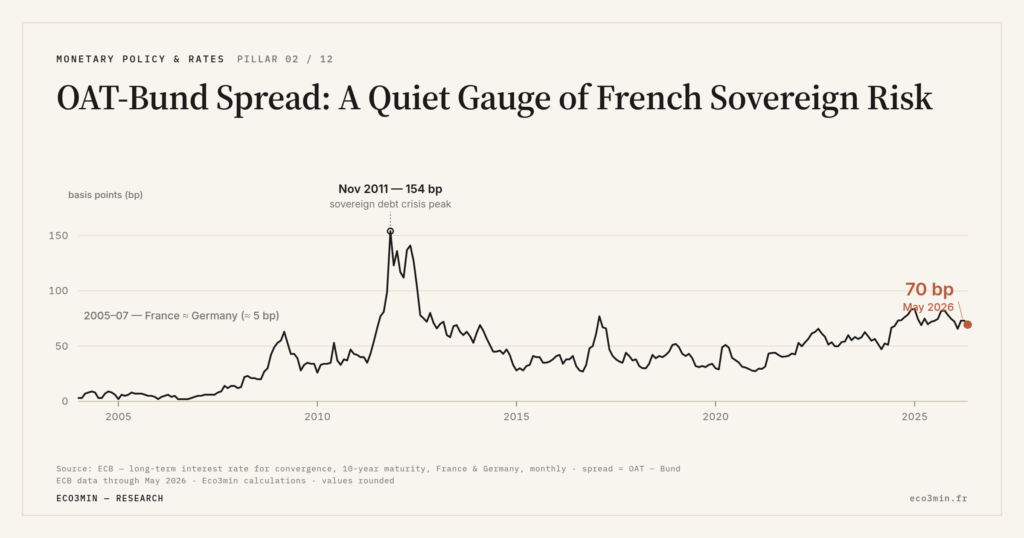
The 10-year OAT–Bund spread has held near 65–80bp since autumn 2025, its widest sustained level since the euro-area debt crisis, pricing France as an intermediate rather than quasi-core issuer.
- France ran a deficit near 4.5–5% of GDP over 2024–2025 with debt around 110–115%, against roughly 60% in Germany, feeding the country-specific risk premium.
- Yields set on the secondary market mean heavy OAT selling mechanically widens the gap, which can turn self-reinforcing as rising interest charges revive the sustainability debate.
- Past regimes ranged from 0–20bp in 2005–2007 to roughly 150bp at the 2011–2012 crisis peak, with 30–50bp marking benign periods.
- The ECB's anti-fragmentation backstop, active since 2022, caps extreme scenarios but stays conditional on a credible fiscal trajectory and reforms.
OAT–Bund spread: why this yield gap is back at the centre of attention
Since autumn 2025, the yield gap between the 10-year French OAT and the German Bund has been hovering at levels not seen on a sustained basis since the euro area sovereign debt crisis. Without reaching panic territory, this widening spread is an indicator markets are still digesting imperfectly: it compresses into a few basis points the confidence — or distrust — surrounding France’s fiscal trajectory. That confidence is priced in the open on fixed dates, since the Thursday sessions where France sells its OATs come round twice a month.
The dominant search intent here is understanding the mechanism. The aim is to explain how the OAT–Bund spread works, what it actually measures and why it has become a sensitive signal for monetary policy and financing conditions.
Angle paragraph — what is changing without making noise
The aspect most often overlooked is not so much the absolute level of the OAT–Bund spread as its growing sensitivity to fiscal announcements and ECB signals. This gradual shift means the market increasingly treats France not as a “quasi-core” issuer, but as an intermediate one whose risk premium can widen quickly if fiscal or reform-related communication loses credibility.
How is the OAT–Bund spread constructed?
The OAT-Bund spread refers to the yield gap between the 10-year French OAT and the 10-year German Bund. If, for instance, the Bund yields 1.6% and the OAT yields 2.1%, the spread is 50 basis points (0.50 percentage points). This reasoning continues in our analysis of eurozone sovereign spreads.
Technically, this spread reflects:
- the relative risk-free rate in the euro area, proxied by the German Bund;
- a France-specific risk premium (public debt, politics, potential growth);
- ECB monetary policy expectations, common to the entire euro area but affecting each country differently depending on its fiscal situation.
Yields are largely determined on the secondary market: investors buy or sell already issued bonds, pushing yields up or down. Episodes of heavy OAT selling, all else being equal, mechanically widen the OAT–Bund spread.
To place this move in a broader frame, it is useful to start from an analysis of policy rates and real rates as the general structure of monetary policy, then zoom in on how this architecture translates into sovereign spreads.
Historical reference points: when the spread becomes an alarm signal
Historically, the euro area has experienced several spread regimes for France:
- 2005–2007: spread close to 0–20 basis points, with France perceived at almost the same risk level as Germany.
- 2011–2012 (sovereign debt crisis): the gap widened to around ≈150 basis points at peak stress, with strain on fiscal sustainability across several countries.
- 2016–2019: return to an intermediate zone (≈30–50bp on average), but with episodic spikes around political events (for example, peaks ahead of certain electoral deadlines).
- 2022–2023: against the backdrop of abrupt monetary tightening, the gap occasionally rose above 60–70bp, indicating that rate normalisation exposed the most indebted issuers more sharply.
In 2025, after several ECB rate hikes followed by pauses, nominal yields stopped climbing as fast, but the OAT–Bund spread took over as the adjustment variable. The market is no longer looking only at the level of rates, but at intra-area differentiation.
Recent trigger: why the France–Germany spread is widening
Since the autumn of 2025, several elements have combined:
- French public deficit: around ≈4.5–5% of GDP over 2024–2025 according to official macro projections, well above the previous 3% benchmark.
- Public debt: stabilised around ≈110–115% of GDP, against ≈60% in Germany over the same period.
- Potential growth perceived as moderate (≈1%), while Germany, despite its own fragilities, remains associated with stricter fiscal discipline.
To this is added the ECB’s messaging: in 2024–2025, the central bank repeated that anchoring inflation around 2% remained its priority, while suggesting that emergency sovereign bond purchase tools would be used more sparingly. This framework makes markets more attentive to each member state’s fiscal trajectory.
Mainstream projections often assume these yield gaps will stay “contained” as long as the ECB keeps an implicit safety net. The analysis offered here insists on a different point: the OAT–Bund spread can become a self-reinforcing stress signal if rising interest charges in turn fuel debate around fiscal sustainability.
What the OAT–Bund spread actually measures about French risk
From an economic standpoint, this spread synthesises three dimensions:
A wider spread means investors require additional compensation to hold French rather than German debt. Assuming a 2025 average spread close to 65–80bp, this translates, at constant debt outstanding, into several billion euros of additional interest charges over a 3–5 year horizon as older bonds are refinanced.
This does not trigger an immediate crisis, but accelerates the fiscal constraint: the higher the risk premium, the smaller the fiscal room for manoeuvre.
2. The perception of political risk
The OAT–Bund spread also reacts to political episodes: elections, social tensions, debate around structural reforms. A programme perceived as weakening public revenues or durably increasing spending could, by hypothesis, trigger a 10 to 30bp spread widening over a few sessions, even without immediate change to macro data.
3. The ECB’s stance and the European framework
The presence of mechanisms such as the ECB’s “anti-fragmentation backstop” has, since 2022, limited extreme euro area crisis scenarios. But this support remains conditional (compliance with European rules, credible debt trajectory, reforms). The OAT–Bund spread thus becomes a thermometer of market confidence in France’s ability to remain aligned with this framework.
What users actually want to understand
Behind the interest in the OAT–Bund spread sits a simple question: at what point does the France–Germany gap signal significant macro risk? The real query is not so much whether the spread will widen by 10 or 20bp, but whether a sustained widening dynamic could call into question the financing conditions of the State, of corporates and of domestic credit.
Macro and micro impact: when the spread widens, who is exposed?
A wider spread acts as a differential rise in the cost of capital for France. The effects spread across several layers:
- The State: interest charges rise progressively as refinancing occurs. On gross debt outstanding above €3,000 billion, an average extra cost of 50bp on a few hundred billion of annual refinancing can represent several additional billions of expenditure, constraining future fiscal trade-offs.
- Banks and insurers: heavily exposed to domestic sovereign bonds, they suffer portfolio mark-to-market losses when rates rise, which can weigh on credit distribution capacity and prudential requirements.
- Corporates: euro borrowing costs for French issuers often embed a reference to the national sovereign rate. A wider OAT–Bund spread can therefore, at constant market conditions, raise financing costs for French companies relative to German peers.
- Households: even though the link is indirect, higher long-term rates eventually weigh on mortgage and long-term loan conditions, in interaction with other parameters such as usury rate rules.
For a broader reading of the interactions between rates, inflation and growth, the category page on monetary policy and rate moves provides a useful reference frame, before returning to the specific OAT–Bund spread signal. A companion piece: Our walkthrough of the profit-side mechanics of the rate regime.
Weak signals: what the market is still digesting imperfectly
Several signals remain underestimated in the standard reading of the France–Germany spread:
- The maturity structure of French debt: an average duration around 8–9 years smooths the short-term impact, but also lengthens the period over which a durably higher spread will transmit to public finances.
- The role of non-resident investors: if their share in OAT holdings declines (for example, from ≈50% to ≈40% over several years), spread sensitivity to international flows may diminish, but dependence on domestic institutions rises, with other types of risks.
- Correlation with other sovereign spreads: a widening of the OAT–Bund gap aligned with that of other countries (Italy, Spain) may indicate a global market move; a France-specific decoupling would, by contrast, signal an idiosyncratic problem.
Mainstream scenarios often expect a gradual normalisation of spreads if growth stabilises and inflation converges. An alternative reading is that the current regime of higher rates, regularly detailed in the macroeconomic barometer and roadmap, makes risk premia more reactive to even slight fiscal deviations.
Key indicators to monitor around the OAT–Bund spread
To interpret this signal, several KPIs can be tracked systematically:
- Absolute level of the 10-year spread: for example, reference zones around 30bp (close to “core”), 60–80bp (moderate tension), >100bp (significant stress).
- Speed of variation: a +30bp move within a few days following a political or fiscal event is often more telling than a slow drift over several months.
- Gap between the 2-year and 10-year spread: a sharper widening at the short end can signal immediate concern about fiscal management, while long-end moves point more towards structural sustainability.
- Implied real yields: combining nominal yields with inflation expectations allows assessment of whether France pays a higher real risk premium than Germany, which is critical for productive investment.
Frequent misreadings of the OAT–Bund spread
- Confusing absolute level and dynamics: a 70bp spread does not have the same meaning if it has just risen from 30bp in a few weeks or if it has been stable for a year. The dynamic is often more informative than the raw figure.
- Reading the spread in isolation: interpreting the OAT–Bund gap without looking at ECB rates, inflation expectations or potential growth can lead to overstating a purely French risk when it is in fact part of a broader market move.
- Assuming automatic contagion: a widening spread does not mechanically mean an imminent funding crisis. The euro area’s institutional framework, potential ECB purchases and the structure of domestic investors can absorb the shock, even if these safeguards have their limits.
Two plausible trajectories for the coming years
Scenario 1 — Controlled spread stabilisation
This scenario rests on the assumption that France adopts a fiscal trajectory deemed credible (gradually narrowing deficit, reforms targeting expenditure and supply) and that nominal growth remains around 3–4% (real growth + inflation). In this frame, the OAT–Bund spread could oscillate within a 40–70bp range, with episodic but contained tensions.
Markets would then treat France as a “semi-core” issuer: not at Germany’s level, but well clear of the most fragile countries.
Scenario 2 — Persistent widening and reinforced fiscal constraint
This alternative scenario assumes a less favourable mix: sluggish growth, delays in fiscal adjustment, political messaging that fuels uncertainty over the debt trajectory. In this case, the spread could remain durably above 100bp, or even spike higher in the event of an external shock.
Such a configuration would significantly raise the marginal cost of debt, reducing the State’s capacity to absorb future crises. Capital-intensive firms and sectors dependent on long-term credit would be particularly sensitive to this regime of higher rates and spreads.
This is not the central scenario today, but it is a possibility the market still appears to under-price, focused as it is on policy rate moves rather than intra-area differentiation.
Potential consequences for investors, corporates and individuals
For investors, the OAT–Bund spread serves above all as an analytical frame: it helps locate France in the euro area sovereign risk hierarchy, gauge the required risk premium and assess the sensitivity of various assets (bonds, domestic equities, real estate) to bond market tensions. Eco3min develops this reasoning in the link between bond ETF choice and the rate regime. It does not, in itself, dictate an automatic allocation choice, but it provides a diagnostic input on the risk/return trade-off.
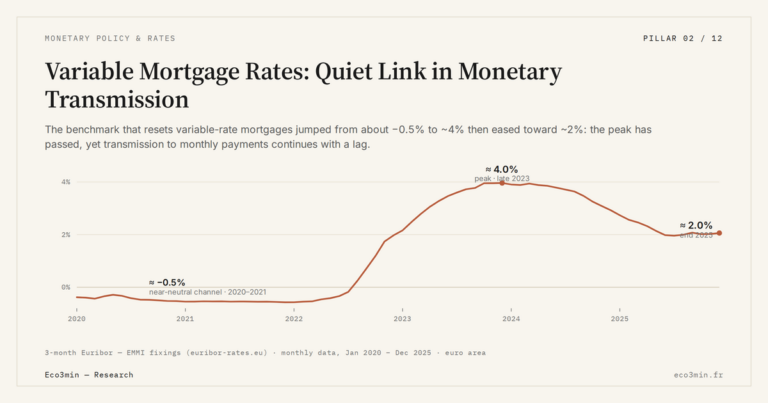
For corporates, the spread dynamic influences the cost of bond financing and, indirectly, of bank credit. A sustained widening trajectory can weigh on long-term projects, particularly in capital-intensive sectors. Understanding this mechanism allows financing cost dynamics to be anticipated within investment plans. On the household side, the transmission is measured directly as the gap between French mortgage rates and the 10-year OAT.
For individuals, the issue is mainly macro-financial: a State facing a higher risk premium may eventually have to make different trade-offs between spending, taxation and economic support policies. The OAT–Bund spread is therefore an indicator worth tracking to grasp the broader context for employment, credit and taxation, without providing direct answers on individual decisions. Because those spreads usually move before an agency does, the market impact of a sovereign rating cut is often smaller than expected.
Ultimately, several trajectories remain possible: a contained spread regime that nonetheless stays durably above pre-2008 levels, or a more pronounced widening phase if fiscal discipline and growth deteriorate. The risk is less visible than other more publicised indicators, which makes it all the easier to underestimate.
3 takeaways
- The OAT-Bund spread does not simply measure a yield gap; it compresses market confidence in France’s fiscal and political trajectory.
- A spread that widens quickly, even from a moderate level, can signal a future fiscal constraint stronger than current debate suggests.
- In a regime of higher rates, intra-euro area differentiation through the OAT–Bund spread becomes a quiet but strategic barometer of French sovereign risk.
Frequently asked questions about the OAT–Bund spread
How can one tell whether the OAT–Bund spread is at a “worrying” level?
There is no official threshold, but recent history suggests that levels around 30–50bp correspond to a relatively benign environment, while a sustained move above 100bp reflects significant tension. The speed of the rise and the context (political, fiscal, macro) matter as much as the figure itself.
Can the OAT–Bund spread widen sharply without a euro area crisis?
Yes. The European institutional framework and the ECB’s tools limit extreme scenarios but do not prevent a France-specific risk premium from rising. A higher spread can coexist with a broadly stable euro area, while still weighing on French financing costs. French financing costs also answer to a benchmark set outside the euro area: the DGS10, the 10-year Treasury yield as a macro signal and financing benchmark.
Why does the OAT–Bund spread sometimes react to political announcements without new figures?
Because the market constantly updates its long-term expectations. A discourse perceived as less credible on deficit reduction or spending reform can push the risk premium higher even before fiscal statistics evolve.
Is the France–Germany spread more important than the German yield curve alone?
The two pieces of information are complementary. The absolute level of German yields reflects the cost of money in the euro area, but the OAT–Bund spread shows how France is positioned relative to the core of the area. It is this combination that helps measure the country-specific financing constraint. Large French borrowers pay their banks a rate of their own, tracked in the rate on new French corporate loans above EUR 1m, monthly since 2003.
How can the OAT–Bund spread be tracked concretely day-to-day?
It can be observed by comparing 10-year yields on French and German bonds published by financial institutions and central banks. Interpreting these data is most useful when set against policy rates, inflation and macro analyses, such as those synthesised in regular economic barometers.
Last updated — 18 September 2026
Disclaimer – Financial Information: The analyses, commentary, and content published on eco3min.fr are provided for informational and educational purposes only. They do not constitute investment advice or a solicitation to buy or sell financial instruments. Past performance is not indicative of future results. All investment decisions involve risk and are the sole responsibility of the reader.
Read next
Full pillar →Real Rates: The True Cost of Capital Is Repricing
Why real rates are reasserting themselves as markets' anchor and how to recalibrate investment and financing decisions facing…
Real Interest Rates: The Quiet Signal Reshaping Markets
Real interest rates: why their persistence in positive territory in 2026 is reshaping the rules for bonds, equities,…
Inverted Yield Curve: Reading a Regime Signal Without Immediate Effect
The inverted yield curve operates as a regime signal, not a timing tool. Its lagged effects are constitutive…