Real Interest Rates: The Quiet Signal Reshaping Markets
Real interest rates: why their persistence in positive territory in 2026 is reshaping the rules for bonds, equities, real estate and sovereign debt valuations.

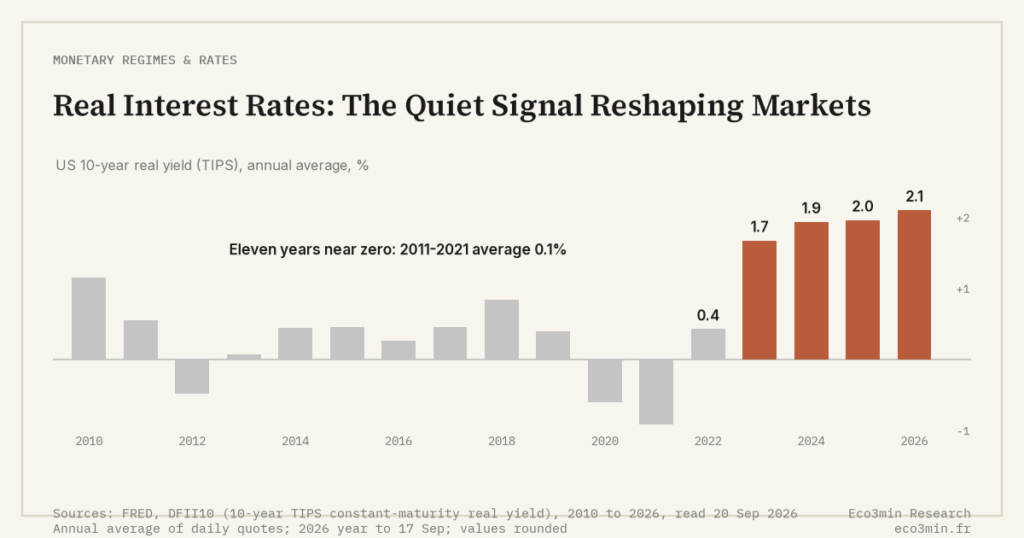
Real interest rates: why their persistence in positive territory in 2026 continues to redefine the rules for bonds, equities, real estate and sovereign debt.
TL;DR
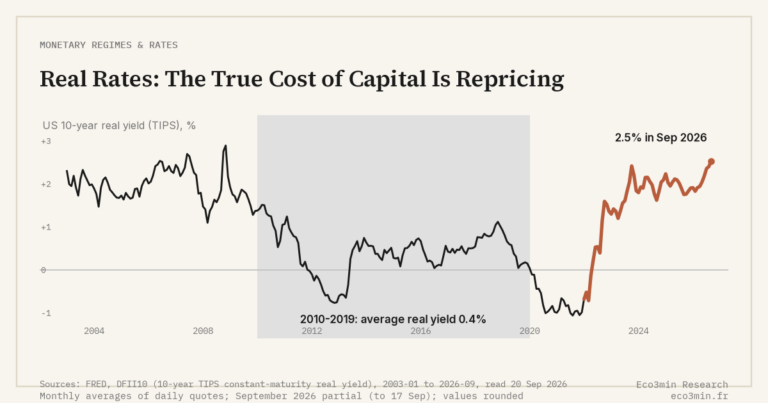
A silent tightening reshapes valuations: as inflation recedes faster than nominal rates fall, US 10-year real yields hold near 1.5-2% in 2026 versus roughly 0% across 2013-2021, pressuring long-duration assets. Worth reading alongside: the traditional-versus-Roth timing bet.
- Real rates near 2% imply a downward adjustment of theoretical valuations, especially for assets resting on distant cash flows, mechanically compressing multiples.
- With positive real yields, sovereign bonds re-emerge as a credible alternative, reconfiguring the bond-equity arbitrage; intermediate 5-10-year maturities regain a central role.
- The watched signal is the gap between earnings yield and the 10-year real rate: a premium compressed below roughly 3 points marks a deteriorating equity risk-reward profile.
For two years, attention has focused on rate cuts or pauses by central banks. Yet the structuring indicator for the next 3 to 5 years remains the real interest rate. See our explainer on modified duration for the full explainer. In 2026, with inflation normalized but not back to the ultra-low levels of the 2010s, real yields remain significantly positive. This parameter is reshaping the value of long-duration assets.
The central point: it is not the nominal level that drives valuation, but the yield after expected inflation. This difference — the real rate — conditions the equity risk premium, the sustainability of sovereign debt and real estate market equilibrium. Related data: our equity-risk-premium data.
These dynamics fit within the broader context of monetary policy and rate regimes. Central bank arbitrages, anti-inflation credibility and expectations management durably shape real yields. The pillar page on monetary policy and interest rates details these mechanisms.
3 key things to remember
- Durably positive real rates: in the United States, 10-year real yields hover around ≈1.5–2% in early 2026 (versus ≈0% on average over 2013–2021) → mechanical pressure on long-duration assets.
- Potential multiple compression: real rates near 2% imply an adjustment of theoretical valuations, especially for distant cash flows.
- Reconfigured bond-equity arbitrage: sovereign bonds offering positive real yield re-emerge as a credible alternative, particularly for cautious profiles.
Decoding: what current data reveal
In 2026, policy rates have entered a phase of stabilization, even slight easing in some regions. However, core inflation remains close to 2–3%. This combination keeps real rates in positive territory.
The mechanism is straightforward: if inflation recedes faster than nominal rates fall, the real rate rises or stays elevated. This “silent” tightening alters the present value of future flows, even without further policy rate hikes. A related read: the framework on how monetary tightening reaches earnings with a lag. This disconnect between monetary signals and risk-asset trajectories is examined in detail in our study on phases where markets and inverted curve diverge.
Part of the consensus considers that normalization is already priced in. The more cautious angle envisions central banks, mindful of credibility, keeping real rates positive longer than the market anticipates.
Concrete impacts: what this changes
- Sovereign bonds: intermediate maturities (5–10 years) regain a central role. With positive real yields, they have historically played a larger part in cautious profiles.
- Growth equities: the present value of distant cash flows is more sensitive. Diversification toward “value” segments or near-term cash flow profiles has historically reduced multiple-compression risk.
- Real estate: positive real rates raise the cost of long-term financing and reduce the present value of future rents. Yield requirements have been recalibrated higher relative to 2018–2021.
- Sovereign and corporate debt: a positive real cost imposes greater fiscal discipline. Heavily indebted actors see their room for maneuver reduced.
Weak signals to monitor
- 10-year real rates (US TIPS, inflation-linked OATs): persistence above ≈1.5% indicates a constraining regime for stretched valuations.
- Credit spreads: if real rates stay elevated without a marked widening of spreads, the market is adjusting mainly through the risk-free rate.
- Equity risk premium: comparing earnings yield with the 10-year real rate. A heavily compressed premium signals potential imbalance.
- Flows into bond ETFs: sustained inflows would confirm structural reallocation toward real yield.
3–12 month outlook
- Scenario 1 – Gradual normalization: inflation stabilized around 2–2.5%, moderate policy rate cuts. Real rates around 1–1.3%. Partial relief for equities.
- Scenario 2 – Prolonged real tightening: persistent inflation near 2.5–3%, monetary caution. Real rates around 1.8–2%. Lasting pressure on multiples and on highly capital-intensive projects.
- Scenario 3 – Unexpected reflation: an inflation shock pulling real rates back to 0–0.5%, but at the cost of heightened pressure on monetary credibility.
Common reading errors
- Focusing only on the nominal: the nominal 10-year is not enough; the real rate determines the valuation of future flows.
- Assuming an automatic return to the 2010–2021 regime: negative real rates were tied to a specific context (massive QE, low inflation).
- Overinterpreting one favorable inflation print: central bank reactions depend on durable trends, not isolated data points.
Key indicators for 2026
- US 10-year real yield: to be tracked alongside major equity indices.
- Trailing core inflation: durable stabilization around 2% conditions the trajectory of real rates.
- Earnings yield – real rate gap: if it falls below 3 points, the equity risk-reward profile deteriorates.
Positioning reference points
- Investors: quality bond exposure has historically been monitored more closely when real rates are persistently positive, alongside equity diversification toward segments less sensitive to long-dated cash flows.
- Companies: integrating a higher discount rate (≈+100–200 bp vs 2018–2021) into investment decisions.
- Individuals: reviewing whether an allocation does not implicitly assume a rapid return to zero real rates.
A faster monetary easing in the event of a macro shock could reverse this dynamic. As things stand, the central regime remains one of positive and durable real rates. This calibration for a world where capital again has a cost finds its extension in the synthesis tying real rates to savings resilience. The point is not to predict the next move, but to ensure that portfolios and decisions are calibrated for a world where capital has regained a real cost.
3 key takeaways
- Real rates drive the valuation of future flows and structure the arbitrage between assets.
- A portfolio designed for real rates near zero needs to be recalibrated.
- The discreet risk is a prolonged real tightening without further policy rate hikes.
Last updated — 20 September 2026
Disclaimer – Financial Information: The analyses, commentary, and content published on eco3min.fr are provided for informational and educational purposes only. They do not constitute investment advice or a solicitation to buy or sell financial instruments. Past performance is not indicative of future results. All investment decisions involve risk and are the sole responsibility of the reader.
Read next
Full pillar →Real Rates: The True Cost of Capital Is Repricing
Why real rates are reasserting themselves as markets' anchor and how to recalibrate investment and financing decisions facing…
OAT-Bund Spread: A Quiet Gauge of French Sovereign Risk
OAT-Bund spread: how this yield gap has become a key signal on French sovereign risk, fiscal policy and…
Inverted Yield Curve: Reading a Regime Signal Without Immediate Effect
The inverted yield curve operates as a regime signal, not a timing tool. Its lagged effects are constitutive…