Central Banks 2026: Toward a New Monetary Equilibrium?
December 2025 marks a quiet pivot in global macroeconomics. Major central banks now arbitrate between price stability, sovereign-debt sustainability and an investment shock from AI and the energy transition. The question for investors is no longer rate direction, but where capital is heading.

the major central banks no longer steer interest rates alone: they now arbitrate between price stability,
sovereign-debt sustainability and an investment shock tied to AI and the energy transition. For investors,
the question is no longer “rate hikes or cuts,” but where capital is heading in this new monetary regime.
That shift is the one to decode now.
TL;DR
Headline inflation across many developed economies is settling on a 2.5–3.5% plateau, well above the old 2% target, as central banks weigh sovereign-debt sustainability against price stability into 2026.
- The easing cycle has turned asymmetric: some advanced-economy central banks guide cautious 2026 cuts while others stay on hold over still-elevated services inflation, lifting currency volatility.
- Monetary policy is fragmenting along geopolitical lines, with zones aligned to the United States, those gravitating toward China and non-aligned countries now following distinct rate paths.
- Behind communication centered on inflation, decisions increasingly reflect fear of a bond-market accident on sovereign debt, with markets now testing fiscal credibility country by country. The underlying mechanism is detailed in the sovereign-spread channel in the euro area.
- The cost of capital is re-sorting winners by sector: only quickly profitable tech and AI players still secure easy financing, while predictable-cashflow energy projects like grids and contracted renewables increasingly trade like bonds.
Key Takeaways This Week
1. The monetary pivot is selective, not synchronized
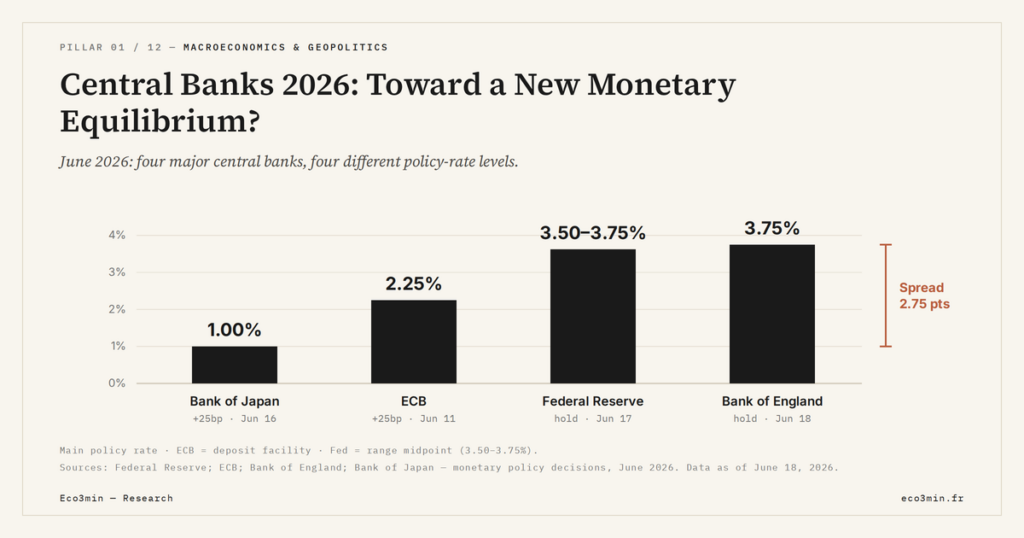
Advanced-economy central banks are starting to ease, but at divergent paces.
Some are guiding cautious 2026 rate cuts; others remain on hold, concerned by still-elevated services
inflation. The world is exiting a cycle in which “everyone tightened together” and entering an asymmetric
phase. Consequence: currency volatility is rising and country risk premia are once again decisive. The full treatment appears in our breakdown of asset-class correlations across regimes.
2. Inflation is normalizing, but the implicit target is higher
Headline inflation is converging, but rarely toward the traditional 2%. A durable plateau between 2.5% and 3.5% is settling
across many developed economies. This level reflects the triple force of energy transition, demographic ageing
and industrial reshoring. For portfolios, it means the end of deeply negative real rates,
but also the end of artificially high risk-free returns.
3. The geopolitics of rates: the return of blocs
Geopolitical fragmentation is translating into monetary fragmentation. Zones aligned with the United States,
those gravitating toward China, and non-aligned countries are now following distinct rate paths.
Capital flows are reorganizing along balances that are as political as they are economic.
This monetary fragmentation cannot be understood without considering the strong-dollar regime, which polarizes capital flows, tightens financial conditions outside the United States and turns monetary-policy divergences into genuine macro fault lines.
In-Depth Analysis: What These Signals Actually Say
The implicit message from central banks is clear: the 2010–2019 world is not coming back.
The era of zero rates, unlimited liquidity and unconstrained valuations is over.
A new regime is emerging in which:
- governments must finance structural deficits (defense, climate, AI, infrastructure) in a world where money is no longer free;
- central banks tolerate slightly higher inflation to avoid a sovereign-debt crisis;
- markets test fiscal credibility country by country, rather than buying everything indiscriminately.
Macroeconomically, a permanent tension is settling in between three objectives:
price stability, financial stability and structural transition.
In the short term, official communication focuses on inflation, but actual decisions reflect mainly
the fear of a bond-market accident on sovereign debt.
Sectoral impact: the cost of capital reshapes the winners
- Technology and AI: only players able to demonstrate rapid profitability still secure easy financing.
- Energy and climate: predictable-cashflow projects (grids, contracted renewables, regulated nuclear) trade increasingly like bonds.
- Real estate: sharp segmentation between still-attractive prime areas and oversupplied zones penalized by the cost of debt.
Immediate Implications for Companies, Investors and Households
For companies
“Growth-at-any-cost” models funded by cheap debt are obsolete.
Priority is shifting back to cash-flow generation and margin visibility.
Groups rapidly reorganizing capex (AI, automation, energy) and reducing dependence on short-term refinancing
have historically been the cycle winners through similar regimes.
For investors
- Equity/bond rebalancing: with bond yields again offering meaningful real returns, observed institutional allocations have rebuilt sovereign-debt pockets they had compressed during the zero-rate era.
- Integrating central banks into stock selection: the cost of capital depends on the country’s fiscal credibility, which now factors directly into bottom-up valuation.
- Updating real-return assumptions: historically, achieving 3–4% real returns in regimes of this kind has involved a higher share of profitable-growth equities and AI/energy themes.
For households
- Reasoning in real rates (rate – inflation), rather than nominal rates.
- Long-dated floating-rate debt taken on without hedging has historically transmitted rate volatility directly to household balance sheets.
Weak Signals to Watch Closely
- “Green” monetary frameworks: some regulators now distinguish climate-linked financing,
which can implicitly favor certain assets. - The AI–productivity–inflation link: AI may eventually moderate inflation,
but in the short term, massive investment functions more like a demand shock. - Differentiated-rate experiments: a few countries are testing preferential financing for strategic sectors,
blurring the line between monetary and industrial policy.
Outlook: How the Next 3 to 12 Months Could Evolve
Base case
Inflation slightly above 2%, gradual rate cuts, equities supported but selective,
bonds stable and attractive. Valuations recalibrate around mildly positive real rates.
“Debt stress” scenario
A major country faces a fiscal credibility crisis. Rate volatility, flight to quality,
pressure on fragile sovereigns. Portfolios positioned in real assets or solid balance sheets have historically held up better.
“AI positive surprise” scenario
Rapid productivity gains allow inflation to be better contained despite elevated deficits.
Quality growth equity outperforms bonds materially.
Indicators to track: fiscal-deficit trajectories, central-bank communication on “inflation tolerance,”
services wage dynamics, sovereign and corporate spreads.
Conclusion
The 2022–2025 cycle has buried the illusion of permanently free money. Monetary policy enters a hybrid phase:
less spectacular, but more structuring for valuations.
Understanding this new regime — slightly higher inflation, heavier debt, AI and climate as investment drivers —
allows portfolio adjustments well ahead of consensus.
Those who don’t see the change will only register it through volatility.
Last updated — 29 June 2026
Disclaimer – Financial Information: The analyses, commentary, and content published on eco3min.fr are provided for informational and educational purposes only. They do not constitute investment advice or a solicitation to buy or sell financial instruments. Past performance is not indicative of future results. All investment decisions involve risk and are the sole responsibility of the reader.
Read next
Full pillar →Hidden Unemployment: Reading the Real Labor Market in 2026
Headline unemployment is stabilizing while broad underemployment still runs above pre-2020 levels. Reading the gap between official rates…
2026 Economic Outlook: Key Trade-Offs After the End of Cheap Money
2026 ushers in a more constrained macro regime where real rates stay positive, fiscal space narrows and geoeconomic…
Monetary Strain and Geopolitical Tensions: Key Risks for the 2026 Economy
Recent market turbulence, central bank caution and rising geopolitical tensions form a complex picture for 2026. Persistent inflation,…