Monetary Strain and Geopolitical Tensions: Key Risks for the 2026 Economy
Recent market turbulence, central bank caution and rising geopolitical tensions form a complex picture for 2026. Persistent inflation, fiscal fragilities and a constrained energy transition are redrawing the macro-financial framework.

Recent turbulence in financial markets, unexpected central bank decisions and rising geopolitical tensions form a complex picture that could durably reshape the global economy. Early 2026 is marked by weak signals pointing to a structural recomposition, at the intersection of persistent inflation, institutional fragilities and a still-constrained energy transition. Understanding these dynamics is no longer optional for investors, companies and households alike.
TL;DR
Desynchronized US, European and Chinese cycles and the growing financialization of strategic resources deepen 2026's fragility, even as the Fed holds rates against inflation near 4%.
- The Fed holds elevated rates against inflation still near 4%, a stance that weighs on credit markets and amplifies fiscal vulnerabilities in already heavily indebted economies.
- Competition for oil, copper, lithium and rare earths intensifies just as US, European and Chinese cycles desynchronize, complicating any coordinated international stabilization.
- An underappreciated shift: transnational private actors are entering sectors long dominated by states, and the financialization of strategic segments can amplify volatility during stress periods.
This week’s notable economic developments
1. The temptation of a prolonged plateau in policy rates
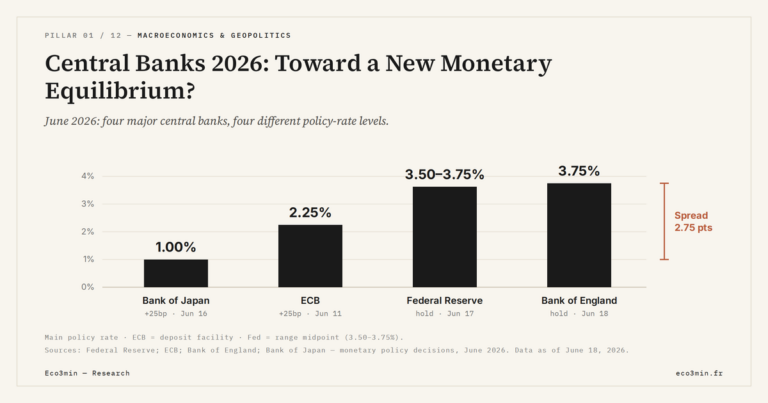
After several tightening cycles, some central banks — notably in Europe and Asia — now hesitate to engage in rapid monetary easing. The Fed maintains elevated policy rates against inflation still close to 4%, while the ECB remains cautious despite moderate growth. This context reflects a persistent tension between anchoring inflation expectations and the risk of a sharper economic slowdown. The broader logic is traced in our study of asset-class correlations across regimes.
What this actually means: Sustained elevated rates weigh on credit markets and dampen productive investment, while amplifying fiscal vulnerabilities in already heavily indebted economies.
2. The rise of geopolitical and energy tensions
Friction around strategic energy and mineral resources remains acute. Tensions in Eurasia and the Middle East sustain structural uncertainty over supply flows. Competition for control of critical commodities (oil, copper, lithium, rare earths) is intensifying, accentuating global geopolitical fragmentation.
What this actually means: The realignment of alliances and the reorganization of supply chains can generate durable volatility in energy and commodity prices, with direct effects on inflation and growth.
3. The energy transition under strategic pressure
Renewables investment continues to advance in 2026, but the energy transition remains exposed to supply constraints: technology dependency, geographic concentration of critical resources, trade tensions. Disruptions in essential component supply continue to affect parts of the industrial base.
What this actually means: Regulatory uncertainty and the fragmentation of economic blocs complicate industrial strategies and lengthen the profitability horizon for decarbonization-related projects.
Structural decoding of the forces at work
The weak signals observed in early 2026 converge toward a more durable macro-financial transition than initially anticipated. Central banks are seeking to preserve their anti-inflation credibility, but their room for maneuver remains constrained by the scale of public and private debt accumulated during the previous decade. Part of inflation remains tied to supply constraints, which limits the effectiveness of traditional monetary tools.
This fragility does not stem solely from national monetary choices. It is embedded in a strong-dollar regime, which continues to tighten global financial conditions, weigh on emerging economies indebted in dollars, and amplify global imbalances.
The desynchronization of business cycles across major regions (United States, Europe, China) complicates any stabilizing international coordination. The intensification of geopolitical tensions around strategic resources remains one of the principal sources of uncertainty.
An element still underappreciated lies in the rise of transnational private actors in sectors historically dominated by states. The increasing financialization of strategic segments can amplify volatility during stress periods.
Sectoral stakes remain decisive: energy, industrial metals, advanced technologies (AI, semiconductors, quantum). These sectors operate in an environment marked by structural regulatory and geopolitical instability.
Concrete near-term consequences for different actors
For companies, prudence remains central. The cost of capital remains higher than during the 2010–2020 decade, which reshapes investment trade-offs. FX risk management and supplier diversification have become major strategic axes.
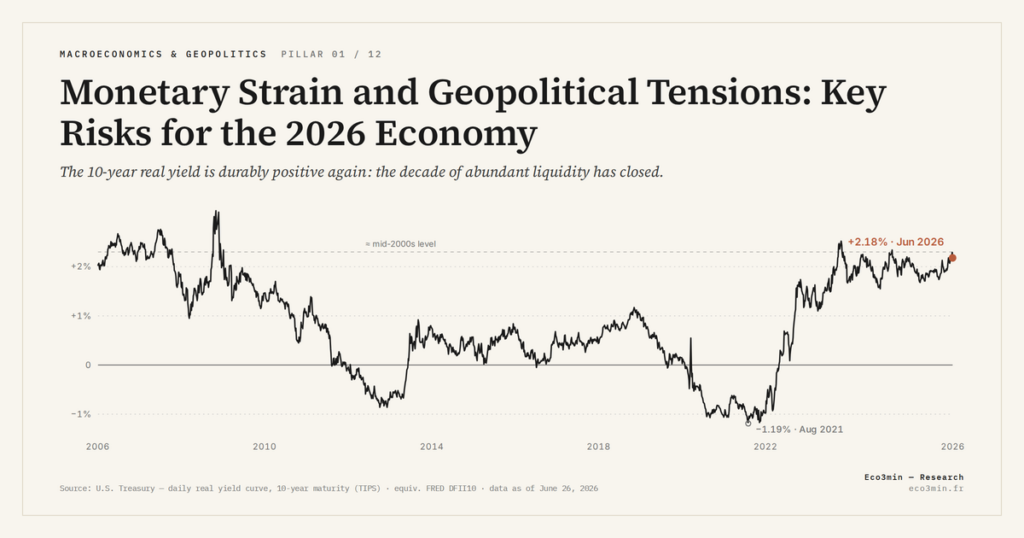
Investors must integrate a regime in which liquidity is no longer systematically expansive. The analysis of systemic vulnerabilities takes precedence over yield-seeking alone. Sensitivity to real rates and geopolitical shocks constitutes a key allocation parameter.
Households face an environment in which inflation erosion remains a latent risk. Debt management and the preservation of purchasing power become priorities in a context of persistent uncertainty.
Discreet but decisive indicators to monitor
Several indicators warrant particular attention: the evolution of sovereign credit spreads, tensions in strategic energy corridors, and dollar dynamics. The combination of elevated real rates and fiscal fragilities can constitute a tipping point.
The slowdown in certain strategic industrial investments, particularly in Europe, also constitutes a signal worth watching. It could reflect a deeper adjustment of growth expectations.
Finally, the gradual reconfiguration of trade and technology alliances could redraw global capital flows over the medium term.
Possible trajectories for the economy over a 3–12 month horizon
Scenarios for 2026 oscillate between gradual stabilization and amplification of fragilities. A progressive normalization remains plausible if inflation converges durably toward central bank objectives and if geopolitical tensions do not intensify.
Conversely, a marked correction in bond markets or an energy shock could trigger a broader contraction, particularly in the most heavily indebted economies.
The decisive variables remain: real rate dynamics, public debt sustainability, commodity volatility, and the stability of the international financial system.
Conclusion
In 2026, the conjunction of monetary, geopolitical and energy stakes continues to test the resilience of the global economy. Stability is no longer a structural acquis but a precarious equilibrium dependent on multiple interconnected factors.
Navigating this environment requires the capacity to identify regime signals early. The challenge is not to anticipate every cyclical variation, but to understand the structural forces redefining the global macro-financial framework.
The central question remains: how does one adapt to a world in which abundant liquidity is no longer the norm and in which geopolitical equilibria are continually being redrawn?
Last updated — 27 June 2026
Disclaimer – Financial Information: The analyses, commentary, and content published on eco3min.fr are provided for informational and educational purposes only. They do not constitute investment advice or a solicitation to buy or sell financial instruments. Past performance is not indicative of future results. All investment decisions involve risk and are the sole responsibility of the reader.
Read next
Full pillar →Monetary Tightening: How Central Banks Are Reshaping Financial Markets
After more than a decade of ultra-accommodative policy, monetary tightening has reintroduced the real cost of capital as…
Hidden Unemployment: Reading the Real Labor Market in 2026
Headline unemployment is stabilizing while broad underemployment still runs above pre-2020 levels. Reading the gap between official rates…
2026 Economic Outlook: Key Trade-Offs After the End of Cheap Money
2026 ushers in a more constrained macro regime where real rates stay positive, fiscal space narrows and geoeconomic…