2026 Economic Outlook: Key Trade-Offs After the End of Cheap Money
2026 ushers in a more constrained macro regime where real rates stay positive, fiscal space narrows and geoeconomic fragmentation reshapes investment decisions. A year of trade-offs, not easy growth.

TL;DR
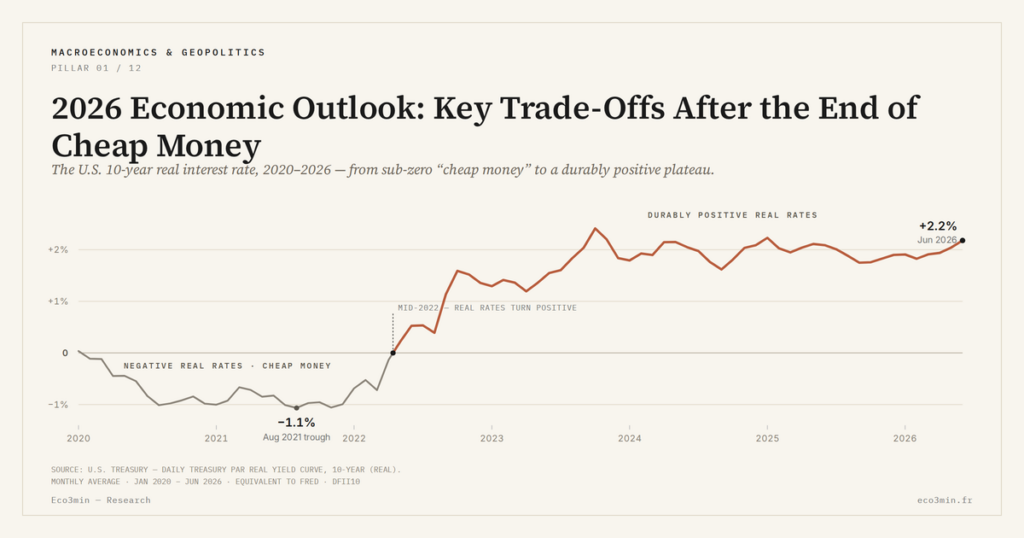
Regimes of durably positive real rates have historically preceded delayed slowdowns, particularly when the yield curve stayed inverted in episodes since 1976, the pattern 2026 now sits in.
- Durably positive real rates have, since 1976, often preceded delayed slowdowns when the yield curve stayed inverted, making credit a strategic tool rather than an automatic reflex.
- The 2026 fiscal question shifts from stimulus-versus-austerity to forms of trade-off: subsidy targeting, prioritizing productive investment, or accepting slower growth.
Why 2026 is a year of economic trade-offs
Unlike 2024–2025, dominated by abrupt adjustment to past shocks, 2026 marks a transition toward a more stable but more constrained regime. Monetary and fiscal room for maneuver has narrowed, forcing governments, companies and investors into more selective choices. Related discussion: Our reference page on the phases and market signals of the economic cycle.
Interest rates: an elevated plateau that reshapes decisions
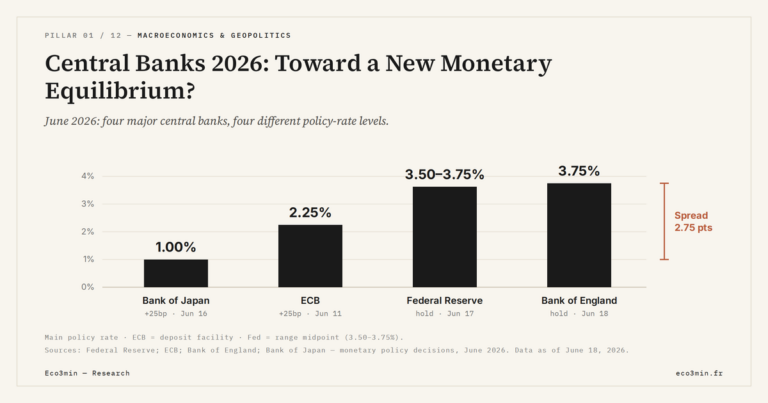
In 2026, the central scenario is no longer a rapid return to near-zero rates. Even with gradual cuts, real rates are likely to remain positive, durably installing a higher cost of capital. Historically, this type of monetary regime has often preceded delayed slowdown phases, particularly when the yield curve has stayed durably inverted , as documented in episodes since 1976.
- governments must arbitrate between economic support and debt sustainability,
- companies favor projects with rapid returns and high productivity,
- credit reverts to being a strategic tool, not an automatic reflex.
This logic is part of the regime shift described in
our analysis of the new economic cycle.
Geopolitics and the economy: a more fragmented framework in 2026
2026 economic forecasts must integrate a factor that has become central: geoeconomics. Value chains remain under tension, industrial policies are intensifying, and investment decisions are increasingly conditioned by security considerations.
This fragmentation does not necessarily trigger a crisis, but it weighs on potential growth and widens divergences between regions and sectors, as the dynamics of the new cycle linked to higher rates illustrate.
Public budgets and inflation: the 2026 dilemma
In 2026, most major economies will have to contend with:
- still-elevated deficits,
- more contained but not fully eradicated inflation,
- increased political pressure on public spending.
The choice will no longer be between stimulus and austerity, but between different forms of fiscal trade-off: targeting of subsidies, prioritization of productive investment, or acceptance of slower growth.
What 2026 economic forecasts concretely imply
For companies
Models grounded in real profitability, cost discipline and productivity have a structural edge. Companies able to self-finance part of their investment hold a comparative advantage in this regime. Self-financed investment is also the part of the real economic cycle driven by investment and productivity that survives the end of cheap money intact.
For investors
Asset allocation reverts to being a macro exercise. Understanding economic scenarios matters as much as asset selection, alongside the strategies described in this analysis.
For households
In 2026, residual inflation, the cost of credit and the evolution of taxation continue to strongly influence saving, real estate and consumption decisions.
Conclusion: 2026, a pivotal year without illusion
2026 economic forecasts paint neither a collapse nor a return to the 2010s decade. They describe a more constrained world, in which trade-offs matter more than promises of easy growth.
Anticipating 2026 means accepting this new framework and adjusting decisions accordingly. It is not a year for blind bets, but for structuring choices.
Last updated — 18 September 2026
Disclaimer – Financial Information: The analyses, commentary, and content published on eco3min.fr are provided for informational and educational purposes only. They do not constitute investment advice or a solicitation to buy or sell financial instruments. Past performance is not indicative of future results. All investment decisions involve risk and are the sole responsibility of the reader.
Read next
Full pillar →Monetary Tightening: How Central Banks Are Reshaping Financial Markets
After more than a decade of ultra-accommodative policy, monetary tightening has reintroduced the real cost of capital as…
Hidden Unemployment: Reading the Real Labor Market in 2026
Headline unemployment is stabilizing while broad underemployment still runs above pre-2020 levels. Reading the gap between official rates…
Monetary Strain and Geopolitical Tensions: Key Risks for the 2026 Economy
Recent market turbulence, central bank caution and rising geopolitical tensions form a complex picture for 2026. Persistent inflation,…