Monetary Tightening: How Central Banks Are Reshaping Financial Markets
After more than a decade of ultra-accommodative policy, monetary tightening has reintroduced the real cost of capital as a central variable, reshaping bond, equity and currency markets.

The monetary tightening cycle initiated by central banks is not a mere cyclical adjustment: it is profoundly transforming how financial markets operate.
TL;DR
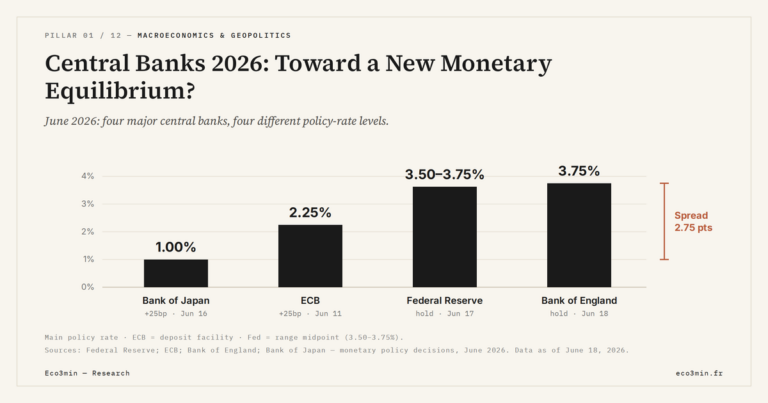
Since late 2022, coordinated rate hikes have put the real cost of capital back into asset pricing, reshaping the hierarchy between bonds, equities and the dollar through monetary transmission channels.
- Higher rates lift the discount rate on future cash flows, penalizing firms reliant on credit or distant growth while cash-flow-rich companies prove more resilient, widening performance dispersion across equities.
- Sustained high US rates support the dollar and squeeze dollar-indebted economies abroad, while central banks now prioritize credibility over market support, repeatedly disappointing pivot expectations.
After more than a decade of ultra-accommodative policies, the rapid rise in interest rates has reintroduced a long-neutralized variable: the real cost of capital. This shift is altering the hierarchy of assets, corporate valuations and the trade-off between risk and safety. Related reading: Our note on the phases and market signals of the economic cycle.
To understand today’s financial markets, it has become essential to analyze the transmission of monetary policy, well beyond rate announcements themselves.

A global monetary tightening that changes the rules of the game
Since late 2022, the main central banks have engaged in coordinated tightening to contain inflation that has become more structural than cyclical. Even as the pace of hikes has slowed, the message is clear: low rates belong to the past.
This monetary normalization fits within a broader frame where apparent stability masks deeper tensions.
Global monetary tightening cannot, however, be read in isolation: it sits within a broader chain of macroeconomic constraints, geopolitical tensions and economic policy choices, analyzed within the framework of macroeconomics and geopolitics, which durably shape market regimes and the transmission of financial shocks.
Monetary transmission: why markets react differently
Rate hikes do not affect all assets in the same way. The monetary transmission mechanism operates at several levels:
- an increase in the discount rate used to value financial assets;
- higher financing costs for corporations and governments;
- a gradual reallocation of flows toward fixed-income assets.
This dynamic explains the growing performance dispersion observed across equity markets, a phenomenon complementary to the one described in the analysis of the new economic cycle.
Bonds, equities, currencies: a new and unstable equilibrium
Bond markets: the return of yield… and of risk
After years of near-zero yields, bonds are once again offering value. But this normalization comes with elevated volatility, particularly on long maturities, which are highly sensitive to inflation expectations and central bank decisions. Spillover from bonds into equities is anything but automatic, which is exactly why the link between rate hikes and falling markets deserves to be taken apart.
Equity markets: the end of complacency
The rise in rates mechanically penalizes companies highly dependent on credit and on the promise of distant growth. By contrast, firms generating solid cash flows have proven more resilient.
This sharper selectivity aligns with the observations developed in the analysis of equity ETF flows and concentration risk.
Currencies and the dollar: an often underestimated channel
Sustained high rates in the United States support the dollar, which puts pressure on economies and corporations indebted in US currency. This monetary channel plays a key role in the global transmission of tightening.
Why central banks prioritize credibility over short-term support
Facing the risk of durably anchored inflation, central banks now accept a controlled economic slowdown. Their priority is no longer to support markets, but to preserve their credibility.
This stance explains why expectations of a monetary pivot are regularly disappointed, consistent with the soft stagflation scenario discussed in other analyses.
Concrete consequences for investors and corporations
- Investors: the risk/return trade-off becomes central again. Real diversification and duration management take precedence over simple directional exposure.
- Corporations: debt structure, cash flow visibility and financial discipline become key survival factors.
- Financial markets: volatility is no longer an accident, but a feature of the current regime.
In this context, certain hybrid strategies, such as the barbell strategy, are gaining relevance in the face of monetary uncertainty.
Conclusion: monetary policy as the markets’ compass
Current monetary tightening is not a parenthesis. It marks the durable return of the cost of capital as a central variable in economic and financial decision-making.
To read financial markets correctly, following corporate results or growth indicators is no longer sufficient. Understanding the logic of central banks and the channels of monetary transmission has become a decisive strategic advantage.
In this new environment, the error would be to reason using the reference points of the 2010s. Markets have changed regime — and monetary policy is at its core.
Last updated — 18 September 2026
Disclaimer – Financial Information: The analyses, commentary, and content published on eco3min.fr are provided for informational and educational purposes only. They do not constitute investment advice or a solicitation to buy or sell financial instruments. Past performance is not indicative of future results. All investment decisions involve risk and are the sole responsibility of the reader.
Read next
Full pillar →Hidden Unemployment: Reading the Real Labor Market in 2026
Headline unemployment is stabilizing while broad underemployment still runs above pre-2020 levels. Reading the gap between official rates…
2026 Economic Outlook: Key Trade-Offs After the End of Cheap Money
2026 ushers in a more constrained macro regime where real rates stay positive, fiscal space narrows and geoeconomic…
Monetary Strain and Geopolitical Tensions: Key Risks for the 2026 Economy
Recent market turbulence, central bank caution and rising geopolitical tensions form a complex picture for 2026. Persistent inflation,…