Eurozone Fragmentation: Sovereign Spreads and the Euro

The euro is issued by a monetary union without a complete fiscal union: nineteen sovereign debts coexist under one currency, with no single sovereign behind it. This peculiarity makes fragmentation a euro-specific currency force, one that never supports the euro.
This satellite isolates that channel: the euro’s structural peculiarity, the BTP-Bund spread and what it aggregates, the redenomination premium, the 2010 precedent, and the role of the TPI, without ever treating the dollar as a subject.
1. A currency without a single sovereign
Most major currencies are backed by a single state, which issues its debt and runs a central budget. The euro is the exception: it is carried by a monetary union whose fiscal union remains incomplete. Nineteen sovereign debts, of different credit qualities, circulate under the same currency, with no common Treasury nor generalised mutual guarantee. This architecture, chosen at the euro’s creation, creates a specific vulnerability: when doubt arises about the area’s cohesion, the market can demand a higher risk premium on the most fragile debts, and that premium can weigh on the euro itself. This channel ranks among the second-order forces identified in the framework that decomposes what moves the euro against the dollar.
The consequence is that there is no single risk-free rate for the euro area, but a hierarchy of sovereign rates. The German Bund serves as the safe benchmark, other debts trading at a gap, the spread, which measures the extra yield demanded to hold them. The more the area’s cohesion is doubted, the wider these gaps grow, and the more the common currency becomes sensitive to a risk that exists for no currency backed by a single sovereign.
2. The reference indicator: the BTP-Bund spread
The most-watched gauge is the yield gap between Italian and German ten-year debt, the BTP-Bund spread, complemented by the OAT-Bund gap for France. This gap does not measure one thing: it aggregates several overlaid risks. Credit risk, tied to the sustainability of a country’s debt, with Italy carrying debt of around 140% of GDP. Political risk, tied to coalition instability and fiscal uncertainty. Liquidity risk, tied to the swings between safe and risky assets within the area. And redenomination risk, discussed below. For France, those risks meet real demand at fixed intervals, because the French Treasury’s auction dates recur every week for bills and twice a month for bonds.
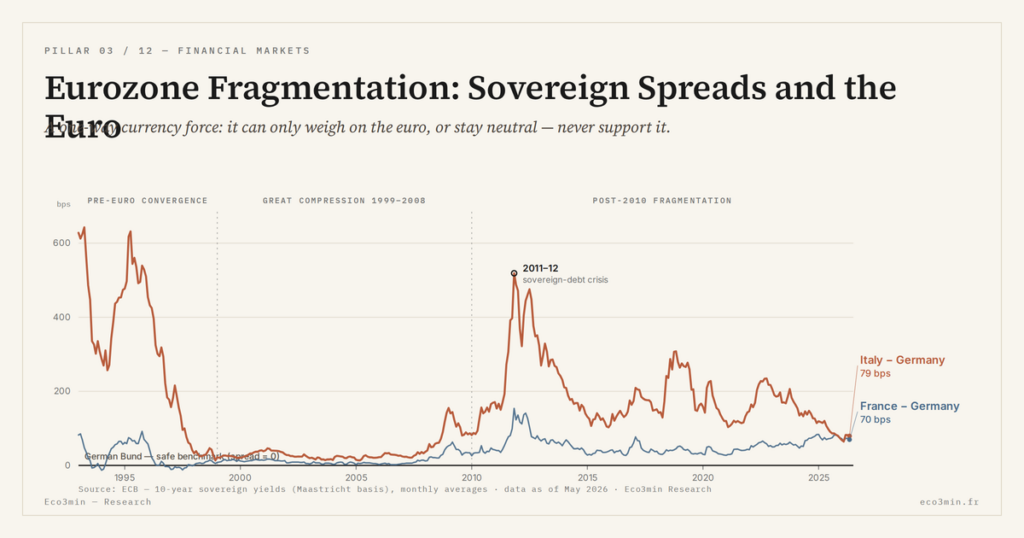
Historically observed thresholds serve as reading benchmarks, with no prescriptive value. Below roughly 150 basis points, the gap is generally seen as manageable; between 200 and 300, it signals stress that warrants monitoring; above 400, it has accompanied exceptional central-bank interventions in the past. The French dimension of this mechanism is tracked through the OAT-Bund spread for France, which follows the same logic with lower credit risk but its own political sensitivity. The history of the gap is documented in the Italy-Germany spread series.
The history of that spread traces three successive regimes. Before the euro, in the 1990s, the Italian gap far exceeded current levels, reflecting a currency and credit risk specific to the lira. Convergence toward the union melted it to a few basis points, and the 1999–2008 decade saw a great compression, with the market pricing almost no redenomination risk. The 2010 crisis opened a third regime, that of post-crisis fragmentation, in which the gap has since oscillated within a wide range as tensions ebb and flow. This history shows that the spread is not a fixed level but the moving expression of confidence in the area’s cohesion.
Among the risks the spread aggregates, the one most specific to the euro is the redenomination premium. It is the probability, as perceived by the market, that a country leaves the euro area and redenominates its debt in a new currency, generally assumed to be weaker. This risk has no equivalent for debt backed by a single sovereign: a holder of US government bonds does not fear that the United States will leave the dollar. For the euro area, by contrast, the very existence of the union is a variable, and it is this variable that turns a simple credit gap into a systemic risk for the currency.
The redenomination premium is, most of the time, close to zero: the market does not price imminent breakup. But it can wake sharply in periods of stress, and it is precisely this awakening that pulls the euro away from its monetary driver. It is a latent component, invisible in calm regimes, dominant in crisis regimes.
The premium is hard to isolate cleanly, but markets offer partial windows onto it. The basis between sovereign credit-default-swap contracts written under different legal frameworks, which treat a euro exit differently, has at times been read as a proxy for redenomination fear. Such measures are noisy and contested, and they say nothing precise about timing. Their value is qualitative: when they move together with widening spreads, they suggest that part of the gap reflects existential doubt about the union rather than ordinary credit concern, which is exactly the component that bears on the currency rather than on a single bond.
4. The 2010–2012 precedent
The episode that durably installed this premium in investors’ minds is the sovereign debt crisis of 2010 to 2012. The widening of peripheral spreads, in Greece first then in Italy and Spain, raised a real risk of the area breaking apart, until the central bank affirmed its determination to preserve the union. This episode showed that fragmentation was not a theoretical risk but a force capable of threatening the currency itself.
The institutional response was built in stages: the SMP programme in 2011, the OMT announcement in 2012, and, a decade later, the creation of a dedicated instrument. Each of these steps reduced, without erasing, the ability of speculation to provoke a self-fulfilling widening of spreads. The lesson of 2010 remains that a monetary union without a complete fiscal union carries a structural fragility, one that institutions can contain but not remove. Transmission to the currency runs through flows and expectations: when a fragmentation risk wakes, capital flees peripheral assets toward safe ones, and part of these flows leaves the euro, mechanically weighing on the currency, while a reflexive dimension can let the fear of breakup feed on itself.
The BTP-Bund spread is often read as a direct measure of the probability of the area breaking apart. This is inaccurate: the gap aggregates credit risk, political risk, liquidity, and a redenomination premium, in varying proportions. A moderate spread does not guarantee the absence of latent risk, and a wide spread does not mean imminent breakup. Reading the gap as a single thermometer of sovereign risk leads to errors.
5. The TPI: a better-contained risk, not removed
The Transmission Protection Instrument, created in 2022, changed the nature of fragmentation risk. It allows the central bank to buy, in targeted fashion, the debt of a state whose financing conditions deteriorate in a manner judged unwarranted, in order to preserve the transmission of its policy across the whole area. Its existence acts as a conditional safety net: by capping, in theory, the widening of spreads tied to pure speculation, it makes a self-fulfilling crisis harder.
But the TPI does not remove the risk; it moves its boundary. It targets unwarranted widening, tied to disorderly market dynamics, not widening justified by a real deterioration of a country’s fiscal fundamentals. The distinction is essential: fragmentation tied to speculation is now better contained, but fragmentation tied to a debt’s sustainability remains. For the exchange rate, this means fragmentation risk has become a better-contained residual risk, without disappearing from the list of forces that can specifically weaken the euro.
6. The asymmetry and transmission to the currency
Fragmentation displays an asymmetry that sets it apart from other forces, such as the energy bill. Energy is bidirectional: a fall in prices supports the euro as much as a rise penalises it. Fragmentation is one-way. A perfectly cohesive area does not produce a positive premium for the euro; at best, the absence of tension is neutral. Fragmentation can therefore only weigh or be neutral: it never supports the currency. It is a tail specific to the euro, invisible most of the time, capable of suddenly becoming the dominant factor.
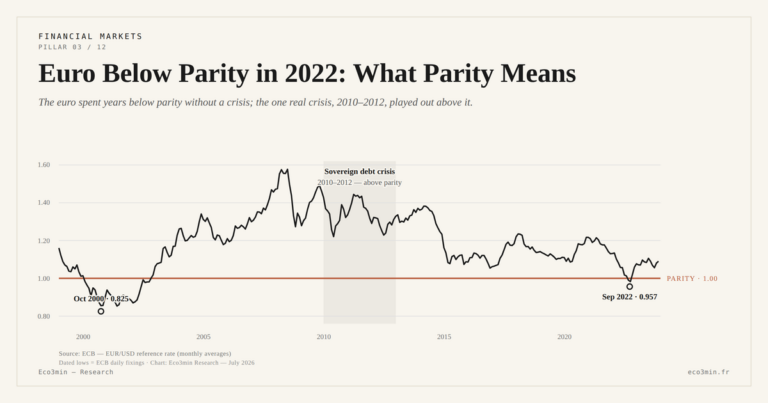
In 2026, this force stayed largely dormant: sovereign spreads remain contained and fragmentation does not influence the exchange rate, which drifts on other factors. But the 2022 episode, where the euro’s own weakness combined with other tensions during the euro’s fall under parity, is a reminder that the latent risk can wake. The place of this factor among the determinants of the exchange rate is mapped in the sub-pillar devoted to the foreign exchange and money markets.
Conclusion
Sovereign fragmentation is the most specifically European currency force, because it follows from a design choice: a common currency without a single fiscal sovereign. It is read in the BTP-Bund and OAT-Bund spreads, aggregates several risks including a redenomination premium with no equivalent elsewhere, and stays asymmetric: it never supports the euro. Institutions, from the SMP to the TPI, have learned to contain it, without removing it. Containment of that sort also dampens the announcement of a downgrade, one of the reasons rating cuts on monetary issuers move markets less than headlines suggest. Reading fragmentation means following sovereign spreads while keeping in mind that they measure several things at once, and that their apparent calm does not rule out a latent risk that needs only a shock to become the dominant factor again.
Last updated — 21 August 2026
Disclaimer – Financial Information: The analyses, commentary, and content published on eco3min.fr are provided for informational and educational purposes only. They do not constitute investment advice or a solicitation to buy or sell financial instruments. Past performance is not indicative of future results. All investment decisions involve risk and are the sole responsibility of the reader.
Read next
Full pillar →Euro Below Parity in 2022: What Parity Means
In September 2022, the euro fell below parity with the dollar, to around 0.95, a low not seen…
The Euro’s Energy Import Bill: the Gas Shock and the Currency
In 2022, the surge in gas prices turned the euro area's historic current-account surplus into a deficit and…
The ECB-Fed Rate Differential: the Driver of EUR/USD
The rate differential between the ECB and the Fed is the first-order driver of EUR/USD. But it is…