Chinese Shadow Banking: Systemic Risk Beneath the Surface
Chinese shadow banking: how this parallel credit system, its vulnerabilities and the signals to watch help anticipate systemic risk in 2026.

[Editor’s note: Article updated in April 2026 to incorporate the latest data on Local Government Financing Vehicles (LGFVs) and Q1 property market dynamics.]
TL;DR
China's regulatory squeeze is shrinking reported shadow-banking outstandings, but it displaces the risk rather than resolving it — less a Lehman-style shock than a slow, deflationary zombification. For a different source of systemic financial risk, see our analysis of artificial intelligence and systemic financial risk.
- Since several local property groups were placed under tutelage in late 2025 and Evergrande and Country Garden restructurings dragged on, the question is how shadow banking absorbs or transmits these shocks.
- Non-bank funding channels, long tolerated to fuel local growth, are being compressed while still carrying illiquid assets tied to real estate and local-government vehicles (LGFVs).
- The gap between apparent macro stabilization and the slow degradation of parallel balance sheets is what makes the system worth monitoring in 2026.
Chinese shadow banking: a systemic risk quietly reconfiguring
Chinese shadow banking: understanding this parallel credit system, its vulnerabilities and the signals to watch to anticipate systemic risk in 2026. A broader view: our analysis of financial innovation, market infrastructure and systemic risk.
Since several local property groups were placed under tutelage in late 2025 and the prolonged debt restructurings of historic developers like Evergrande or Country Garden, what markets imperfectly price in is no longer just the visible property crisis but how Chinese shadow banking absorbs — or transmits — these shocks. The parallel credit system is contracting under regulatory pressure, but its risks are shifting more than disappearing.
Angle: what is changing without making noise
Most attention remains focused on spectacular developer defaults or PBOC interventions on the yuan, while the architecture of risk is mutating in the interstices of the financial system. Non-bank funding channels, long tolerated to boost local growth, are now compressed while still carrying illiquid assets tied to real estate and local governments. This gap between apparent macro stabilisation and slow degradation of parallel balance sheets is precisely what makes Chinese shadow banking strategic to monitor at the start of this year.
Search intent: a systemic risk to decode
The central angle is risk analysis: to what extent can Chinese shadow banking become a channel of systemic contagion, in China and beyond? The point is not to judge whether this system is “good” or “bad”, but to understand where vulnerabilities concentrate today, how they may materialise, and what leading signals deserve monitoring.
What do we mean by Chinese shadow banking?
The term covers an ecosystem of intermediaries and products that create or distribute credit outside the conventional regulated bank balance sheet:
- wealth management products (WMPs) distributed by banks or private managers;
- trust companies financing real estate, industrial or infrastructure projects;
- local government financing vehicles (LGFVs), heavily housed off balance sheet;
- inter-company loans and residual online financing platforms.
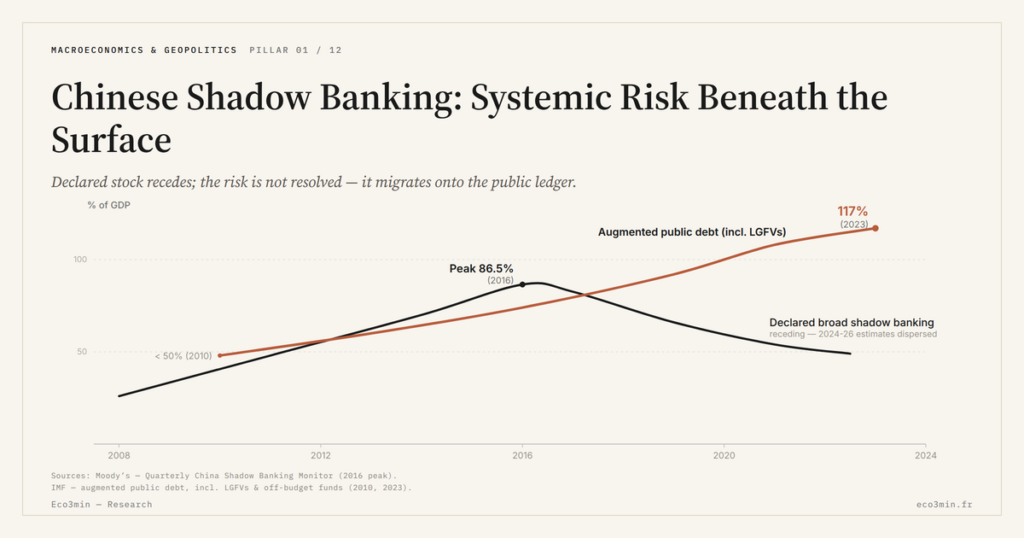
Between 2010 and 2017, aggregate estimates indicated that Chinese shadow banking represented up to ≈80–90% of GDP, peaking around 2016–2017. Since then, declared volumes have receded: by Q1 2026, several estimates place it closer to 45–50% of GDP. Note, however, that this apparent decline reflects accounting reclassifications and massive buyback programmes by state-owned banks (transfer of risk to the public sector) as much as genuine structural deleveraging.
To grasp the overall logic, it is useful to connect these dynamics to the global framework on credit cycles and the structure of the business cycle, which shape how debt excesses are absorbed or mutate.
Risk mechanics: maturity transformation and opacity
Two classical mechanisms turn a sectoral problem (real estate or unprofitable infrastructure) into systemic risk:
- Maturity transformation: many WMPs promise short-term yields while being backed by long-dated assets (5–15-year property or infrastructure projects). As long as subscribers roll over their investments, the structure holds. Once confidence cracks, the liquidity crisis is immediate.
- Credit risk transformation: these products were long marketed as “quasi-secure”, with the implicit notion of state guarantee. The reality of 2026 is a stark reminder that actual losses borne can be disconnected from buyers’ initial perceptions.
At a macro level, this system long amplified accommodative monetary policy. Today, with relative liquidity declining for the least viable players, pockets of chronic insolvency are coming to light.
Why this topic is becoming critical now
Since 2024 and throughout 2025, several defaults of large property-linked trust companies (such as Zhongzhi) ended impunity, with shortfalls running into tens of billions of yuan. In parallel, Beijing has had to force debt restructurings and massive swap programmes to rescue LGFVs, whose outstanding stock approached ≈60% of GDP at year-end 2025 according to the IMF. This perilous rebalancing increases the risk that severe losses will eventually be imposed on savers, against a backdrop where Chinese growth struggles to exceed 4–4.5% per year.
Dominant reading vs underestimated risk
The consensus scenario (a “Chinese-style soft landing”) rests on the idea that Beijing has absolute control over its banking system and sufficient regulatory tools to engineer an orderly deflation of Chinese shadow banking. The implicit assumption: the Party accepts more sluggish growth in exchange for a financial purge stretched out over time, thereby avoiding a “Lehman moment”.
The analysis proposed here does not refute this state firepower but highlights a blind spot: even with hyper-centralised management, the combination of slower nominal growth, adverse demographics and overvalued local assets produces a deadly silent erosion of balance sheets. Systemic fragility manifests less as a sudden equity crash than as prolonged “zombification” of the local economy and episodes of liquidity stress. Its slow form is exactly what cross-border surveillance struggles to capture, a gap tracked by the FSB in its non-bank monitoring.
What readers are really looking for
The question is no longer simply “will Chinese shadow banking blow up?”, but rather “to what extent will this slow purge sap global demand, and what warning signals would help anticipate a loss of control by authorities?”. Put plainly, will this risk reshape commodity prices and volatility in Western markets through 2026–2027?
Three concrete channels of systemic risk
1. Real-estate – local-government – trusts loop
A large share of Chinese shadow banking financed local government infrastructure, themselves dependent on land sales. The pattern has seized up:
- a local government financing vehicle (LGFV) issues debt through a trust company;
- the funds finance often-unprofitable infrastructure projects;
- the sharp drop in land sales (-30% cumulative between 2021 and early 2026) drains the revenue that was meant to repay the debt.
The debt itself remains. The capacity to “roll over” these claims via new artificial financial products has materially deteriorated.
2. Flight to quality and pressure on liquidity
At a microeconomic level, China’s upper middle class was accustomed to WMPs offering 5–7% guaranteed yields. Today, faced with high-profile failures, confidence has broken. A retreat is observed toward state-bank deposits, sovereign bonds or gold. This massive capital withdrawal drains shadow banking liquidity: there are no longer enough “new entrants” to pay older ones, forcing recognition of losses.
3. International transmission via demand and confidence
Systemic risk for the West does not run through direct bank failures, but through second-round effects:
- Subdued Chinese demand for intermediate goods (steel, copper, European machine tools);
- Deflation export: to compensate for the domestic market collapse, China floods global markets with low-cost manufactured goods (electric vehicles, solar panels), reigniting trade tensions;
- Geopolitical risk premium: financial opacity justifies a structural discount on all assets linked to emerging Asia.
Key indicators to track Chinese shadow banking
- Outstanding wealth management products (WMPs): a decline too rapid and not offset by conventional bank credit signals an abrupt credit crunch in the real economy.
- Payment incidents of trust companies: the frequency of defaults on non-guaranteed products is the thermometer of Beijing’s “pain tolerance”.
- Implicit spreads on LGFV debt: although heavily managed by state banks, the yield gap between fragile-province bonds and Beijing’s sovereign debt remains the best radar for local stress.
- Real policy rate evolution: addressed more broadly in the analysis of real policy rates and risk assets, a real rate that stays too high in China would definitively suffocate fragile debtors.
Common misreadings of the risk
- Confusing absolute size with immediate danger: focusing solely on trillions of yuan off balance sheet ignores that most of this debt is denominated in local currency and held by domestic players. The state can print to smooth the shock — something it could not do with dollar-denominated debt.
- Assuming unconditional state support (systematic “bailout”): Beijing uses creative destruction. Letting some players fail is a deliberate policy to impose “market discipline”. Navigating markets with the illusion of a total state guarantee has historically been the main mistake of foreign investors.
Possible scenarios for 2026–2027
Scenario 1: Managed purge and sluggish growth (probability ≈60%)
Authorities continue to restructure local debt via very long-dated special sovereign bonds. Losses are spread over a decade. Real growth stagnates around 3.5–4%. Capital is forcibly redirected toward the “new economy” (tech, batteries). No global systemic crisis, but a Chinese locomotive durably slowed.
Scenario 2: Local loss of control and domestic contagion (probability ≈25%)
An unexpected default by a major LGFV triggers a saver panic. Commercial banks balk at lending, creating an interbank liquidity crisis. Growth falls below 3%, forcing Beijing to aggressively devalue the yuan to restart the engine through exports, exporting a massive deflationary shock to Europe and the United States.
Scenario 3: Explicit nationalisation of off-balance-sheet (probability ≈15%)
Faced with too-rapid deterioration, the central government explicitly absorbs the majority of local government (LGFV) debt onto its own balance sheet. Implosion risk disappears, but the sovereign debt-to-GDP ratio explodes. China shifts onto a Japan-like trajectory (zero rates, debt monetisation, very weak long-term growth).
Concrete implications for economic actors
- For investors: equities tied to the Chinese consumer and to construction have historically shown elevated structural sensitivity in such episodes. Global industrial sectors overexposed to Asian demand have similarly traded with a higher risk premium during prior phases of Chinese balance-sheet adjustment.
- For Western corporates: fierce competition from Chinese industrials is a documented feature of past deleveraging episodes — when deprived of domestic outlets, exporters have historically slashed prices to preserve volumes.
Going further: macro and geopolitical framework
Chinese shadow banking fits into a broader strategic repositioning of China, between technological tensions, monetary policy adjustments and preparation for potential global financial fragmentation. To place these dynamics in context, the reference page on macroeconomics and geopolitics offers the keys to understanding how this forced deleveraging connects with current geostrategic stakes.
Frequently asked questions on Chinese shadow banking
The structures differ: in China, the link to physical land and ultra-indebted local governments concentrates risk. In the West, shadow banking (hedge funds, private credit) is more tied to corporate capital markets. The Chinese danger lies in the abrupt transfer of losses to retail savers in case of default. Different in who absorbs the loss, identical in structure, both variants belong to the family of non-bank intermediaries that perform bank functions without bank backstops.
Watch interbank rates (Shibor): if they remain stable and the People’s Bank of China is not injecting emergency liquidity, the default is being tolerated and contained. A sharp rise in short-term rates would, on the contrary, signal an early freeze of the financial system.
Yes and no. It weighs heavily on commodity-exporting countries (Australia, Brazil, Chile) and on Europe’s heavy industry. Conversely, the deflation it generates through lower prices on Chinese manufactured goods can temporarily help Western central banks keep inflation under control.
3 takeaways
- Chinese shadow banking is contracting in appearance, but this is a mutation: bad debt simply moves from unregulated off-balance-sheet to the books of state banks or local institutions.
- Fragility does not stem from the nominal amount of the debt (denominated in local currency) but from its deflationary impact on the real economy through a slow purge.
- The real risk for the rest of the world is indirect: less Chinese demand for Western exports, and an inflow of cut-price Chinese goods to compensate for domestic market weakness.
Last updated — 28 July 2026
Disclaimer – Financial Information: The analyses, commentary, and content published on eco3min.fr are provided for informational and educational purposes only. They do not constitute investment advice or a solicitation to buy or sell financial instruments. Past performance is not indicative of future results. All investment decisions involve risk and are the sole responsibility of the reader.
Read next
Full pillar →Monetary Tightening: How Central Banks Are Reshaping Financial Markets
After more than a decade of ultra-accommodative policy, monetary tightening has reintroduced the real cost of capital as…
Hidden Unemployment: Reading the Real Labor Market in 2026
Headline unemployment is stabilizing while broad underemployment still runs above pre-2020 levels. Reading the gap between official rates…
2026 Economic Outlook: Key Trade-Offs After the End of Cheap Money
2026 ushers in a more constrained macro regime where real rates stay positive, fiscal space narrows and geoeconomic…