Crypto Airdrops: Mechanisms, Dilution and Selection Risk
Crypto airdrops have shifted from free token distributions to dilutive financing tools. This analysis details the mechanisms, selection risks and signals to monitor before the next wave.

Crypto airdrops: understanding the mechanisms, selection risks and signals to monitor before the next wave of token distributions.
TL;DR
Crypto airdrops have shifted from free giveaways to dilutive financing tools resembling capital increases, where the real risk is overestimating net value once dilution and selling pressure are counted. For context: the Eco3min framework on bitcoin and liquidity cycles.
- Since autumn 2025, major DeFi protocols have launched or announced large airdrops, with distributed amounts estimated at roughly $500-700M over October-November 2025 on aggregated on-chain data.
- Positive real rates change the calculus: with sovereign bonds near 2% real yield and policy rates near 3-4% in late 2025, every token issued competes with better-paid, more legible yields.
- The distributed-value-to-FDV ratio works as a filter: near 5-10% it fits a gradual launch, while distributions above 20-25% often signal heavy reliance on incentives and sustained selling pressure.
- Aggregate airdrop volume set against ecosystem inflows acts as a discreet saturation signal: when distributions grow faster than net inflows, the probability of market saturation rises.
Crypto airdrops: why this topic is moving again
This analysis treats airdrops as mechanisms specific to the crypto-asset economy — liquidity allocation, dilution, incentives and risk transmission — rather than as financial innovations in the institutional or technological sense.
Since the start of autumn 2025, several major decentralized finance protocols have launched or announced large airdrops, with distributed amounts estimated at ≈$500–700M in October–November 2025 according to aggregated on-chain data. Over the same period, bitcoin’s price remained volatile around $90,000 in early December, and real policy rates stayed positive across most major economies, raising the cost of capital for crypto actors.
This new airdrop cycle bears little resemblance to the “free” distributions of the early days: airdrops increasingly operate as financing tools, liquidity acquisition channels and economic-and-governance incentive mechanisms. Understanding how these operations redistribute incentives and shift risk has become as much an economic question as a curiosity for end users.
This wave of airdrops highlights what prices integrate imperfectly: who actually pays the bill (dilution, selling pressure, future emissions) and which metrics distinguish an opportunistic distribution from a genuine value-sharing mechanism.
This dynamic can only be properly analyzed within the broader context of crypto-asset liquidity cycles, real rates and institutional integration, which condition the market’s capacity to absorb large distributions without lasting destabilization.
From “free” to financing tool: the regime shift
Historically, crypto airdrops mainly distributed tokens to a user base to bootstrap a protocol. Between 2018 and 2021, the dominant logic was simple: maximize network effects by spreading tokens as widely as possible. The macro context (zero rates, abundant liquidity, risk appetite) made dilution easy to absorb.
The current regime is markedly different. With nominal policy rates near 3–4% in advanced economies in late 2025 and inflation back around 2–3%, capital has become more selective. Crypto teams now arbitrate between:
- raising capital through traditional channels (equity or token sales to investors),
- charging higher protocol fees,
- or using crypto airdrops as a hybrid instrument: usage reward, liquidity incentive, quasi-marketing campaign.
The result: many recent airdrops look more like dilutive refinancings than “gifts” — which does not make them useless, but does mean the underlying economics resemble a capital increase, with winners and losers.
To place this shift within the broader digital-market context, the general framework on monetary policy reminds us that the risk premium required for speculative assets rises when real rates rise. Airdrops then become a tool for partially offsetting, through one-off distributions, an environment that is structurally less generous in liquidity.
Anatomy of a modern airdrop: who creates the value, who absorbs it?
From an economic standpoint, a crypto airdrop involves three actors:
- the issuer (protocol, DAO, development team) which sets the volume and the rules;
- the direct beneficiaries (users, liquidity providers, traders) who receive the tokens;
- the secondary market, which quickly prices in potential dilution.
Distributed value is not “created” out of thin air: it represents a share of the project’s future capitalization, anticipated by the market. As long as tokens remain locked or thinly traded, that value is theoretical. Once the airdrop unlocks, the dynamic shifts to:
- the speed at which beneficiaries sell (immediate selling pressure),
- vesting mechanisms (gradual unlocks),
- the protocol’s ability to generate cash flows (fees, revenues, token burns).
Part of the consensus assumes that the larger the airdrop, the greater the traction and therefore the lasting value created. The opposite analysis is worth considering: an overly generous airdrop may primarily signal that the protocol needs to heavily subsidize its usage, in the absence of organic demand.
The real economic question behind airdrops
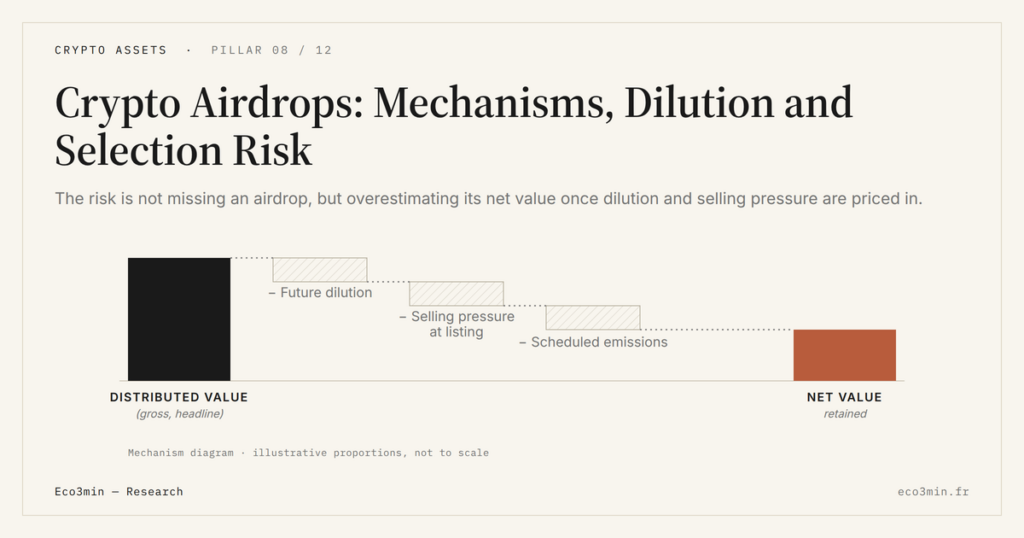
What many participants are really trying to assess is whether crypto airdrops still represent an opportunity or have become primarily a risk-transfer mechanism: from teams and early investors to users drawn in by the promise of tokens. In other words, the main risk is not “missing an airdrop” but overestimating the net value of what it distributes once dilution and selling pressure are accounted for.
Macro context: why airdrops are becoming more selective
Airdrops do not happen in a vacuum. Three macro-financial parameters now weigh much more heavily than in 2020–2021:
- Positive real rates: when sovereign bonds offer ≈2% real yield, the implicit profitability bar for a crypto protocol rises, since it must compensate for a better-paid risk-free asset.
- Capital-flow rotation: since mid-2024, flows into equity and bond ETFs have substantially outpaced flows into crypto assets, shrinking the pool of capital available to absorb large distributions.
- Stablecoin market consolidation: as analyzed in the crypto-assets pillar page, the dominance of dollar-pegged stablecoins reinforces project sensitivity to US monetary conditions.
In an environment where central banks maintain a cautious bias even after the tightening cycle has passed, every new token issued via airdrop competes with assets offering more legible yields. Mainstream projections still expect gradual normalization, but a lasting return to zero rates remains a minority hypothesis — which changes the calculus for aggressive distribution strategies.
The weekly macro bulletin regularly highlights the gap between “infinite liquidity” narratives within the crypto ecosystem and the more constraining reality of monetary aggregates and real rates.
Concrete checkpoints for analyzing a crypto airdrop
Moving from a purely opportunistic view (“how many tokens?”) to an economic reading requires several central parameters.
1. Distributed-value to potential-capitalization ratio
A simple rule estimates the share of fully diluted valuation (FDV) represented by the airdrop. An airdrop equivalent to ≈5–10% of FDV can be consistent with a gradual launch, especially if the protocol already generates fees. Beyond ≈20–25%, the distribution often signals heavy reliance on incentives and a risk of sustained selling pressure.
This ratio can be tracked over time as an indicator: if multiple projects within the same segment (for example DeFi on a given blockchain) repeatedly run airdrops above 20% of FDV in less than 12 months, this suggests the ecosystem is compensating for structural weakness in demand.
2. Eligibility criteria and the quality of rewarded activity
A crypto airdrop centered on real usage (transaction volume not artificially inflated, stable liquidity provision, governance participation) has a better chance of supporting medium-term value than an operation that mainly rewards:
- volume “farming” without economic effect,
- the mere presence of funds at an address,
- or mechanical tasks (following an account, joining a channel, etc.).
When criteria are vague or shift up to the eve of the snapshot, the team may primarily be seeking to maximize the wave of attention, at the expense of economic legibility.
3. Vesting schedule and synchronization with market liquidity
The key question is not just “how much” but “when”. An airdrop fully unlocked at listing concentrates selling pressure into a few sessions, whereas vesting spread over 12–24 months diffuses dilution. However, if unlock periods coincide with:
- a weakening crypto cycle (declining bitcoin, contracting volumes),
- or an unexpected monetary tightening,
then available liquidity to absorb these tokens drops sharply. This scenario assumes that macro-financial conditions remain volatile: a hawkish surprise from a major central bank can turn a manageable vesting schedule into an outright wall of supply.
Behind technical discussions on snapshots, whitelists or points levels, the core concern is simple: participating heavily in a system of crypto airdrops only to end up exposed to a token whose net value, once dilution is factored in, is low or negative relative to the time, fees and capital deployed.
The implicit question is therefore not just “will there be an airdrop?” but: “does the protocol have an economic model robust enough that the token distribution amounts to something other than a risk transfer?”
Common reading errors around crypto airdrops
Error 1: Confusing gross amount received with net value created. Looking only at the number of tokens distributed or their listing price leads to overstating the economic benefit. Initial selling pressure, future emissions and FDV must be integrated for a more complete view.
Error 2: Over-interpreting an airdrop as a market “vote of confidence”. A protocol can launch a large airdrop to engineer a communication shock, without that reflecting organic demand. Post-airdrop usage volume over 3 to 6 months is a better relevance indicator than the initial peak.
Error 3: Ignoring portfolio effect. Accumulating many small crypto airdrops concentrated in the same segment (for example highly leveraged DeFi) builds a specific exposure, often correlated and very rate-sensitive. Sectoral or business-model diversification is frequently underestimated.
Indicators to monitor for the new airdrop wave
Moving from isolated opportunity hunting to a cycle-level reading requires several useful KPIs:
- Airdrop absorption rate: share of distributed tokens that remain on beneficiary addresses 30 and 90 days after distribution. A rapid exit signals weak conviction.
- Protocol fee evolution: comparing daily or weekly revenues before and after the airdrop. If, six months later, fees have returned to prior levels, the operation has mostly shifted value through time.
- Floating-cap-to-TVL or actual-usage ratio: for DeFi protocols, this compares circulating token value with the value actually locked or measured activity.
A simple metric is to aggregate the total announced value of airdrops per quarter and compare it to spot crypto transaction volume over the same period. If distributions grow faster than volumes or net inflows, the probability of saturation increases.
Three scenario-based reading angles for crypto airdrops
Scenario 1: Gradual airdrop normalization
In this scenario, teams reduce distributed volumes, prioritize eligibility criteria tied to real usage, and better integrate macro constraints (real rates, capital flows). Crypto airdrops become an occasional tool, aligned with protocol revenues, rather than a primary financing channel.
Scenario 2: Competitive escalation and saturation
Conversely, some current estimates favor an escalation hypothesis: each new actor distributes more than the previous one to capture attention. If this dynamic persists, the mass of tokens seeking liquidity could durably exceed net inflows, with:
- shorter pump-and-dump cycles,
- valuations resting more on incentives than on economic flows,
- heightened volatility around unlocks.
Scenario 3: Regulatory reconfiguration
A third, less-discussed scenario involves a regulatory tightening on token distributions treated as unregistered securities offerings. Such a shift, already raised in several major jurisdictions, could:
- narrow the scope of airdrops open to the public,
- push teams toward compensation models closer to revenue shares,
- or accelerate sector concentration around already-regulated actors.
This is not the most likely scenario near term, but it represents an asymmetric risk that the market does not fully price.
Practical reference points: situating airdrops within a broader strategy
Without entering the register of personalized recommendation, several general principles help situate crypto airdrops within a wider allocation framework:
- Simple framing rule: treat airdrops as a sub-component of any limited overall crypto exposure, itself a sleeve distinct from broader risk-asset positions.
- Time horizon: clarify whether airdrop participation seeks a one-off gain or long exposure to the protocol. The two logics call for different decisions on holding versus selling tokens.
- Monitoring signals: track trading volume evolution, fees generated, new airdrop announcements within the same ecosystem, and the trajectory of global real rates, which influence pressure on speculative assets.
What could invalidate these readings
Several factors could materially change the configuration: a far more accommodative macro cycle than expected (rapid drop in real rates), a massive inflow of institutional capital seeking crypto exposure, or conversely a regulatory shock targeting governance tokens distributed via airdrops. In each case, current balances between dilution, incentives and value created could be redistributed.
Implications for investors, companies and individuals
For financial investors, the question is less “capturing” every airdrop than tracking aggregate distribution volumes as a barometer of the speculative crypto cycle. Excess distributions relative to inflows can be read as a fragility signal.
For companies involved in the ecosystem (platforms, infrastructure providers, developers), crypto airdrops are both an acquisition channel and a potential source of reputational risk if distributed value proves highly transitory. Clear rules and tracking metrics become a competitive advantage.
For individuals using protocols, the central question is to place each airdrop within a global risk frame: total crypto-asset exposure, sensitivity to market cycles, correlation with other assets, and capacity to absorb volatility without depending on these distributions for essential financial objectives.
A generalized airdrop collapse is not the central scenario today, but the probability of harder selection between subsidized projects and genuinely self-sufficient models is rising. The risk is less visible than others — precisely because it hides behind the appearance of free distribution — and that is what makes it a durable point of attention.
Frequently asked questions about crypto airdrops
Do crypto airdrops always dilute the value held by existing holders?
Most of the time, yes, since they increase token supply in circulation. However, if the airdrop triggers a lasting rise in protocol usage and revenues, the value created can offset, or even exceed, the dilution. It all depends on the ratio between tokens issued and economic flows generated afterward.
How can one tell whether an airdrop is mainly marketing or genuinely strategic?
A primarily marketing-driven airdrop emphasizes distribution size and media buzz, with little detail on governance or future revenues. A strategic airdrop is typically characterized by eligibility criteria tied to useful behaviors (stable liquidity provision, voting, development) and a clear articulation with the protocol’s economic model.
Does participating in many airdrops automatically increase overall risk?
It mainly depends on correlation between targeted projects. Concentrating on a single niche (for example leveraged DeFi derivatives) can create a highly cyclical exposure. Diversifying across protocol types (infrastructure, payments, decentralized finance, gaming…) and tracking macro evolution can reduce — though not eliminate — this risk.
What hidden costs should be factored into airdrop participation?
Beyond time spent, transaction fees, possible lock-up obligations, hack or smart-contract bug risk, and the volatility of intermediate tokens used to “farm” an airdrop are part of implicit costs. Ignoring them can give the illusion of larger gains than truly achieved.
- 3 key takeaways
- Crypto airdrops are no longer simple gifts: they resemble capital increases, with potential dilution and macro arbitrages to factor in.
- The distributed-value to FDV ratio, the quality of rewarded activity and the vesting schedule are three key filters for judging the sustainability of an airdrop.
- Tracking aggregate airdrop volumes against inflows into the ecosystem provides a discreet signal on the degree of saturation and fragility in the crypto cycle.
Last updated — 12 July 2026
Disclaimer – Financial Information: The analyses, commentary, and content published on eco3min.fr are provided for informational and educational purposes only. They do not constitute investment advice or a solicitation to buy or sell financial instruments. Past performance is not indicative of future results. All investment decisions involve risk and are the sole responsibility of the reader.
Read next
Full pillar →Crypto Seasonality: Why the Signal Is Weaker Than It Looks
Crypto’s cyclical regularities, monthly seasonality or the four-year cycle, rest on a very small number of observations. That…
Bitcoin Halving: How the Programmed Supply Cut Works
The halving writes bitcoin’s scarcity into an immutable rule, applied without exception since 2012. It shapes the pace…
Crypto Cycles: Why Their Amplitude Dwarfs Equity Swings
Crypto cycles post drawdowns two to four times deeper than equity markets. The asymmetry stems from market microstructure,…