Stablecoin Reserves: What US Backing Rules Actually Require

The GENIUS Act sets what must sit behind every US payment stablecoin: a one-to-one reserve in high-quality liquid assets, ring-fenced from other uses. Federal proposed rules issued in 2026 detail how those reserves are held, custodied and redeemed.
Reserves adequate on paper can prove illiquid under stress. That gap between the written rule and behaviour in a run is exactly what backing requirements try, imperfectly, to close.
US rules turn the redemption promise into a defined requirement. Yet a reserve that balances on the books need not convert to cash fast enough in a run.
- A one-to-one reserve mandate: each token backed by high-quality liquid assets, with issuers barred from drawing on reserves for other purposes.
- A yield prohibition keeps a compliant stablecoin closer to payment infrastructure than to an interest-bearing account.
- Proposed 2026 rules address custody, redemption and the deposit-insurance treatment of reserves held as bank deposits.
1. What the rule requires an issuer to hold
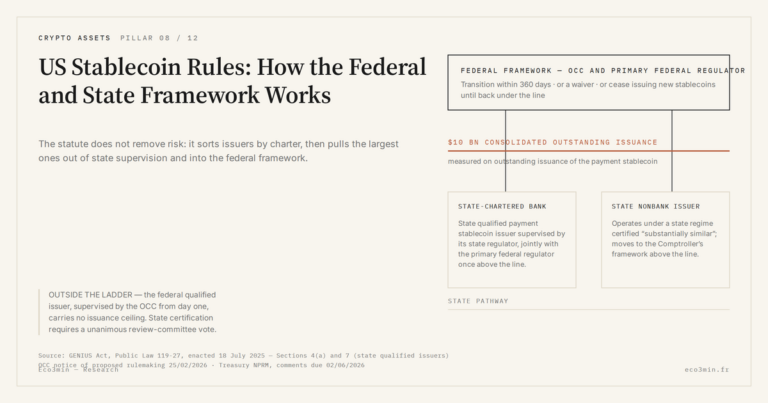
A stablecoin makes a simple promise: a token always worth one dollar. Honouring it requires reserves, assets that can turn into cash on demand to meet redemptions. The GENIUS Act converts that common-sense expectation into a defined legal requirement, and the lens here is the rule itself, once the US regulatory framework is in place, rather than the market mechanics that follow from it: what issuers must hold, in what form, segregated how, and verified by whom. The statute sets a one-to-one reserve mandate, with each outstanding token backed by high-quality liquid assets.
Composition is not left to the issuer’s discretion. The reserve must consist of the kind of short-dated, low-risk instruments that clear quickly, and the proposed federal rules bar a permitted issuer from drawing on those reserve assets for any other purpose. Rehypothecation, the quiet reuse of collateral that fuelled fragility in earlier corners of finance, is precisely what the design closes off. The reserve is meant to back the token and nothing else, a ring fence written into the rulebook rather than left to the issuer’s promise.
Two further constraints shape the regime. A yield prohibition prevents issuers from paying interest to holders simply for holding the stablecoin, which keeps the instrument anchored to its payment function and away from the economics of a savings account. And the deposit-insurance agency, in its 2026 proposal, set out how reserve assets held as bank deposits would be treated for insurance purposes, alongside the treatment of tokenised deposits. The effect is to pull the stablecoin reserve into the familiar prudential vocabulary of banking, custody, insurance, segregation, rather than leaving it in a regulatory void.
Custody carries its own weight in the proposed rules. Banks that hold reserve assets for an issuer face obligations that attach to them regardless of which agency supervises the issuer itself, and the rules press on where and how those reserves may sit. The point is to keep the assets not only owned by the right party but held in the right place, close to cash and clear of the issuer’s other creditors. A reserve is only as sound as the custodian and the account structure that hold it, and the framework spends much of its detail there.
Composition, in practice, settles into a narrow band of instruments. Beyond cash at qualified banks, a compliant reserve leans on short-dated Treasury bills, overnight repurchase agreements collateralised by government paper, and money-market holdings, the assets that clear fastest with the least price give. The maturity choice is itself a lever: the shorter the paper, the closer to cash, but the lower the yield the issuer earns on assets it cannot lend out under the yield prohibition. Every rung down the maturity ladder trades a little liquidity for a little return, and the proposed rules push issuers toward the liquid end. The reserve is engineered less for income than for the moment it must be spent.
2. The blind spot: liquidity under stress
Here the quiet mechanism starts. Reserve adequacy is measured first on the balance sheet: the value of assets held meets or exceeds the value of tokens outstanding. That accounting adequacy says nothing, on its own, about how fast those assets become cash. A portfolio of perfectly solvent securities can still be hard to sell within hours without a price concession, at the exact moment every holder asks to redeem at once. Composition rules address solvency; they do not exhaust the question of liquidity.
The distinction is not academic, and recent history supplied the clearest case, not the one usually cited. In May 2022, an algorithmic token lost its peg for want of any real reserve; that was a failure of backing, not of liquidity. The instructive episode for reserves came later. In March 2023, a fully reserved stablecoin briefly slipped from its peg because a slice of its cash sat in a failing bank and was momentarily unreachable. The reserve was full; it was not mobilisable. Reserves adequate on paper can be illiquid under stress, and that depeg showed exactly what the phrase means, familiar to anyone tracking issuers and T-bill demand.
What resolved that episode is as telling as what caused it. The peg was restored once access to the frozen cash was assured, not because the reserve had grown but because it became reachable again. Liquidity, not solvency, had been the binding constraint, and liquidity returned when the account did. The same logic scales up as reserves concentrate in Treasury bills: a sector large enough to move the market for short-dated government debt can find that its own forced selling, in a broad run, moves prices against it. The instrument built to be safest, sovereign paper, becomes a channel through which stress transmits when everyone reaches for the exit at once.
The deferred effect is what makes the risk easy to underestimate. In calm markets, a compliant reserve looks like a guarantee; the coverage ratio sits at or above one, the attestations arrive on schedule, redemptions clear without friction. The fragility appears only when the flow reverses faster than the reserve can be turned over, and by then the design choices, how much sits in instantly available form versus in assets or accounts that need time to reach, have already decided the outcome. A rule calibrated on ordinary conditions protects poorly against a run whose scale, by nature, exceeds anything the record has logged.
3. What the law covers, and what it cannot lock down
Regulation does more than describe; it constrains and verifies. The federal framework requires disclosure, custody standards and supervision, and it reduces the opacity that once surrounded stablecoin reserves. A holder can now, in principle, read the declared composition of a permitted issuer’s reserve, something out of reach a few years earlier. That transparency has a value of its own, independent of the liquidity question: it makes the risk legible even when it does not erase it, a limit central to crypto regulation and its limits.
That legibility has its blind spots. A periodic attestation photographs the reserve on a given date; it says little about its composition between checkpoints, or about how fast each line would liquefy on a day of stress. The holder sees a snapshot, not a film. Knowing a reserve was full at quarter-end tells you nothing about mobilising it on a Tuesday panic. The visibility gained is visibility of solvency more than of liquidity, a real advance bounded by what a still image can show.
What remains is the underestimated risk. No composition rule, however strict, turns a redemption promise into an unconditional guarantee. The reserve can be full, ring-fenced, audited, and still slow to mobilise at the worst moment. That is the difference between the regulatory requirement, which governs what the issuer must hold, and the market mechanics that decide how quickly those holdings become cash again. The two angles meet without overlapping: one belongs to the rulebook, the other to T-bill backing compared to MMFs, the plumbing that links these reserves to the demand for government debt.
Redemption timing sharpens the point. A promise to convert on demand means little if conversion takes days when it is needed in hours; the value of a redemption right is set by its speed, not merely its existence. In calm markets the distinction is invisible, because demand is spread and the reserve turns over comfortably. Under stress the clock becomes the whole story: an issuer that can return cash same-day survives a scare that sinks one whose assets, however sound, settle too slowly. The rulebook can mandate that reserves exist; it cannot legislate the speed of a market on its worst day.
Reading US backing rules therefore means holding both ends at once. The written rule sets a verifiable floor of safety; behaviour under stress is a reminder that the floor is measured against events the record has not always seen. This extends how regulation compresses volatility across the asset class. The requirement closes a gap. It does not remove the source of the gap.
- A one-to-one reserve in high-quality liquid assets, with issuers barred from reusing reserves for other purposes.
- Accounting adequacy, assets equal to tokens, is not the same as liquidity, the ability to mobilise those assets instantly.
- A yield prohibition keeps the stablecoin tied to payments rather than to interest-bearing savings.
- A fully reserved token slipped from its peg in March 2023 when part of its cash was frozen in a failing bank: solvent, yet momentarily illiquid.
A guarantee of form, a promise of substance
The container decides almost everything except the precise instant a solvent reserve must become liquid. US rules have made that container robust, verifiable, enforceable. They have not abolished the distance between a reserve that balances and a reserve that clears within hours. That distance is not a flaw in the text; it is the nature of a redemption promise backed by assets that, however safe, do not all sell at once without friction. The written rule and behaviour in a crisis do not always line up, and it is in that interstice that the residual risk of stablecoins sits. The rule can guarantee the form of the promise; its substance, on the worst day, still belongs to the market that must honour it. Form is legislated; substance is tested.
Last updated — 4 August 2026
Disclaimer – Financial Information: The analyses, commentary, and content published on eco3min.fr are provided for informational and educational purposes only. They do not constitute investment advice or a solicitation to buy or sell financial instruments. Past performance is not indicative of future results. All investment decisions involve risk and are the sole responsibility of the reader.
Read next
Full pillar →Crypto Cycles: Why Their Amplitude Dwarfs Equity Swings
Crypto cycles post drawdowns two to four times deeper than equity markets. The asymmetry stems from market microstructure,…
Bitcoin Cycle: A Quiet Inflection the Market Is Still Ignoring
A quiet on-chain indicator points to a different Bitcoin market regime, with material implications for allocation framing and…
Bitcoin ETFs: The Quiet Shift Reshaping the Crypto Market
Bitcoin ETFs: how the rapid arrival of listed vehicles is reshaping liquidity, flows and risk management for investors.…