US Stablecoin Rules: How the Federal and State Framework Works

The GENIUS Act, signed into law on 18 July 2025, created the first comprehensive federal framework for payment stablecoins in the United States. Its implementing rules moved to proposed form in early 2026, with enforcement expected no later than January 2027.
The belief that a federal statute would tame stablecoins by locking them down runs through the US debate. The record points elsewhere: the framework channels the instrument, it does not neutralise it.
US stablecoin oversight now runs through a federal statute layered over state charters. Regulation does not remove risk; it relocates it.
- The GENIUS Act sets a dual pathway: OCC-supervised federal issuers and state-qualified issuers under certified state frameworks.
- A state issuer that crosses ten billion dollars in outstanding issuance must move to federal oversight within 360 days or obtain a waiver.
- As of early 2026 the rules sat at proposed stage: an OCC notice on 25 February, an FDIC notice on 10 April, with comment windows running into June.
1. One statute, two doorways
US oversight of stablecoins no longer emerges from silence. The GENIUS Act, the Guiding and Establishing National Innovation for US Stablecoins Act, became law on 18 July 2025 after clearing the Senate 68 to 30 and the House 308 to 122. It is the first federal statute to define a payment stablecoin and to set the terms under which one may be issued at scale. What preceded it was a patchwork of state money-transmitter and trust charters; what the Act adds is a federal spine running through that patchwork.
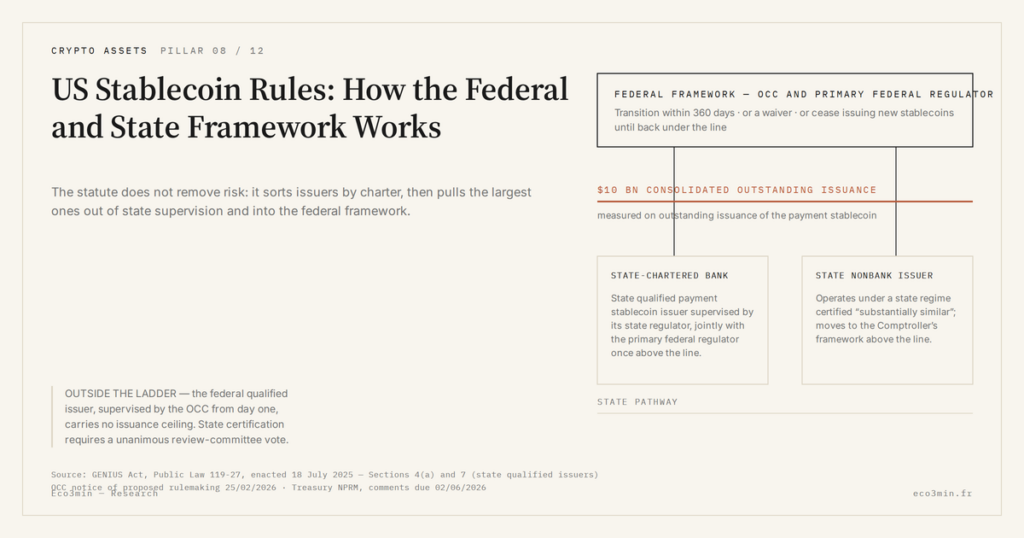
The architecture offers two doorways rather than one. An issuer can become a federal qualified payment stablecoin issuer, supervised directly by the Office of the Comptroller of the Currency and able to operate nationally without stitching together individual state licences. Or it can become a state qualified issuer under a state framework that the federal authorities have certified as substantially similar. The choice is not merely administrative. It determines who supervises, which capital and reserve rules bite, and how far an issuer can grow before the federal system reclaims jurisdiction. Replicated at international scale, the same question of who supervises whom defines the global patchwork of securities regulation.
That reclaiming is written into the statute. A state-qualified issuer whose consolidated outstanding issuance passes ten billion dollars must transition to federal oversight within 360 days or secure a waiver, with the Federal Reserve Board holding authority over state issuers above that line. The threshold works as an automatic escalation: a small issuer can mature under Wyoming or New York supervision, but once it becomes systemically meaningful, federal control is no longer optional. Certification of a state regime, and approval for certain non-financial public companies to issue, both require the unanimous nod of a review committee drawn from the Treasury Secretary, the Federal Reserve Chair and the head of the deposit-insurance agency, which must act within a tight thirty-day window.
The dual structure carries a subtlety worth naming. A federal charter buys national reach at the price of the OCC’s full prudential gaze; a state charter buys lighter early oversight at the price of a hard ceiling on growth. Issuers therefore choose not only a regulator but a trajectory, and the framework quietly steers the largest players toward the federal door while leaving a regulated on-ramp for smaller ones. The design is less a wall than a funnel.
The certification machinery gives that funnel its teeth. For a state regime to host qualified issuers, the review committee must find it substantially similar to the federal standard, and it must do so unanimously within thirty days. Unanimity across the Treasury, the Federal Reserve and the deposit-insurance agency is a high bar; a single dissent blocks certification. The same committee gates a separate and politically charged question, whether public non-financial companies may issue stablecoins at all, subject to the same unanimous approval. The effect is to concentrate a surprising amount of discretion in three offices, and to make the boundary of the regime turn on their agreement rather than on a bright-line test.
Underneath the pathways sits a definition that does much of the work. The Act reserves the label of payment stablecoin for a digital asset redeemable at a fixed monetary value, held out by its issuer as convertible one-for-one into dollars on demand. That redemption-at-par promise, lifted from a marketing claim into a statutory obligation, is what separates a regulated stablecoin from the wider field of crypto tokens. It also fixes the issuer’s core duty: not to deliver a return, but to stand ready to convert. Everything else in the framework, reserves, custody, disclosure, exists to make that single promise credible.
2. A framework still setting into concrete
A law is not the same as a rulebook, and in early 2026 the distinction mattered. The GENIUS Act required federal regulators to issue implementing regulations within a year of enactment. The Office of the Comptroller of the Currency opened that phase on 25 February 2026 with a notice of proposed rulemaking running to several hundred pages, published in the Federal Register on 2 March, covering application requirements, permissible activities, the treatment of reserves, redemption obligations and the prohibition on paying yield to holders. The notice posed more than two hundred specific questions on definitions, activities, reserves and liquidity, a sign of how much detail remained open. Its comment period ran into early May.
Other agencies followed on parallel tracks. The deposit-insurance authority issued its own proposal in April on prudential requirements and on how reserve assets held as bank deposits would be treated, with comments due in June. On the same day, the financial-crimes and sanctions authorities jointly proposed rules on anti-money-laundering and sanctions obligations for issuers. The sequencing shows how the framework channels behaviour before it is even final: issuers must plan against proposed rules, not settled ones, and custody banks must anticipate obligations that attach to them regardless of which agency supervises the issuer whose reserves they hold.
The effective date compounds the point. The statute binds at the earlier of eighteen months after enactment or 120 days after the primary regulators finalise their rules, which places the pivotal moment in the neighbourhood of early 2027. A separate window stretches further: digital-asset service providers have until 2028 before they are barred from offering non-compliant stablecoins. Between enactment and those dates, the market moves under a framework whose edges are still being drawn, and much of the current behaviour is a bet on where those edges will land.
The distribution logic differs from the European template in form but rhymes in effect. Where the EU gates stablecoins through authorised venues, the US routes them through chartered issuers and a yield prohibition that keeps a compliant stablecoin closer to payment infrastructure than to an interest-bearing instrument. The Act also carves stablecoins out of securities law and writes in insolvency protections that prioritise holders’ redemption claims. Both regimes decide who may issue a dollar-pegged token at scale and where redemption promises are enforceable. Both, in doing so, push some activity toward the perimeter and beyond it.
The rules also fence in what an issuer may do. A permitted payment stablecoin issuer is confined, in the proposed framework, to issuing and redeeming stablecoins and to activities directly supporting that function, holding and managing reserves, providing custody, handling redemptions. It cannot repurpose the franchise into a general banking or trading operation on the back of the reserve. That confinement is deliberate: it keeps the issuer’s balance sheet legible and its failure, if it comes, contained to a narrow set of activities rather than entangled with lending or proprietary risk. The narrowness is a feature, and it is also a limit on how far the model can stretch.
3. The reversal: relocated, not removed
Here the common reading breaks down. The intuition holds that a federal statute secures stablecoins, sterilises the run risk, turns a fragile promise into a safe one. The design says otherwise. The GENIUS Act does not abolish the risk inherent in a redeemable liability; it reassigns the burden of proof and moves the fault lines. Reserve rules shift a slice of the exposure onto the assets behind the token and onto the banks that custody them. The yield prohibition steers demand away from stablecoins as savings vehicles and back toward their payment function, relocating the appetite for return rather than extinguishing it.
The offshore channel makes the relocation visible. An issuer unwilling or unable to meet US reserve, charter and disclosure requirements does not vanish; it migrates to a jurisdiction outside the federal perimeter and continues to serve demand from there, away from the regulated stablecoin dollar plumbing. Foreign issuers that want US access, by contrast, must register with the OCC, hold reserves onshore and meet standards comparable to the domestic regime. The perimeter does not seal the market; it sorts it into an onshore tier bound by the rules and an offshore tier that carries a different risk profile.
The winners follow from the barrier. A high cost of entry, capital, charter, disclosure, comparable-standards tests for foreigners, favours established institutions with the balance sheet and compliance depth to absorb it. It disadvantages small issuers and concentrates issuance among a handful of large, bank-adjacent players. That concentration is itself a relocation of risk: fewer, larger issuers mean tighter supervision but also a heavier systemic footprint if one of them stumbles. The framework trades a dispersed, opaque risk for a concentrated, legible one.
For the holder, the split lands as a question of access rather than of the asset itself. A token issued under a federal or certified-state charter carries reserve, custody and disclosure guarantees; the same dollar peg reached through an offshore, non-compliant issuer carries none of them, yet remains a click away. The framework does not remove the risky choice; it moves the line, so that the danger sits less in the coin than in the door one uses to reach it. Reading the regime well means asking not whether a stablecoin is safe but through which gate it is held, and what that gate carries with it.
None of this is a verdict on the statute. It is a lens. Reading the US approach means seeing how a spine of federal law, bolted onto a lattice of state charters, channels a global instrument through American guardrails without pretending to remove what makes it volatile, echoing the regulation and volatility compression visible across the asset class. The same displacement runs through the concrete requirement at the heart of the regime, the reserves that must sit behind every token, where the written rule and behaviour under stress do not always line up.
Reading federal authorisation as a guarantee that a stablecoin cannot break its peg. The misreading trips on a confusion between compliance and resilience: a statute mandates reserves and disclosure, it does not suspend the possibility of a run. Corrected: federal rules cut some exposures and shift others, without turning a redemption promise into a certainty.
What the framework leaves open
The GENIUS Act replaced federal silence with a federal spine, defined a payment stablecoin, and set a dual pathway that reclaims jurisdiction as an issuer grows. What it did not do, and does not claim to do, is erase risk. Regulation does not remove risk; it relocates it, and the US market since enactment has borne that out at every turn. The statute has bought clarity, not safety, and the two should not be confused. The unsettled question is not whether reserves exist on paper but whether they hold under stress, the precise gap that stablecoin reserve requirements try, imperfectly, to close, a recurring theme among structural crypto risks.
Last updated — 3 August 2026
Disclaimer – Financial Information: The analyses, commentary, and content published on eco3min.fr are provided for informational and educational purposes only. They do not constitute investment advice or a solicitation to buy or sell financial instruments. Past performance is not indicative of future results. All investment decisions involve risk and are the sole responsibility of the reader.
Read next
Full pillar →Crypto Cycles: Why Their Amplitude Dwarfs Equity Swings
Crypto cycles post drawdowns two to four times deeper than equity markets. The asymmetry stems from market microstructure,…
Bitcoin Cycle: A Quiet Inflection the Market Is Still Ignoring
A quiet on-chain indicator points to a different Bitcoin market regime, with material implications for allocation framing and…
Bitcoin ETFs: The Quiet Shift Reshaping the Crypto Market
Bitcoin ETFs: how the rapid arrival of listed vehicles is reshaping liquidity, flows and risk management for investors.…