Bitcoin Halving: How the Programmed Supply Cut Works

The halving writes bitcoin’s scarcity into an immutable rule, applied without exception since 2012. It shapes the pace at which new coins are issued, not the price path, which demand alone decides.
The confusion between programmed scarcity and assured gains runs through the whole halving discourse. Separating it from the actual mechanics clarifies what the event changes, and above all what it does not decide.
The halving cuts bitcoin issuance on a fixed, known schedule. It tightens supply at the margin, where nine coins in ten already exist, and does not set the price.
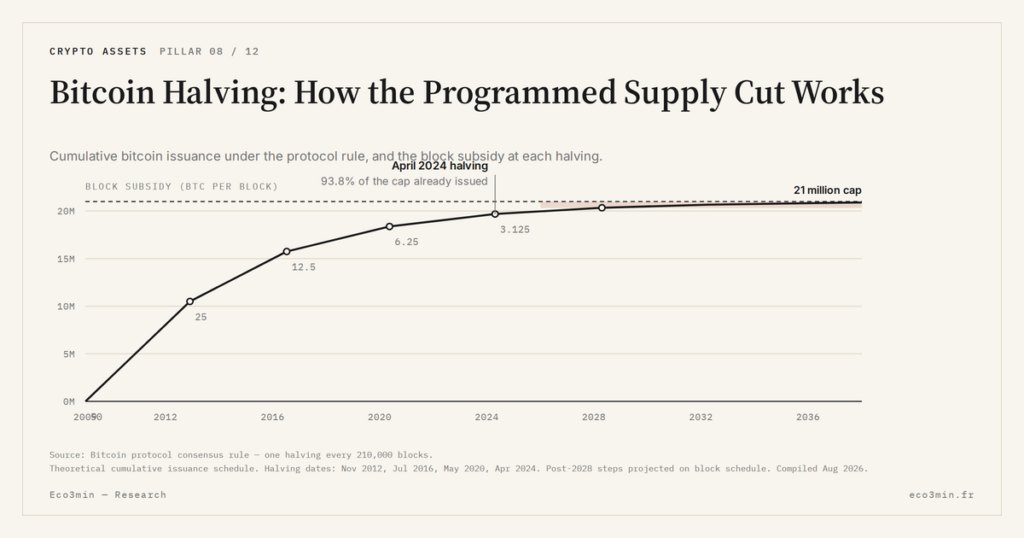
- Since 2012 the block reward has fallen from 50 to 25, 12.5, 6.25 and then 3.125 bitcoin in April 2024, a halving every 210,000 blocks, about four years.
- More than 19 million bitcoin already circulate, above 90 % of the 21 million cap: the halving removes only a marginal slice of the existing stock.
- The supply rule is known and anticipated: scarcity is a programmed fact, the link to price a separate inference.
Roughly every four years, the Bitcoin protocol cuts in half the reward miners receive for each block. This is not a market decision or a discretionary monetary policy; it is a rule written into the code, known in advance, applied without exception since 2012. The halving reduces the flow of newly issued bitcoin, regardless of demand. The popular reading treats it as an almost mechanical driver of price, captured by the shorthand “supply drops, price climbs.” The halving does do something real, and not at all what that narrative assigns to it. Trimming issuance shifts the supply-demand balance at the margin, in a market where most bitcoin already exists. Programmed scarcity is a fact; the causal link to price is an inference far more fragile than the dominant narrative implies. To place the stakes, this mechanism is one of three parts behind the amplitude of crypto cycles, at the heart of this sub-pillar on crypto cycles and volatility.
A supply rule written into the code
The core of the mechanism fits in a single line of protocol. Each validated block rewards the miner who adds it to the chain with a set number of newly created bitcoin. That number is not fixed over time: every 210,000 blocks, about four years at one block every ten minutes, it is cut in half. That is the halving.
Nothing about the timing is left to judgment. The count runs on blocks, not on calendar dates, so the exact day drifts slightly, yet the sequence is locked. Anyone can compute the next reduction down to the block.
The schedule leaves no room for interpretation. The reward fell from 50 bitcoin per block at the start to 25 in November 2012, then 12.5 in July 2016, 6.25 in May 2020, and 3.125 since April 2024. At each step, the flow of money creation is halved. The path is known all the way to its end: issuance will tend toward zero around 2140, when the cap of 21 million units is reached.
This absolute predictability is the defining trait. Where a central bank adjusts the money supply according to conditions, the Bitcoin protocol applies a rule deaf to any outside signal. No authority can speed up issuance when demand surges, or slow it when demand recedes. The constraint is mechanical, transparent, and identical for everyone. Scarcity is programmed; the rally is not.
Two guardrails keep this regularity. The protocol targets one block every ten minutes on average and retargets mining difficulty every 2,016 blocks, about two weeks, to offset computing power joining or leaving. The pace of issuance therefore stays anchored, and the interval between halvings hovers around four years without ever being fixed to the day.
This rigidity has a virtue and a cost. The virtue: it makes issuance policy credible, since no one can change it under the pressure of the moment. The cost: it denies the network any instrument of adjustment. Where a sovereign currency cushions a shock by flexing supply, bitcoin takes the shock with no such lever to pull.
What the halving changes, at the margin
What remains is to measure the real effect of the cut. And here one figure reframes the entire debate: the stock. More than 19 million bitcoin are already in circulation, above 90 % of the total cap. The halving acts only on the marginal flow of creation, a shrinking fraction of a nearly complete stock. Halving a tap that barely fills the tub anymore does little to the water level.
Orders of magnitude finish deflating the immediate effect. Since April 2024, about 450 bitcoin are created each day, against close to 900 before that date. Set against the daily volumes traded on spot and derivatives markets, that new flow stays tiny. The cut acts on a tap whose output was already small relative to the mass in circulation.
The so-called stock-to-flow narrative draws the opposite conclusion from that fact: the smaller the new flow against the stock, the more scarcity should command a premium. The formula has the elegance of simple models. It also has their fragility: it treats scarcity as a sufficient cause of price, leaving demand out of the equation. Yet it is demand, not the pace of issuance, that made the cycles diverge.
On the day of the halving, the mining economy reorganizes. The least profitable machines switch off, total computing power recedes while difficulty retargets, then a new equilibrium settles in. This adjustment cycle, purely operational, is the least spectacular but most concrete face of the event.
The most tangible effect of the halving plays out elsewhere, on the miners. Their revenue per block drops sharply on the day itself, which squeezes the least efficient operators and gradually concentrates activity. This pressure on network security, distinct from any question of price, is a direct and measurable consequence of the rule, whereas the relevance of the halving cycle belongs to a different register of analysis.
This shift raises a long-term question, often sidestepped. As the block reward shrinks, miner pay will depend more and more on transaction fees alone. Network security, today funded mostly by new issuance, will need another source. That is a structural effect of the schedule, independent of any price level.
None of this makes the schedule irrelevant. It makes it legible: the arithmetic of each cut can be read off years ahead, which is precisely why the event carries no element of surprise when it finally arrives.
What the halving does not decide
Then comes the most common logical leap: from programmed scarcity to a rising price. The reasoning appeals because it is simple, and misleads for the same reason. A supply rule known to everyone and anticipated for years is, by construction, already built into expectations. A dated, public, certain event surprises no one on the day it occurs.
Each halving, moreover, landed in a different macro environment: rates, global liquidity and institutional support are nothing alike between 2012 and 2024. Isolating the specific effect of the issuance cut, amid that tangle of variables, is an attribution problem the mechanics alone cannot settle.
Whether prices actually follow an identifiable “halving cycle” is a wholly different exercise: a statistical test on a very small number of observations. That robustness, or its absence, is examined separately, in the fragility of apparent cycles. Here, the point stays with the mechanics: what the rule does, not what is attributed to it.
This does not mean the event has no effect. A halving concentrates attention, feeds narratives, at times draws in fresh flows: channels that all run through demand, not through the supply constraint itself. The distinction looks fine, it is decisive. What moves then is buyer appetite, not the number of bitcoin created.
Three distinct questions often hide under one word. The supply mechanics, described here. The robustness of a price pattern keyed to the halving, a matter of statistics. A supply inflection tied to holder behavior, something else again. Conflating them breeds the illusion of a direct link where independent layers merely stack.
The market, besides, did not wait for the cut to account for it. Miners plan their investments months ahead, holders know the date, analysts have discussed it since the previous halving. An event this well telegraphed gets absorbed gradually, not all at once on the day.
The split is clean. Bitcoin’s scarcity is a protocol fact, verifiable, dated, immutable. Its price path depends on a demand that no schedule fixes and no issuance cut commands. To conflate the two is to mistake a supply constraint for a promise of return.
- The halving is a deterministic supply rule: block reward cut in half every 210,000 blocks, up to the 21 million cap.
- Its market effect is marginal: it touches only the new flow, already small against a stock issued past 90 %.
- Its most measurable direct consequence concerns miner revenue, not price.
- The link between programmed scarcity and price is an inference, distinct from the supply mechanics themselves.
Understood this way, the halving sheds its aura of a price trigger and gains something more useful: a fixed reference point in an otherwise moving landscape. It tells you exactly how supply evolves over time. It says nothing about what buyers will pay for it.
The halving is worth understanding for what it is: an issuance clock, precise and public. It paces the creation of bitcoin without steering its value. The scarcity it carves into the code is real; what the market makes of it stays in the hands of demand, the one variable the rule does not touch. That, in the end, is the whole distinction and the whole point.
Last updated — 3 August 2026
Disclaimer – Financial Information: The analyses, commentary, and content published on eco3min.fr are provided for informational and educational purposes only. They do not constitute investment advice or a solicitation to buy or sell financial instruments. Past performance is not indicative of future results. All investment decisions involve risk and are the sole responsibility of the reader.
Read next
Full pillar →Crypto Seasonality: Why the Signal Is Weaker Than It Looks
Crypto’s cyclical regularities, monthly seasonality or the four-year cycle, rest on a very small number of observations. That…
Bitcoin Cycle: A Quiet Inflection the Market Is Still Ignoring
A quiet on-chain indicator points to a different Bitcoin market regime, with material implications for allocation framing and…
Bitcoin ETFs: The Quiet Shift Reshaping the Crypto Market
Bitcoin ETFs: how the rapid arrival of listed vehicles is reshaping liquidity, flows and risk management for investors.…