Why Frequent Strategy Changes Become Costly
Frequent investment-strategy changes generate hidden costs that go beyond isolated errors. Each modification disrupts the continuity of decisions and prevents cumulative mechanisms from delivering their effects, with consequences felt mainly through a loss of legibility rather than immediate underperformance.

Frequently changing investment strategy does not produce only isolated mistakes. Each modification of the decision-making framework introduces invisible frictions that disrupt the continuity of decisions and prevent cumulative mechanisms from delivering their full effects.
TL;DR
Each strategy revision shortens the effective window in which a framework's logic can express itself; the dominant cost is a loss of legibility in results that compounds with every rewrite. More on this: the full account of reading the economic cycle for portfolio positioning.
- Annualised volatility on major equity markets ran near 18-25% between 2022 and 2024, versus roughly 10-12% across 2013-2019; in such conditions, frequent adjustments raise the odds of exiting a framework just as its logic starts to pay off.
- Because results then aggregate several successive frameworks, a weak phase cannot be cleanly traced to context, timing or design, and that very uncertainty drives still more changes in a self-reinforcing loop.
- A durable regime shift, a new regulatory constraint or a deep change of objectives can make a framework genuinely obsolete, and in those cases the absence of adjustment becomes the cost instead.
A strategy operates as an intertemporal framework linking investment horizon, arbitrage rules and risk tolerance. When this framework is modified too often, results become harder to interpret and long-term dynamics — diversification across time, discipline in the face of volatility, gradual accumulation of gains — are interrupted before they can materialise.
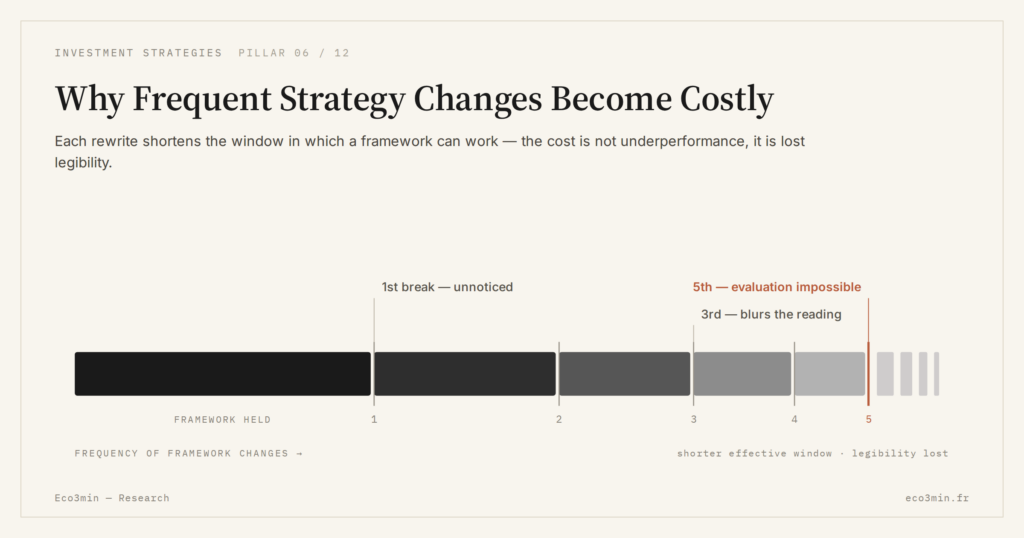
Changing strategy means modifying the rules that organise decisions over time. Each break introduces frictions that are rarely visible immediately. These costs do not take the form of an isolated error, but of a loss of continuity that weakens a strategy’s capacity to let cumulative mechanisms operate.
A strategy operates as a framework of intertemporal coherence. It defines implicit rules: horizon, arbitrage criteria, tolerance for deviations, decision rhythm. When this framework is modified frequently, each new version redefines the reading of past results. Earlier decisions cease to be comparable with one another, blurring the assessment of what stems from normal risk versus a design flaw.
This mechanism acts slowly. The first breaks may seem innocuous, since they often rest on plausible signals. But as changes accumulate, the strategy loses its logical continuity. Cumulative effects — diversification across time, smoothing of cycles, discipline in the face of volatility — are interrupted before they have produced their effects. These cumulative effects sit at the core of our study on investment discipline and performance over a complete cycle.
Why the consensus underplays this cost
Part of the operational consensus considers that strategic agility helps reduce risk. Dominant projections assume that regularly adjusting the framework improves alignment with the macroeconomic context. This reading values reactivity and assumes that the cost of change is negligible compared with the risk of remaining exposed to a shifting environment.
The analysis diverges on one central point: the principal cost is not macroeconomic but structural. Each change shortens the effective duration during which a strategy is applied. On financial markets, however, many effects only become readable beyond several cycles. Between 2022 and 2024, annualised volatility on major equity markets remained around ≈18–25%, against ≈10–12% over the 2013–2019 period. In such an environment, frequent adjustments raise the probability of exiting a framework precisely when its logic is beginning to express itself.
A loss of legibility more than an immediate loss
The principal cost of repeated change is not always immediate underperformance. It manifests as a loss of legibility. Observed results become difficult to interpret, since they aggregate several successive frameworks. A negative phase can be attributed to context, to poor timing or to the strategy itself, with no possibility of disentangling them.
This blurring fuels a self-reinforcing cycle: uncertainty about the cause of results drives further changes, which further reduce the capacity to draw reliable lessons. The framework presented in the analysis of strategy ahead of performance recalls that performance is a delayed consequence of a stable framework, not a short-term steering tool.
Why this dynamic becomes more visible today
Since 2023, the persistence of elevated policy rates has fragmented performance trajectories. With the cost of capital remaining higher than levels observed before 2020, several asset classes have alternated between rapid rebounds and corrections over a few months, without lasting trends. In 2025, these short sequences reinforced the illusion that frequent framework changes would allow one to “track” the market.
In this context, the risk lies less in occasional mistakes than in multiplying strategic rewrites. Each adjustment shortens the effective horizon and reduces the capacity to benefit from temporal dynamics, particularly when markets remain volatile but non-directional.
What many actually seek to understand
The real question is not whether a recent change was justified, but whether the succession of these changes still forms a coherent trajectory. Behind the desire to adapt often hides a simpler concern: that of remaining exposed to an uncomfortable framework for too long. When this tension is not made explicit, the strategy gradually transforms without any structuring decision.
Counter-reading and possible limits
This analysis does not imply that a strategy must remain unchanged regardless of conditions. A lasting change in macroeconomic regime, a new regulatory constraint or a deep modification of objectives can render a framework obsolete. In such cases, the absence of adjustment itself becomes costly. The challenge is to distinguish a structured revision from a succession of opportunistic reactions.
Observable economic implications
For markets, frequent strategy changes contribute to more erratic flows and an amplification of short-term rotations. For firms, they translate into financial orientations revised before their effects become measurable, which complicates capital allocation. For households, this instability reinforces the sense of confusion in the face of results and reduces the capacity to interpret past decisions.
Within the architecture of investment strategies, continuity is not a luxury: it conditions the legibility and effectiveness of decisions over time.
- Each strategy change shortens the effective duration over which a framework can produce its effects.
- The principal cost is a loss of legibility of results, more than immediate underperformance.
- Distinguishing structured adaptation from a succession of reactions is essential to interpreting observed trajectories.
Last updated — 12 July 2026
Disclaimer – Financial Information: The analyses, commentary, and content published on eco3min.fr are provided for informational and educational purposes only. They do not constitute investment advice or a solicitation to buy or sell financial instruments. Past performance is not indicative of future results. All investment decisions involve risk and are the sole responsibility of the reader.
Read next
Full pillar →Beneficiary Designations, the Step-Up in Basis, and the 10-Year Rule: How US Accounts Transfer at Death
At death, most US financial accounts pass outside the will, straight to a named beneficiary, under tax rules…
The Fee Stack in Variable Annuities: M&E Charges, Riders, and Subaccount Costs
A variable annuity does not carry one fee, but a stack of them. Mortality and expense charges, subaccount…
The Conventional 401(k)-Match-First Funding Order: Where It Comes From, How It Works
The question of what order to fund accounts in usually draws a fixed list, presented as a rule…