Investment Strategy vs Performance: Why Results Mislead Decisions
Strategy is an ex ante framework of rules; performance is what those rules produce once uncertainty has resolved. The most common — and most expensive — error in portfolio reviews is judging the framework by its latest result rather than by the consistency of its decisions across regimes.

An investment strategy is a set of rules for taking decisions under uncertainty. Performance is what those rules produce once uncertainty has resolved. Conflating the two is the most common error in portfolio reviews — and the most expensive over a full cycle.
TL;DR
A strategy is the rule framework fixed before uncertainty resolves; performance is its after-the-fact result, and conflating them is the costliest error over a full cycle. This mechanism is detailed in the cost of behavioural drift over time.
- Morningstar's Mind the Gap 2024 puts the cost at 1.1 percentage points a year over the decade to end-2023: US fund investors earned 6.3% annually where the funds they held returned 7.3%, and the gap widens with turnover, from 0.4 point on allocation funds to 2.6 points on sector equity funds.
- Real rates kept moving through the period: the US 10-year real yield (FRED, series DFII10) averaged 1.91% in January 2026 and stood at 2.68% on 18 September 2026, against 0.31% on average over 2012–2019, which keeps headline performance a noisy read on any framework.
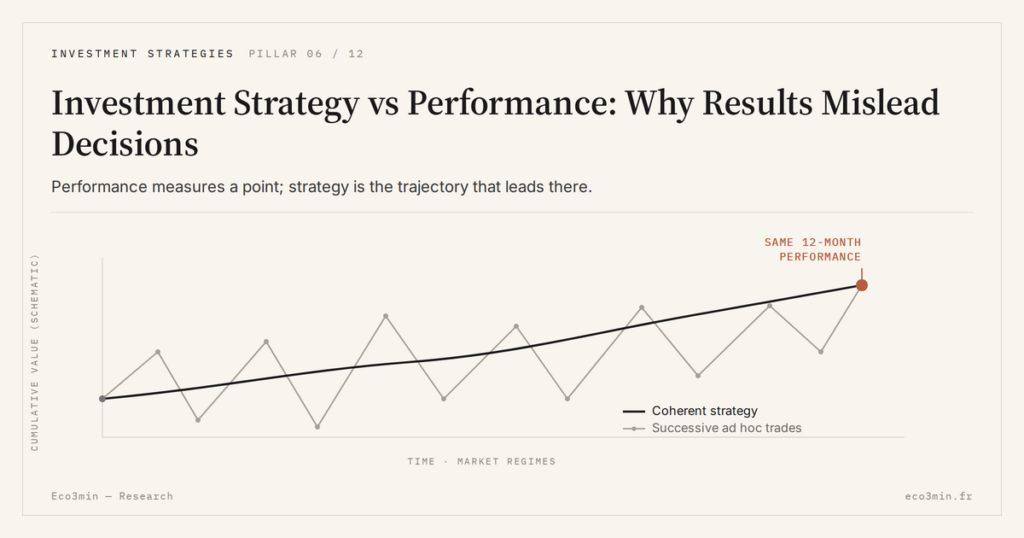
- Two portfolios can post identical twelve-month returns on opposite logics, one coherent with its horizon and the other a residue of ad hoc trades, so a framework is judged on the consistency of its decisions rather than the latest return.
Visible results attract attention, but they say little about the logic that produced them. What shapes an investment trajectory is first a framework that organises decisions before their effects become observable. A strategy fixes that framework and enables a sequence of consistent choices despite uncertainty and market variability. When the framework is missing, individual decisions stop adding up. The most common mistake is judging an approach by its isolated performance instead of by the robustness of its decision architecture. That distinction between observed outcomes and process consistency is what clarifies the actual role of strategy.
- Performance is an ex post outcome; strategy is an ex ante framework.
- A strategy connects decisions over time through explicit rules.
- Without a prior framework, observed results become misleading signals.
In early 2026, the issue is more acute than usual. Markets still operate under positive real rates, both major central banks moved policy rates back up in September 2026, and headline performance can mask very different risk paths. That gap between point-in-time interpretation and long-term consistency makes the strategic question more pressing than it appears.
Performance measures a point, strategy defines a trajectory
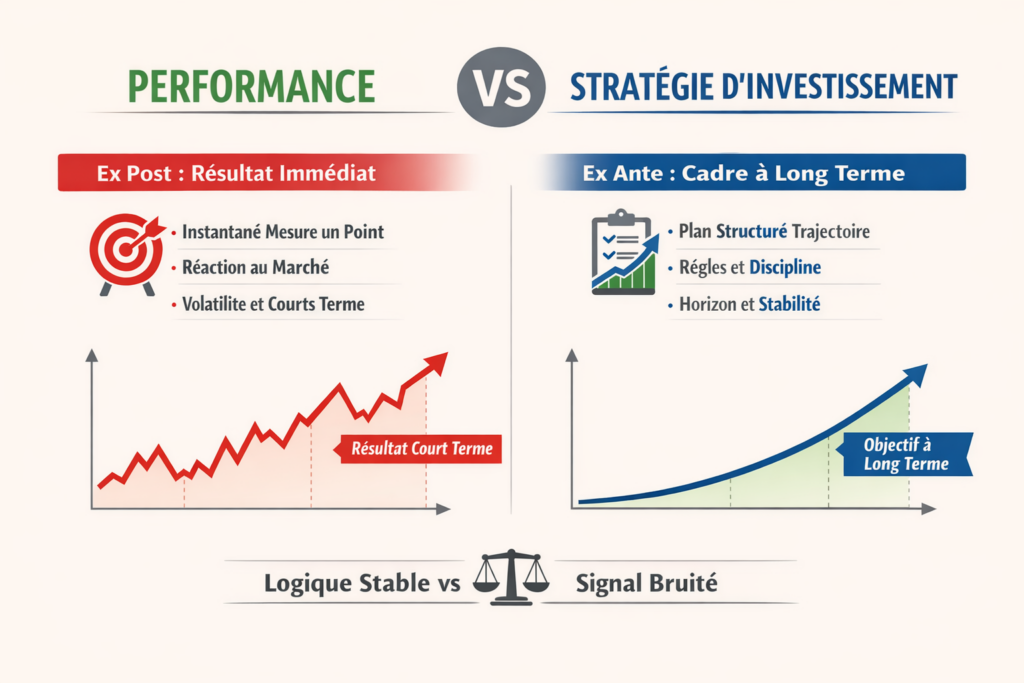
Observable performance is a snapshot. It captures a result at one point in time, under specific market conditions. A strategy is a sequence of rules that connects those points over time. It defines, in advance, what can change, what must remain stable, and under what conditions an adjustment becomes legitimate.
An often underestimated fact: two trajectories can post identical twelve-month performance while resting on fundamentally different logics. One may be consistent with a long-term horizon and an accepted level of volatility; the other may be the residue of successive ad hoc trades without a guiding thread. The visible result then masks the fragility of the process. Over a full cycle, that fragility surfaces.
This is why performance cannot be the starting point. Used as an initial compass, it leads to rewriting the rules constantly based on a noisy signal — which is the operational definition of process drift.
Strategy does not just organise decisions; it organises their sequence over time.
The confusion is often reinforced by a slippage between decision layers. What belongs to strategy — stable rules and time horizon — is frequently mixed with tactical adjustments or timing reactions. That confusion is what makes apparently rational decisions produce an incoherent trajectory, as illustrated by the distinction between strategy, tactics, and timing.
The implicit consensus: judging strategy by recent performance
Most operational practice rests on an implicit equation: a strategy is validated or invalidated by its recent performance. The dominant heuristic, rarely stated, is that a framework which “is not working” over a given window should be replaced.
That heuristic treats strategic validity and recent performance as interchangeable. A strategy can in fact remain coherent through a phase of underperformance precisely because it is exposed to an unfavourable regime. The gap between coherence and recent return is precisely what is examined in our piece on strategic coherence versus observed performance, two notions that the routine review process tends to conflate.
The mechanism diverges from the consensus on one specific point: short-term performance aggregates exogenous factors — rate regimes, flow imbalances, macro shocks — that strategy is not designed to optimise continuously. Confusing strategic validation with cyclical success amounts to ignoring transmission lags and regime effects.
The data make this concrete. The US 10-year real yield (FRED, series DFII10) averaged 1.91% in January 2026 and reached 2.68% on 18 September 2026, against 0.31% on average over 2012–2019, and both the Federal Reserve and the ECB raised policy rates again in September 2026. The implicit assumption that a “good” framework must outperform in every environment becomes hard to defend in that context.
Why the absence of strategy leads to incoherent decisions
Without an explicit strategy, every decision becomes dependent on the latest reading. Reasoning fragments: what was acceptable yesterday becomes unacceptable today, not because the framework changed but because the observed outcome did. That is the operational signature of a process driven by results rather than by rules. More on this: positioning a portfolio across cycle regimes.
The inconsistency has a measurable cost. Morningstar's Mind the Gap, 2024 edition, measures it: over the ten years to 31 December 2023, US fund investors earned 6.3% a year where the funds they held returned 7.3%, a 1.1-point annual gap attributable to mistimed purchases and sales, or roughly 15% of the return those funds produced. The gap tracks turnover, from 0.4 point on allocation funds to 2.6 points on sector equity funds. The order of magnitude is structural across decades, not an artefact of one cycle.
The real question is not whether a recent decision performed “well” or “poorly”. It is whether the decision was consistent with the framework defined before the uncertainty showed up. That is what an investment strategy aims to capture, beyond immediate outcomes.
Facts, assumptions, and interpretations: clarifying the levels
Fact. As of early 2026, policy rates in the major developed economies remain well above their 2010–2019 averages, and monetary policy remains restrictive on the Federal Reserve and ECB measures of real rates. Observed twelve-month performance is therefore strongly conditioned by this regime.
Assumption. A strategy is built to navigate several regimes, not to optimise one. It accepts variability as part of the process rather than as a failure of the framework.
Interpretation. If the current dispersion persists, the temptation to rewrite rules in light of recent results increases mechanically, to the detriment of overall coherence.
This interpretative bias is reinforced by indicators that look reassuring — moderate aggregate volatility, positive headline performance — while process fragility builds underneath. A structured reading of these signals, of the kind developed in our framework on reassuring economic indicators that carry hidden risks, helps separate apparent stability from real robustness.
Time horizon acts as a decisive filter. The same decision can be coherent or not depending on the horizon considered, regardless of its immediate outcome. That is why the investment horizon fundamentally changes the meaning of decisions, turning a temporary deviation into either noise or a true signal.
What the reader actually wants to know
The discomfort usually comes less from results than from uncertainty about the validity of the framework being used.
Behind that question sits a simple concern: is it risky to rely on a framework that does not pay off immediately? The analytical answer is that the main risk is not temporary underperformance but the absence of rules when the environment changes. Underperformance is observable and bounded; rule absence is invisible and unbounded.
Variables that could invalidate this reading
This analysis would be challenged if a structural shift durably reduced uncertainty — for example, a prolonged macro stability scenario with low return dispersion across asset classes — or if exogenous constraints (regulatory, tax-related) forced adjustments independent of the strategic framework. Conversely, a fresh shock in rates or flows would widen the gap between short-term performance and process consistency even further.
Even when structured, a strategy remains bounded by implicit assumptions about regimes, volatility, and liquidity. When those parameters shift persistently, the framework stops being fully effective without being immediately invalidated. That grey zone is precisely what is described in the analysis of the structural limits of any investment strategy.
Treating temporary underperformance as a strategic error. This reading is misleading because it ignores market regimes and adjustment lags. Strategy is assessed on the consistency of decisions, not on the latest twelve-month return.
Useful indicators to assess coherence
- Decision turnover rate: a fast increase signals adaptation to results rather than adherence to the framework.
- Gap between stated rules and actual decisions: the larger that gap, the more fragile the strategy.
- Exposure to macro regimes: whether decisions remain aligned despite changing conditions.
An investment strategy precedes performance because it organises decisions under uncertainty, while observed outcomes primarily reflect the market regime.
Framework before numbers
This is not the base case in routine portfolio reviews, but the temptation to judge a strategy by its latest results remains strong. The point is not to deny the importance of performance — it is to place performance in its proper role: an ex post indicator, never a foundational principle. As long as macro regimes remain unstable, the consistency of the framework deserves more attention than isolated figures.
Within the broader ecosystem of asset allocation strategies and resilient portfolios across market regimes, this distinction shapes how future decisions are interpreted — whether the object is markets, companies, or wealth trajectories.
Last updated — 22 September 2026
Disclaimer – Financial Information: The analyses, commentary, and content published on eco3min.fr are provided for informational and educational purposes only. They do not constitute investment advice or a solicitation to buy or sell financial instruments. Past performance is not indicative of future results. All investment decisions involve risk and are the sole responsibility of the reader.
Read next
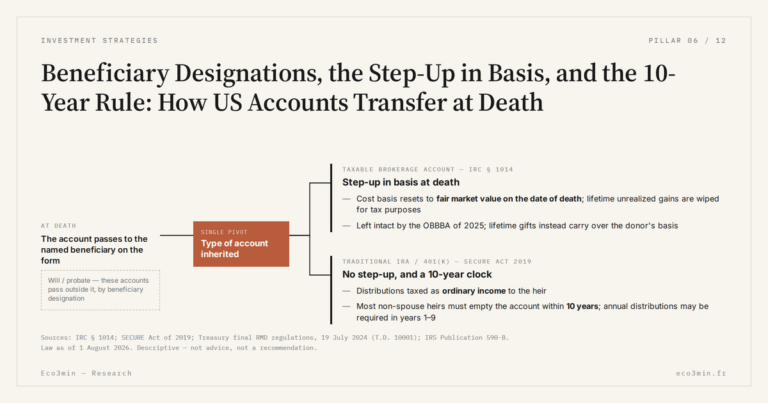
Full pillar →Beneficiary Designations, the Step-Up in Basis, and the 10-Year Rule: How US Accounts Transfer at Death
At death, most US financial accounts pass outside the will, straight to a named beneficiary, under tax rules…
The Fee Stack in Variable Annuities: M&E Charges, Riders, and Subaccount Costs
A variable annuity does not carry one fee, but a stack of them. Mortality and expense charges, subaccount…
The Conventional 401(k)-Match-First Funding Order: Where It Comes From, How It Works
The question of what order to fund accounts in usually draws a fixed list, presented as a rule…