FX Market: What Low Volatility No Longer Tells You
FX market: why low volatility may mask a deep regime shift for the euro, the dollar and the yuan, and how to read it.

FX market: why low volatility may mask a deep regime shift for the euro, the dollar and the yuan.
TL;DR
One-month EUR/USD and USD/JPY volatility sat roughly 30% below its mid-2023 peaks in Q4 2025, yet FX flows have grown more financial than commercial, reshaping currency risk.
- Inflows into selected dollar and local-currency emerging-market funds topped roughly $20bn between September and November 2025, creating mechanical FX round-trips independent of short-term fundamentals.
- Euro-zone exporters extended dollar-flow hedge duration from 6 to 12 months, lowering immediate EUR/USD sensitivity while concentrating more risk at maturity.
- An unhedged sleeve of US or emerging equities can swing annual portfolio performance by roughly 5 to 8 percentage points, as the 2022–2024 dispersion showed.
- China has held the yuan in a tight band against the dollar since summer 2025 while growth slowed to 4.8% year-on-year in Q3 2025, signalling priority on short-term FX stability over abrupt adjustment.
Since autumn 2025, the FX market looks dormant: euro-dollar broadly oscillates between 1.15 and 1.18 (Federal Reserve), implied volatility indicators are back close to their 2017–2019 averages, and many investors are refocusing on equities and thematic ETFs. Yet beneath the surface, FX micro-structure is changing fast. For anyone managing a global portfolio or corporate treasury, ignoring these signals is like driving without a seatbelt. To deepen the underlying logic
To interpret these quiet but structuring moves, it is essential to place the FX market within the broader frame of monetary markets and the interactions between currencies, rate policies and international flows. The pillar page dedicated to currencies and the forex market details these mechanisms and provides the keys to read regime shifts that often unfold without any visible rise in volatility.
FX market: why low volatility may mask a deep regime shift for the euro, the dollar and the yuan.
Since autumn 2025, the FX market looks dormant: euro-dollar broadly oscillates between 1.15 and 1.18 (Federal Reserve), implied volatility indicators are back close to their 2017–2019 averages, and many investors are refocusing on equities and thematic ETFs. Yet beneath the surface, FX micro-structure is changing fast. For anyone managing a global portfolio or corporate treasury, ignoring these signals is like driving without a seatbelt. To deepen the broader allocation logic, the framework described in the 60-30-10 strategy remains a useful starting point.
In short: the combination of still-positive real rates, slowed fiscal deleveraging and rising capital controls in Asia is quietly redrawing the FX market. It is not spectacular, but it is structuring.
What the market is really watching: many actors focus on policy rate levels and central bank meetings. Yet the real shift plays out in how flows are structured (hedged vs unhedged, hedge duration, tolerance for currency risk). These hidden frictions sit within a broader reflection detailed in our reading of the moment when rates become truly dangerous for markets. It is this gap between visible prices and hidden architecture that creates both opportunities and traps.

Key trends to monitor
- Implied FX volatility in a trough: on EUR/USD and USD/JPY, 1-month vol came back roughly 30% below the mid-2023 peaks in Q4 2025 → strong incentive for unhedged carry strategies.
- Real rates still positive in the United States: with core CPI inflation at 3.0% in September 2025 (BLS; the October index was not published) and slightly positive real fed funds, the FX market remains biased toward funding in low-yield currencies → quiet support for the dollar without an extreme “strong dollar” scenario already covered in a previous article.
- Yuan more managed than ever: since summer 2025, CNY has stayed in a tight band against the dollar, while Chinese growth slowed to 4.8% year-on-year in Q3 2025 (NBS) → signal that authorities prioritise short-term FX stability over more abrupt adjustments.
- Rising corporate hedging in the euro zone: numerous exporting groups have extended hedge duration from 6 to 12 months on their dollar flows → less immediate sensitivity to euro-dollar, but more risk concentrated at maturity.
- Carry trade reallocated: after the high-profile yen carry trade unwind, part of the flows have rotated into more discreet pairs (EUR/PLN, USD/MXN) → risk of localised shocks under global stress.
Decoding the signal: what the news really says
Part of the consensus considers that the FX market has entered a phase of “quiet normalisation”: inflation decelerating across major zones, less aggressive central banks, yield curves re-flattening. The implicit assumption: FX as a secondary variable, a simple adjustment lever. This reading misses one central point: the divergence of fiscal and demographic trajectories.
On the macro side, real growth projections for 2026–2027 hover around 1–1.5% for the euro zone, roughly 1.5–2% for the United States, and 4–4.5% for China. But public financing needs do not move at the same pace: the United States is struggling to stabilise a deficit above 5% of GDP in 2025, Europe remains more disciplined around 3%, and China combines targeted support with real-estate deleveraging. This suggests the “price” of currency risk is increasingly integrating latent sovereign risk.
At the micro level, value chains are fragmenting: more contracts billed in dollars in energy, the euro rising in intra-EU digital services, and broader yuan use in selected commodity contracts. Notable point: these invoicing choices create structural FX positions for corporates, sometimes mismatched with their currency debt. The trade-off between hedging cost and capital cost then becomes as important as the exchange rate itself. Broader readings on the macro-geopolitics nexus shed light on this shift.
An often-overlooked detail: the rise of bond and money-market ETFs in foreign currencies. Inflows into selected dollar funds or local-currency emerging-market funds exceeded roughly 20 billion dollars cumulatively between September and November 2025, creating mechanical round-trips in FX, independent of short-term fundamentals. Put differently, market structure has become more “financial” and less commercial than it was a decade ago.
Concrete impact: what changes now
For diversified retail investors, the FX market is no longer background noise. It is a performance parameter. An unhedged sleeve of US or emerging equities can explain plus or minus 5 to 8 percentage points of annual portfolio performance, as the 2022–2024 dispersion has shown. Portfolio simulation tools help quantify this impact.
- Allocation profile: euro-zone investors have historically held a majority share of assets in their domestic currency, with secondary dollar exposure (equities or bonds) and a smaller diversified currency sleeve. Such a structure has been documented as a starting point, to be calibrated according to currency risk tolerance.
- Partial hedging rather than all-or-nothing: hedging a portion of dollar exposure over a 6–12 month horizon has historically limited risk without erasing diversification benefits. The issue is less “forecasting” euro-dollar than smoothing its impact.
- For corporates: setting threshold-based hedging policies (for instance, raising export hedge ratios when EUR/USD moves above 1.12 or reducing them below 1.06) has historically introduced simple discipline, rather than discretionary calls.
- Avoiding the easy-carry trap: seeking yield by buying high-rate currencies funded in low-rate ones can look attractive when volatility is low. But a 10% depreciation erases several years of carry. The barbell logic (a very safe sleeve, a more risky and assumed sleeve) transposes well to FX.
Weak signals to monitor
- Real rate differentials: track the gap between short-term rates and expected inflation in the United States, the euro zone and China. If the US gap narrows markedly below the euro-zone gap, upward pressure on the dollar may ease.
- Yuan’s share in international payments: a gradual rise above 5–7% over several years would indicate genuine diversification away from the dollar, with possible effects on daily FX flows.
- Stress on peripheral currencies: a rapid widening of spreads on dollar-linked emerging currencies (Mexico, Indonesia, etc.) would signal an abrupt turn in currency risk appetite.
- Implied vs realised volatility: a durable gap where implied vol stays well below realised vol suggests FX options are underpriced, hence protection is cheap.
- Flows into dollar money-market funds: a massive outflow over a few weeks would reduce mechanical demand for greenbacks, potentially reshaping the short-term FX landscape.
Likely medium-term scenarios
Central scenario (high probability): an FX market in a “range,” with euro-dollar broadly between 1.03 and 1.15 over the next 6–12 months, moderate volatility, but short stress episodes tied to US fiscal policy or trade tensions. This scenario rests on central banks cutting rates gradually without a credibility shock.
Moderate-rupture scenario: in case of a sharper US growth slowdown during 2026, rate expectations could swing toward faster cuts, reducing the dollar’s relative appeal. Under this hypothesis, a more durable euro rebound cannot be ruled out, especially if the euro zone avoids a new debt crisis. The market does not yet appear to fully integrate this possibility.
Heightened-tension scenario: a major political shock (budget gridlock, sanctions, local banking crisis) could trigger a rushed search for safety in the dollar or in liquid assets, reigniting volatility. Past volatility episodes are a reminder that currency regimes can shift fast, even after months of apparent calm.
Update (September 2026). The range did not hold on the upside: euro-dollar touched 1.198 on 27 January 2026, then 1.135 on 24 June and 1.16 on 11 September (Federal Reserve). The yuan’s “tight band” gave way in the other direction, from 7.21 per dollar in summer 2025 to 6.71 on 11 September 2026, a 7% appreciation. And central banks are no longer cutting: the Fed raised its range to 3.75%–4.00% on 17 September 2026, the ECB its deposit rate to 2.50% on the 16th. The regime described here, financial flows in charge and calm on the surface, survived; its numerical bounds did not.
What could invalidate these trajectories? A monetary policy suddenly more restrictive than expected – for example, if inflation re-accelerates persistently above 3% in a major zone – would force rate hikes and reverse part of the current flows. A regulatory shock on selected FX derivatives could also reshape how investors hedge.
Conclusion
The FX market does not shout, it whispers. The low volatility of late 2025 is not synonymous with absence of risk, but with a quiet regime change: more weight on financial flows, more political constraints, sharper fiscal differentiation. For investors, the issue is not guessing the next euro-dollar print, but deciding how much currency risk to accept, how to smooth it over time, and which indicators to monitor to adjust the path.
For corporates, structuring an FX policy with clear thresholds and horizons is becoming a competitive advantage. For retail investors, simply integrating currency risk in portfolio construction – just as inflation is integrated through real-return simulators – often suffices to avoid costly mistakes. Several trajectories remain possible, but the risk of fully ignoring the FX market is itself very real. We will revisit tomorrow with a possibly different market.
Three takeaways
- Low FX volatility ≠ absence of risk: it is often during apparent calm that currency regimes are redefined.
- The FX market easily weighs plus or minus 5–8 percentage points per year on an unhedged global portfolio: ignoring it means accepting hidden leverage.
- The point is not to forecast euro-dollar, but to calibrate FX exposure with simple, measurable rules.
Last updated — 20 September 2026
Disclaimer – Financial Information: The analyses, commentary, and content published on eco3min.fr are provided for informational and educational purposes only. They do not constitute investment advice or a solicitation to buy or sell financial instruments. Past performance is not indicative of future results. All investment decisions involve risk and are the sole responsibility of the reader.
Read next
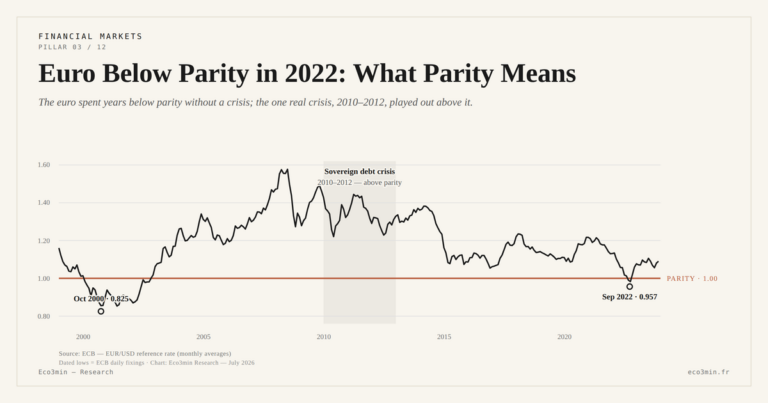
Full pillar →Euro Below Parity in 2022: What Parity Means
In September 2022, the euro fell below parity with the dollar, to around 0.95, a low not seen…
Eurozone Fragmentation: Sovereign Spreads and the Euro
The euro is issued by a monetary union without a complete fiscal union: twenty-one sovereign debts coexist under…
The Euro’s Energy Import Bill: the Gas Shock and the Currency
In 2022, the surge in gas prices turned the euro area's historic current-account surplus into a deficit and…