The Euro’s Energy Import Bill: the Gas Shock and the Currency

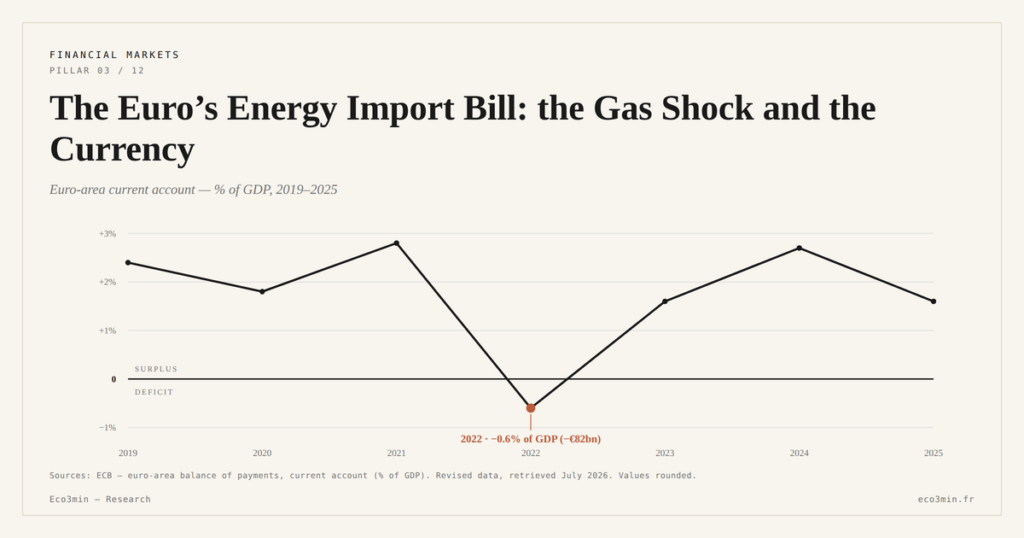
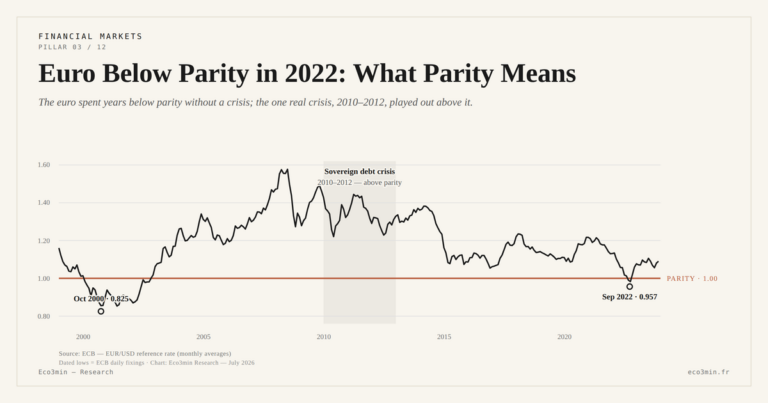
In 2022, the surge in gas prices turned the euro area’s historic current-account surplus into a deficit and amplified the euro’s fall below parity. The energy import bill is a euro-specific currency force, because it degrades the area’s terms of trade.
This satellite isolates that channel: the mechanics of the terms of trade, the special role of gas, the dual effect on the trade balance and inflation, and the milder intensity of the 2026 shock within parallel policies.
1. The euro area as net importer: the mechanics of the terms of trade
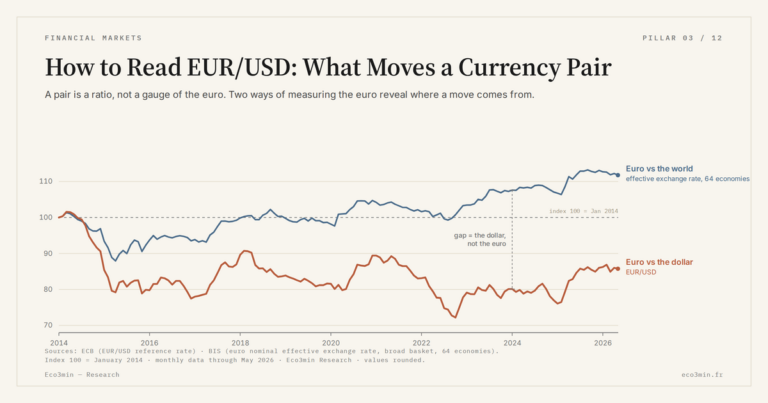
The euro area is structurally a net energy importer. A substantial share of the gas and oil it consumes is bought abroad and priced in dollars. When the price of that imported energy rises, the area must spend more foreign currency for the same physical volume: its terms of trade, the ratio between the price of its exports and that of its imports, deteriorate. This deterioration is the heart of the mechanism linking energy to the currency, and it sits within the general decomposition presented in the decomposition of EUR/USD, where the energy bill ranks among the second-order forces.
The effect is twofold and simultaneous. On one side, the higher energy bill widens the trade deficit in value terms: the area exports as much but pays more for its inputs, which worsens its balance of payments and raises selling pressure on the euro. On the other, dearer energy spreads into domestic prices and feeds inflation, placing the central bank before a trade-off. These two channels reinforce one another, and it is their conjunction that makes energy a distinct currency factor rather than just another macroeconomic parameter. A complementary angle: the EUR/JPY threshold reshuffling the carry trade.
One clarification is needed at the outset: this force is symmetric, unlike sovereign fragmentation. A fall in energy prices improves the terms of trade, reduces the foreign-currency bill, and supports the euro, just as a rise penalises it. Energy is therefore not a one-way risk tail; it is a bidirectional factor whose sign depends on the direction of prices. The intensity of the channel depends on the degree of import dependence, which sets the euro area apart from more energy-autonomous regions. An economy that produces much of its own energy sees a price shock enrich it as much as impoverish it, with an ambiguous net effect on its currency; a net importer bears the higher bill without offset. This structural asymmetry explains why energy weighs more on the euro than on currencies backed by exporting economies. The place of this factor among the forces that move a currency is mapped in the sub-pillar devoted to the drivers of exchange rates.
2. 2022, the gas shock: from surplus to deficit
The 2022 episode is the clearest illustration of this channel. The invasion of Ukraine and the rupture of Russian supplies sent the European gas price to extremes, amid rationing and forced rebuilding of stocks. The euro area, which had run a historic current-account surplus, saw it erode and then flip into deficit as the energy bill swelled. This reversal of the external balance, of exceptional magnitude, removed from the euro an underlying support it had held for years.
This shock did not occur in isolation. It was overlaid on a maximal monetary divergence, with the Fed then holding an advantage of more than 300 basis points and tightening aggressively. Both forces, the rate divergence and the energy shock, pushed the euro down in the same direction, and their conjunction drove the pair to 0.9536 in September 2022, its lowest since 2002. The episode shows that the energy bill does not act alone: it amplifies or dampens the move imprinted by the first-order driver, without replacing it. Beyond trade flows, the 2022 shock also acted through confidence. The prospect of an energy recession, industrial rationing, and durably high inflation degraded the area’s growth expectations, which weighed on European assets and, with them, on demand for euros. This expectations dimension amplifies the mechanical trade-balance effect: an energy shock not only widens the present deficit, it worsens the expected path, and it is often this second component that imprints the sharpest currency moves.
3. The specificity of gas: a market not globally integrated
The whole weight of the European energy channel rests on a peculiarity of gas: its market is not globally integrated like oil. Oil is easily transported and trades on a global market where regional prices stay tethered to one another. Gas, long dependent on pipelines, trades on regional markets whose prices can diverge sharply. The European benchmark, the TTF, and the US benchmark, Henry Hub, thus saw considerable gaps, with Europe paying several times the US price at the height of the crisis.
This price fracture is analysed in detail in the Europe-US gas price gap. It bears directly on the exchange rate and competitiveness: a European manufacturer whose energy costs several times that of its US competitor loses competitiveness, which weighs on exports and, by extension, on the currency. The development of liquefied natural gas has since partly reconnected the markets, without erasing the structural premium Europe pays. The full mechanism of the gas shock and its competitiveness effects is treated in the European gas shock.
4. The dual channel: trade balance and imported inflation
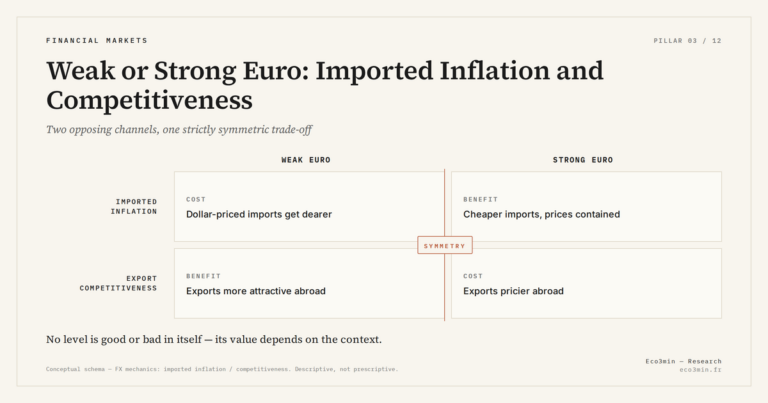
The first channel, the trade balance, acts through flows: a wider energy deficit raises demand for dollars to settle imports and reduces the surplus that supported the euro. The second channel, imported inflation, acts through prices: dearer energy passes into production costs, transport, and, step by step, the whole consumer-price basket. In May 2026, euro-area inflation thus climbed to 3.2%, its highest since 2023, with core inflation also rising to 2.5%, a sign that the pressure extends beyond the energy component alone.
The rise in core inflation is the telling detail. When an energy shock stays confined to its direct component, it tends to be transitory and a central bank can look through it. When it spills into core prices, through wages, transport, and the input costs of non-energy goods, it signals second-round effects that risk de-anchoring expectations. It was precisely this broadening that hardened the ECB’s stance in 2026, turning what might have been a tolerable supply shock into a reason to tighten, and tightening the link between the energy bill and the policy path that ultimately bears on the currency.
It is through this second channel that the loop closes with monetary policy. Inflation fed by energy forces the central bank to arbitrate between supporting activity, already weakened by the shock, and containing prices. The pass-through of the exchange rate to imported inflation and competitiveness, treated without prescription, is the subject of the analysis on a weak euro and imported inflation. This closure explains why the exchange rate and energy are not separate subjects for a central bank, but two faces of the same constraint.
5. 2026: a milder shock within parallel policies
The energy ingredient reappeared in 2026, but at lower intensity and within a different monetary configuration. The Middle East conflict and disruptions around the Strait of Hormuz lifted prices: WTI crude rose from around 57 dollars early in the year to a 113-dollar peak in April, before easing back to about 76 dollars. Inflation accelerated, justifying the ECB’s June hike. But the effect on the exchange rate stayed contained, because the first-order driver was not diverging.
The contrast with 2022 is instructive. In 2022, the energy shock amplified an already violent monetary divergence, and both forces converged to collapse the euro. In 2026, the same type of shock sits within parallel policies, where it weighs on imported inflation and the terms of trade without triggering a wide directional move. The energy bill therefore played its part, but its currency effect stayed muted, for want of a monetary driver to amplify it. It confirms that energy does not set the path on its own: the overall configuration decides the amplitude.
- The energy bill acts on the euro by degrading the terms of trade: the area, a net importer, pays more foreign currency for the same volume of energy.
- The channel is dual: a value trade deficit and imported inflation, which closes on monetary policy.
- The specificity lies in gas, whose market is not globally integrated: the TTF-Henry Hub fracture weighed on European competitiveness.
- Unlike fragmentation, energy is a symmetric force: a fall in prices supports the euro as much as a rise penalises it.
- In 2022, the shock amplified a monetary divergence; in 2026, the same type of shock, within parallel policies, stayed muted on the exchange rate.
Conclusion
The energy bill is one of the euro-area-specific forces that pull EUR/USD away from its monetary driver. It acts through the terms of trade, simultaneously on the trade balance and on imported inflation, and its specificity rests on the regional nature of the gas market. But 2022 and 2026 are a reminder that it does not operate in a vacuum: its effect on the exchange rate depends on the state of the differential, which it amplifies in periods of divergence and which masks it in periods of parallelism. Reading energy as a currency factor means following the terms of trade while keeping in mind that they decide the amplitude only in interaction with the first-order driver.
Last updated — 12 July 2026
Disclaimer – Financial Information: The analyses, commentary, and content published on eco3min.fr are provided for informational and educational purposes only. They do not constitute investment advice or a solicitation to buy or sell financial instruments. Past performance is not indicative of future results. All investment decisions involve risk and are the sole responsibility of the reader.
Read next
Full pillar →Euro Below Parity in 2022: What Parity Means
In September 2022, the euro fell below parity with the dollar, to around 0.95, a low not seen…
Eurozone Fragmentation: Sovereign Spreads and the Euro
The euro is issued by a monetary union without a complete fiscal union: nineteen sovereign debts coexist under…
The ECB-Fed Rate Differential: the Driver of EUR/USD
The rate differential between the ECB and the Fed is the first-order driver of EUR/USD. But it is…