How to Read EUR/USD: What Moves a Currency Pair

EUR/USD is the price of one euro expressed in dollars: when it reads 1.14, one euro trades for 1.14 dollars. It is a currency pair, meaning a ratio between two currencies, and it is this relative nature that governs how to read it.
This satellite lays the basics: how to read a quote, why a pair is always relative, what moves it in simple terms, and what posture to adopt toward it. No recommendation, only a reading grid for understanding the moves.
1. Reading an exchange-rate quote
A currency pair relates two currencies. In EUR/USD, the euro is the base currency and the dollar the quote currency. The figure shown tells you how many dollars one euro is worth: 1.14 means one euro trades for 1.14 dollars. When this figure rises, say from 1.12 to 1.16, the euro appreciates against the dollar: it takes more dollars to buy one euro. When it falls, the euro depreciates against the dollar. It is as simple as that, provided you keep in mind that you are always talking about a ratio between two currencies, never a currency in isolation.
This quoting convention is universal on the foreign exchange market, the largest financial market in the world, where trillions of dollars change hands every day. Understanding a quote already gives you the essentials: a number that rises or falls, and the direction the euro takes relative to the dollar as it moves. The rest is about understanding why that number shifts.
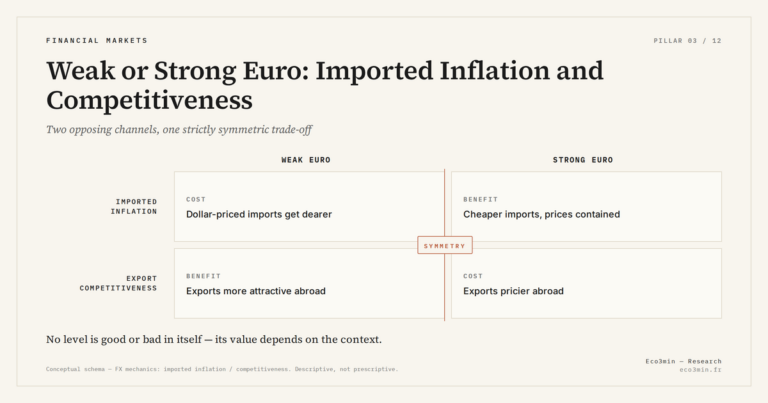
A concrete example helps fix the idea. Suppose EUR/USD moves from 1.10 to 1.14 over a few weeks. For a European traveller converting one euro, the gain is direct: they now get 1.14 dollars instead of 1.10, a little more purchasing power in dollars. For a European exporter selling in dollars, the effect is the opposite: revenues converted back into euros fall, because each dollar earned is worth fewer euros than before. The same move, read from different vantage points, produces a benefit or a drawback. This is why a currency move is never good or bad in itself: it depends on the position you hold.
2. The relativity principle
The most important point, and the most often overlooked, is that a currency pair is always relative. EUR/USD does not measure the value of the euro in absolute terms: it measures the euro relative to the dollar. This distinction changes everything. If EUR/USD rises, two explanations are possible: either the euro is strengthening, or the dollar is weakening, or both to varying degrees. The figure alone cannot settle it. A euro rising against the dollar may well be a euro that is stable against a dollar falling for American reasons.
This relativity explains why it is misleading to read EUR/USD as a barometer of the euro area’s health. The pair depends as much on what happens across the Atlantic as on what happens in Europe. To understand a move, you therefore have to ask each time which of the two sides moved, and why. It is this dual reading that separates rigorous analysis from a hasty interpretation.
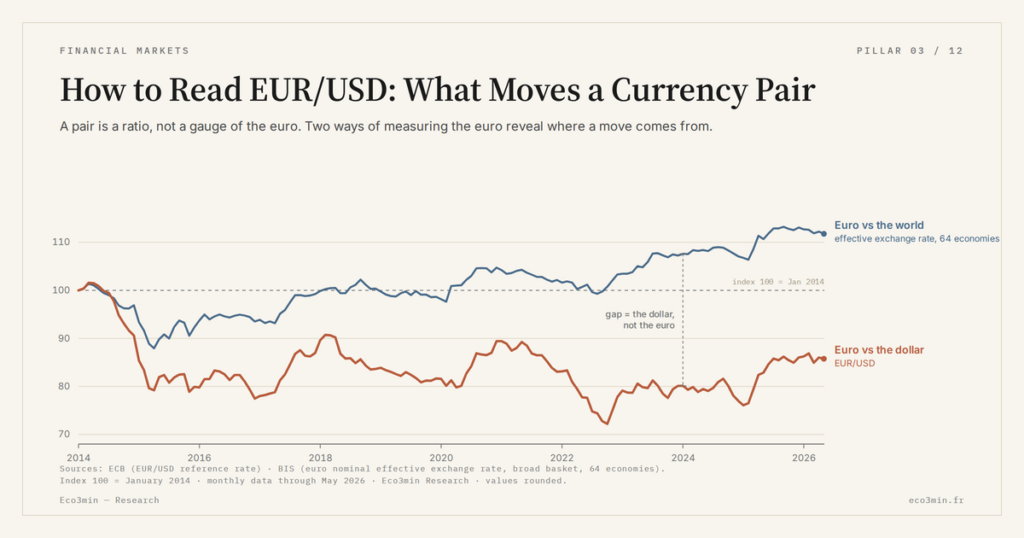
How do you tell, in practice, which side moved? The method is to look at a third reference. If the euro rises against the dollar, the yen, and the pound at once, it is probably the euro strengthening. If the dollar falls simultaneously against the euro, the yen, and the pound, it is the dollar weakening, for American reasons. Comparing a pair with other pairs, or with an index that measures the dollar against a basket of currencies, locates the origin of the move. This triangulation is one of the most useful reflexes for not wrongly attributing to one area what comes from the other. The chart in this article gives the measure: with January 2014 set at 100, the euro against the dollar stands at 86 in May 2026 (ECB), but at 112 against a basket of 64 economies (BIS nominal effective exchange rate). Over twelve years the euro fell against the dollar and rose against the rest of the world: the gap between the two lines is the dollar.
A rising EUR/USD is taken to mean automatically that the euro is strong or that the euro area is doing well. This is inaccurate: a pair is a ratio. EUR/USD can rise because the dollar weakens for reasons specific to the United States, with no improvement on the European side. Reading the pair as a grade assigned to the euro alone, without looking at the dollar, leads to regular misreadings.
3. What moves the pair, simply
Several forces move EUR/USD, and the full framework is set out in the full analysis of EUR/USD drivers. In simple terms, they can be grouped into a few families. The first, and most important, is the interest-rate gap between the two areas. When a central bank pays better on its currency, or is expected to, that currency tends to attract capital and appreciate. This is the role of the interest-rate differential between the European Central Bank and the Federal Reserve, which is the first-order driver of the pair.
Other forces then come into play, more specific to each area. The relative health of the two economies, for instance, shapes expectations. Shocks specific to one region also matter: the euro area, a net energy importer, is sensitive to the price of gas, as shown by the effect of the energy bill. A country’s trade balance, the net of its exchanges with the rest of the world, also influences demand for its currency. For a beginner, remembering these broad families is enough: rates, relative economic health, specific shocks. The detail comes later.
4. Readable, but not predictable
An essential distinction separates two ambitions often confused: understanding and forecasting. EUR/USD is readable: after the fact, you can almost always explain why it moved, by identifying the dominant force of the moment. It is not predictable: no one can reliably say where it will be in three months, because its path depends on future events and on how the market will anticipate them, two unknowns that combine.
This nuance defines the right posture for a beginner. The reasonable goal is not to guess the direction, but to understand the mechanisms: knowing which force dominates at a given moment, why the pair reacted to a particular announcement, what a move reveals about monetary conditions on both sides. Decomposing rather than predicting is not only more honest but more useful: it builds a durable understanding, where forecasting is largely a wager.
Two traps frequently await the beginner. The first is confusing noise with trend: a currency pair moves constantly, and most of these daily micro-variations mean nothing. What matters are the large and lasting moves, carried by identifiable forces, not the swings of a few fractions of a percent. The second trap is to seek a single cause for every move, when several forces often act at once, sometimes in opposite directions. Accepting this complexity, rather than reducing it to a simplistic explanation, is part of a mature reading of exchange rates.
5. Where to start
To go further, the natural path starts from the overall framework, which ranks all the forces and explains how they fit together. Reading the main driver, the rate differential, comes next, since it explains most of the large directional moves. The euro’s own forces, such as energy or sovereign fragmentation, complete the picture for anyone wanting to understand episodes specific to the area. All these determinants are mapped in the sub-pillar devoted to the basics of the foreign exchange market. Seeing the long record also helps, available through the EUR/USD price history.
Understanding EUR/USD requires no complicated model, but a method: read the quote, keep its relative nature in mind, identify the dominant force, and resist the temptation to turn that reading into a prediction. It is an accessible grid, one that turns a seemingly opaque number into a comprehensible story, that of two currencies measuring themselves against each other as economic conditions shift.
One last point worth taking on board early: the foreign exchange market runs on expectations. A pair often moves before an event occurs, because investors buy or sell based on what they expect, not only on what is already known. A central bank that signals it will raise rates can lift its currency immediately, well before the actual hike. Understanding that the exchange rate reflects the anticipated future as much as the observed present spares you the surprise of seeing a pair react to a mere statement, sometimes more strongly than to an actual decision. It also explains why news that confirms what was already expected can leave the pair almost unmoved.
Conclusion
EUR/USD is the price of one euro in dollars, and above all a ratio between two currencies. Reading it correctly means accepting its relativity, recognising the broad forces that move it, and distinguishing understanding from forecasting. None of these steps requires technical expertise or a trading screen: they call mostly for rigour and patience in reading. Once this grid is in hand, the pair’s moves stop looking like random noise and become the readable reflection of monetary and economic conditions that anyone can learn to decode, one announcement and one shift in expectations at a time.
Last updated — 22 September 2026
Disclaimer – Financial Information: The analyses, commentary, and content published on eco3min.fr are provided for informational and educational purposes only. They do not constitute investment advice or a solicitation to buy or sell financial instruments. Past performance is not indicative of future results. All investment decisions involve risk and are the sole responsibility of the reader.
Read next
Full pillar →Eurozone Fragmentation: Sovereign Spreads and the Euro
The euro is issued by a monetary union without a complete fiscal union: twenty-one sovereign debts coexist under…
The Euro’s Energy Import Bill: the Gas Shock and the Currency
In 2022, the surge in gas prices turned the euro area's historic current-account surplus into a deficit and…
The ECB-Fed Rate Differential: the Driver of EUR/USD
The rate differential between the ECB and the Fed is the first-order driver of EUR/USD. But it is…