Euro Below Parity in 2022: What Parity Means

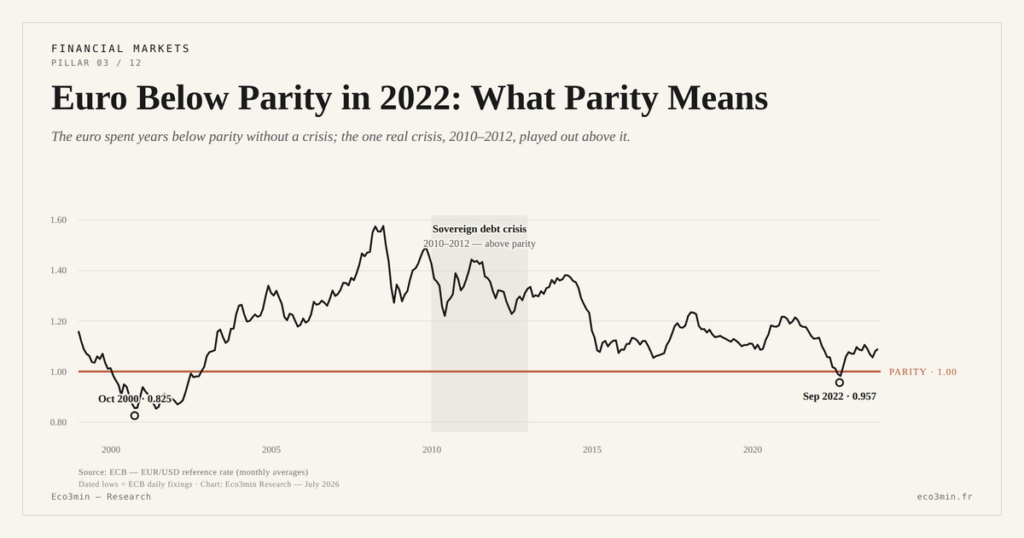
In September 2022, the euro fell below parity with the dollar, to around 0.95, a low not seen since 2002. The event was widely reported as the sign of a crisis. That reading confuses a round number with an economic fact: crossing 1.00 changes nothing in the fundamentals.
This satellite clarifies what parity means, and what it does not. It decomposes the 2022 episode with the cluster’s framework, shows why equating parity with crisis is a misreading, and separates the psychology of the round number from its real effects.
1. What parity is, and what it is not
Parity is the level at which one euro is worth exactly one dollar, an exchange rate of 1.00. It is a round number, and that is all it is. No economic mechanism triggers at that threshold: an importer paying invoices in dollars faces the same change in cost whether the euro moves from 1.05 to 1.02 or from 1.01 to 0.98. The exchange rate acts continuously on prices, margins, and competitiveness, with no particular threshold effect at the crossing of 1.00. Parity is neither a technical floor, nor an equilibrium point, nor an intrinsic alarm signal. It is a numerical coincidence between two units of account.
This clarification is the starting point for any sound reading of the episode. The grid that lays out the framework for reading EUR/USD reveals no magic level: it ranks forces, the rate differential, the energy bill, fragmentation, that push the pair up or down continuously. The figure 1.00 has a special status only in observers’ minds, not in the mechanics of the exchange rate.
2. Decomposing the 2022 episode
The year 2022 offers a textbook case for applying this grid. The euro’s fall toward 0.95 was not the product of a single factor, but the convergence of forces all pushing the same way, which explains its scale. At first order, the Federal Reserve raised rates aggressively and built a lead of several hundred basis points over a more cautious European Central Bank. This directional divergence, analysed in the satellite on the rate differential driver, was the main engine of the decline.
Onto this monetary engine came a euro-specific force: the gas shock following the war in Ukraine sharply degraded European terms of trade, as analysed in the satellite on the euro-area energy bill. Europe, a net energy importer, saw its bill explode at the very moment the United States, a producer, was relatively shielded. The third leg was the strength of the dollar itself, whose trade-weighted index reached multi-year highs, tracked through trade-weighted dollar strength. Three converging forces, not a threshold crossed: that is what describes 2022.
The contrast with a period in which these forces do not align illuminates the mechanics. When forces all push the same way, as in 2022, the move is large and fast. When they offset each other, the move dies out, and the pair drifts within a narrow range with no marked direction. What 2022 showed was therefore not the danger of a level, but the power of a convergence: it was the sum of monetary divergence, energy shock, and dollar strength that produced the scale of the fall, not the crossing of a number. Decomposing rather than dramatising separates a convergence episode from ordinary market noise.
3. Why “parity equals crisis” is a misreading
The idea that crossing below parity signals a euro crisis rests on a confusion of causality. Parity was crossed during the fall, but it was not the crossing that created the strains: it was the underlying forces, monetary divergence and energy shock, that pulled the pair down, and that would have produced the same move whether the trough sat at 0.95, at 1.02, or at 0.90. The round number played no causal role.
History confirms this. The euro already spent several years below parity, between 2000 and 2002, falling to around 0.82 in late 2000, without any existential crisis of the currency. Conversely, the sovereign debt crisis of 2010 to 2012, the most threatening episode for the area’s cohesion, unfolded while the euro stayed well above parity. The exchange-rate level and the health of the union are not the same thing: a weak currency is not a currency in crisis, and a strong currency is no guarantee of solidity. The case of a central bank watching its currency fall without a visible crisis illustrates this dissociation, as does the yen, which declined sharply in 2022–2024 without a currency crisis.
The wider history reinforces the point. Since its 1999 launch near 1.18, the euro has travelled across a broad range against the dollar, from a low near 0.82 in 2000 to a peak around 1.60 in 2008, swinging through long cycles driven by the same forces the cluster maps. Parity sits roughly in the middle of that historical span, not at any structural boundary. A pair that has spent a quarter-century moving between 0.82 and 1.60 does not treat 1.00 as a wall; it is one crossing among many, salient only because the figure is round. Placing 2022 in that long history dispels the idea that the level itself carried any special meaning.
- Parity is a round number, with no threshold effect on fundamentals: the exchange rate acts continuously.
- The 2022 fall is explained by the convergence of three forces, monetary divergence, energy shock, and dollar strength, not by crossing 1.00.
- The euro already spent years below parity without crisis, and the 2010–2012 crisis occurred above parity.
- Crossing 1.00 changes perception, through the symbol, without altering anything mechanically in trade.
4. The psychology of the round number
If parity has no mechanical effect, it has an attention effect. Round numbers act as focal points for markets and media: they are memorable, easy to comment on, and they concentrate attention. This salience can produce very real second-round effects. Intense media coverage around parity can feed sentiment, reinforce short positioning, and, at the margin, accentuate a move already under way. But this effect is psychological and transient, not structural: it amplifies a trend carried by fundamentals, it does not create it.
This dimension explains the gap between the importance given to parity in public debate and its insignificance in the mechanics of the exchange rate. The round number is a media object before it is an economic one. Confusing it with a fundamental signal leads to over-interpreting a crossing that, taken in isolation, says nothing about the path ahead or the health of the currency. Parity is not even the only round number to draw attention. Other symbolic levels, such as 1.20 or 1.10, prompt the same commentary when approached, with no more mechanical weight; the phenomenon is general, and recognising the bias helps shift attention to the variables that actually set direction.
5. What crossing 1.00 actually changes
For economic actors, crossing parity changes nothing in itself. A European exporter sees competitiveness improve as the euro falls, continuously, with no particular jump at 1.00. An importer faces a continuous rise in dollar-denominated inputs. A household travelling outside the euro area loses purchasing power gradually. In all these cases, it is the scale and duration of the move that matter, never the crossing of a symbolic threshold. The symmetry holds in the other direction: a euro climbing back above parity would likewise trigger no mechanical effect, only a change in perception.
Where the crossing does count is in the sphere of perception and positioning. It can trigger commentary, political reactions, hedging adjustments. These reactions are real, but they bear on the symbol, not the substance. Reading an episode like 2022 correctly means separating these two planes: observing the forces that move the pair, and treating the round number for what it is, a convenient marker and nothing more. The discipline is the same one the cluster applies throughout: decompose the move into its drivers, and let the level be a consequence rather than a cause. The place of this episode among exchange-rate regimes is documented in the sub-pillar devoted to how the currency market works.
Conclusion
Parity is a round number, neither an economic threshold nor a crisis signal. The 2022 episode decomposes entirely with the cluster’s grid: a monetary divergence, an energy shock, and dollar strength, all converging, pulled the pair down, the crossing of 1.00 being only a step along the way. The history of the euro shows that a currency can stay durably below parity without crisis, and weather a crisis above it. What parity means is that one euro is worth one dollar at a given moment. What it does not mean is read in everything else: the trajectory, the forces, the duration. The round number deserves the attention it draws as a media object, provided it is not confused with what actually moves the currency, which lies entirely in the forces the rest of this cluster sets out to read.
Last updated — 6 July 2026
Disclaimer – Financial Information: The analyses, commentary, and content published on eco3min.fr are provided for informational and educational purposes only. They do not constitute investment advice or a solicitation to buy or sell financial instruments. Past performance is not indicative of future results. All investment decisions involve risk and are the sole responsibility of the reader.
Read next
Full pillar →Eurozone Fragmentation: Sovereign Spreads and the Euro
The euro is issued by a monetary union without a complete fiscal union: nineteen sovereign debts coexist under…
The Euro’s Energy Import Bill: the Gas Shock and the Currency
In 2022, the surge in gas prices turned the euro area's historic current-account surplus into a deficit and…
The ECB-Fed Rate Differential: the Driver of EUR/USD
The rate differential between the ECB and the Fed is the first-order driver of EUR/USD. But it is…