Why Regulation Reshapes Crypto Markets Without Erasing Them
Regulation does not eliminate crypto-assets but reshapes their structure, actors and market dynamics. An economic analysis of the durable transformation underway.
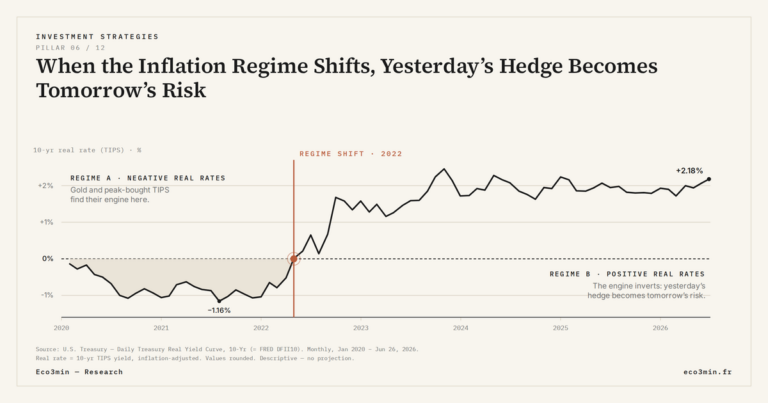
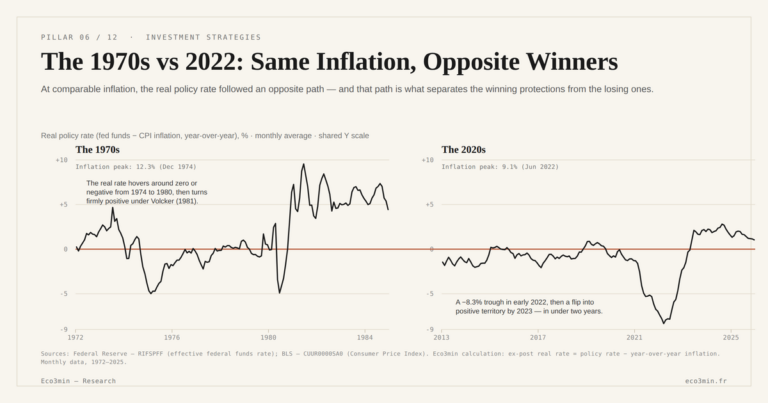
This tag gathers articles analysing the major structural economic configurations: persistent inflation, disinflation, stagflation or deflation. It focuses on transitions between regimes and the ruptures that redefine the investment environment. A macro-financial regime change durably alters the behaviour of assets, central banks and economic agents. It is not a one-off event but a shift in logic.
Regulation does not eliminate crypto-assets but reshapes their structure, actors and market dynamics. An economic analysis of the durable transformation underway.
Inflation does not affect all equities equally. Differentiated effects across sectors and margins explain a growing share of the dispersion observed within equity indices.
Bitcoin’s volatility has compressed from the 2011 extremes toward a durably calmer regime — a gradual maturation that regulation accompanies, without having caused it. Some asset classes stabilize without any triggering crisis marking the turn. Fragility does not vanish at…
The FRED DGS10 series starts in January 1962 at 4.11% and stands in May 2026 around 4.2%. This near-perfect return masks three successive monetary regimes with radically different drivers and amplitudes. Identifying the regime in force is not a historian’s…
Since late 2022, T10YIE has been trading in a narrow 2.2-2.4% corridor. Powell labels this zone well-anchored, yet it sits structurally above the Fed’s 2% target. Three competing readings illuminate this gap without resolving it. This article exposes the three…
Since the beginning of December 2026, volatility has remained elevated across equity and bond markets, after a year marked by periods of calm followed by violent swings. Between shifts in rate expectations, persistent geopolitical tensions, and rapid sector rotations around…