Weak or Strong Euro: Imported Inflation and Competitiveness

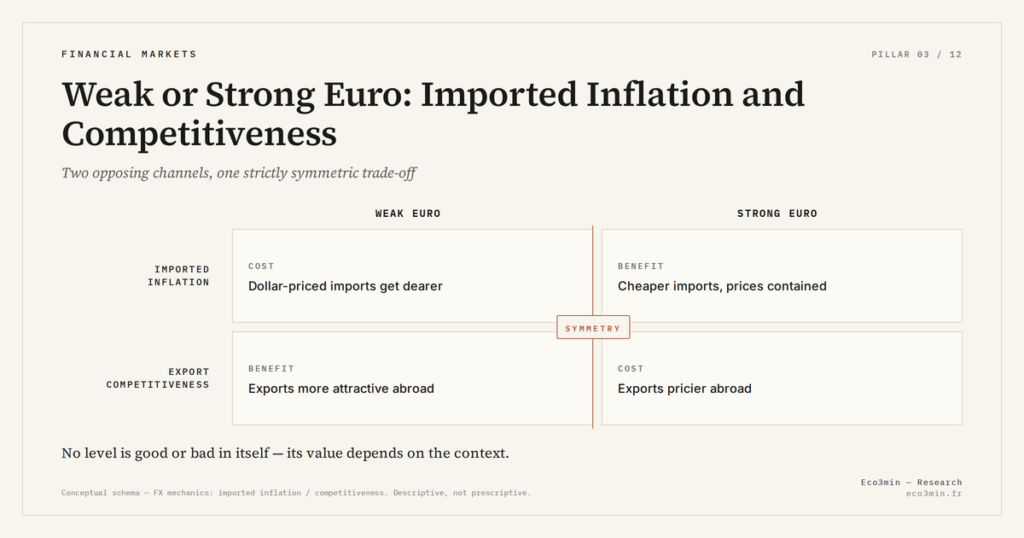
The euro’s level acts on the area’s economy through two opposing channels: it changes the price of imports, hence imported inflation, and it changes the competitiveness of exports. A weak euro and a strong euro each carry a benefit and a cost, never one without the other.
This satellite covers the frontier where the exchange rate meets inflation and competitiveness. It describes the symmetric trade-off between imported inflation and export support, sets out why no level is good or bad in itself, and specifies the transmission mechanics, without offering any normative judgment.
1. Two channels: import prices and competitiveness
The exchange rate links an area’s economy to the rest of the world through prices. When the euro moves, two effects trigger at once, in opposite directions. The first concerns imports: a large share of commodities, starting with energy, is invoiced in dollars. A weaker euro makes these dollar-denominated purchases dearer, and conversely a stronger euro makes them cheaper. The second concerns exports: a weaker euro makes European goods cheaper for a foreign buyer, and a stronger euro makes them dearer. These two channels always work together, which is why any move in the euro creates both winners and losers within the area.
Understanding this dual effect means returning to the framework that explains what determines the EUR/USD level. The level itself results from the monetary and structural forces analysed in the cluster; this satellite looks at what that level produces, once set, on inflation and competitiveness. It is the frontier between the exchange rate and the real economy.
2. The weak euro: imported inflation versus competitiveness
A weak euro exerts upward pressure on prices through the import channel. Since oil, gas, metals, and many intermediate goods are quoted in dollars, their cost in euros rises mechanically when the euro falls, even if their dollar price stays flat. This imported inflation then spreads through the economy, from production costs to consumer prices. The energy channel is the most powerful of these vectors, as analysed in the satellite on the energy channel of imported inflation.
In return, a weak euro supports exporters’ competitiveness. A European product sold in dollars becomes cheaper for the foreign buyer, which can raise export volumes and support activity in internationally oriented sectors. There lies the trade-off: a weak euro imports inflation while improving price competitiveness. The two effects coexist, and their net result depends on the structure of the economy, its degree of openness, and its reliance on imported inputs.
A numerical illustration clarifies the order of magnitude. Suppose a barrel of oil at 80 dollars and a euro moving from 1.10 to 1.00. With the oil price unchanged in dollars, the cost of the barrel in euros rises from about 73 euros to 80 euros, an increase of nearly 10% from the currency move alone. For an economy that imports energy heavily, this mechanism feeds through the entire cost chain. The effect is purely monetary: it is not oil that became dearer, but the euro that weakened, and yet the result on the bill is identical.
3. The strong euro: price stability versus an export drag
A strong euro produces the mirror image, equally two-sided. On the favourable side, it lightens the import bill: energy and commodities quoted in dollars cost less in euros, which contains imported inflation and supports purchasing power. A strong currency thus acts as a buffer against global price shocks, an asset particularly useful in periods of inflationary tension.
On the unfavourable side, a strong euro weighs on competitiveness. European products become dearer for foreign buyers, which can reduce export volumes and slow sectors exposed to international competition. The trade-off is therefore strictly symmetric to that of the weak euro: price stability comes at the cost of a potential export drag, just as export support comes at the cost of imported inflation. This symmetry is central to what the parity level means: no level combines every advantage.
One often-overlooked point is that these effects do not materialise at the same pace. The rise in import costs feeds through to costs fairly quickly, while the competitiveness benefit takes longer to appear: trade contracts are often set in advance, market share is won slowly, and exporters adjust their volumes only gradually. The result is a lag between the immediate cost, felt through imported inflation, and the deferred benefit, perceived through improved exports. This phase difference complicates the reading of a currency move, whose favourable and unfavourable effects do not appear at the same moment.
- The euro’s level acts through two opposing channels: import prices, hence imported inflation, and export competitiveness.
- A weak euro imports inflation while supporting price competitiveness; a strong euro contains imported inflation while weighing on exports.
- The trade-off is symmetric: no level combines every advantage, each configuration carries a cost and a benefit.
- The net result depends on the economic context, the area’s openness, and the intensity of the inflationary or cyclical moment.
4. Why neither is “good” nor “bad”
It is tempting to label a weak euro a problem or a strong euro a success, but this reading is misleading. The desirability of a level depends entirely on context. When inflation is the binding constraint, a strong currency helps contain it, while a weak currency complicates the task by making imports dearer. When growth is the binding constraint, the reasoning reverses: a weak currency can support activity through exports, while a strong currency holds it back. The same exchange-rate level therefore does not carry the same value depending on the economic situation of the moment.
From the European Central Bank’s standpoint, the exchange rate is not a target in itself, but a variable that influences inflation and activity. A weak euro can complicate the control of inflation and enter into the assessment of monetary conditions; a strong euro can weigh on growth and on price dynamics. This reading is descriptive: it describes how the exchange rate enters a central bank’s reasoning, without prejudging any decision or recommending any course. Analytical neutrality requires presenting both sides without taking a stance.
5. Transmission: scale, lag, persistence
The effect of the exchange rate on inflation is neither immediate, complete, nor uniform. The transmission, or pass-through, is partial: only part of the currency move feeds into consumer prices, the rest being absorbed by firms’ margins or offset by other factors. It is also lagged: the effects take several quarters to spread, from import prices to production prices and then retail prices. The precise mechanics of this diffusion are set out in imported-inflation pass-through.
The scale of transmission depends on several factors. The persistence of the move matters: a change seen as durable feeds through more than a passing swing, which firms often absorb without adjusting prices. The energy intensity of the economy also matters: the more an area relies on dollar-priced energy imports, the more a weak euro fuels inflation there. This is why the effect of an identical currency move varies from one period to another and from one economy to another, depending on its structure and the context of global prices. The same euro depreciation can fuel marked inflation amid energy tensions, and stay almost painless in an environment of calm global prices.
6. The frontier between exchange rate, inflation, and competitiveness
This satellite holds a particular position in the cluster: it marks the frontier where the analysis of the exchange rate meets that of inflation and competitiveness, two areas that extend beyond EUR/USD alone. The euro’s level is not just a market figure; it is a variable that runs through the real economy, from firms’ costs to households’ purchasing power. Reading the euro from this angle means connecting the pair’s move to its concrete consequences. All these determinants and their effects are mapped in the sub-pillar devoted to the foreign exchange market in practice.
Placing the exchange rate at this frontier also guards against overstating it. The euro’s level is one input among many into both inflation and competitiveness, not the whole story. Inflation also reflects domestic demand, wages, and global commodity prices in dollars; competitiveness also reflects productivity, unit labour costs, and the quality of products, not only their currency-adjusted price. The exchange-rate channel is significant and sometimes decisive, but it operates alongside these other forces, and isolating its contribution is part of reading it well. Treating the euro’s level as the sole driver of either inflation or competitiveness would replace one oversimplification with another.
Conclusion
The euro’s level acts on the economy through two opposing channels, and each configuration blends a benefit and a cost. A weak euro imports inflation while supporting exports; a strong euro contains inflation while curbing competitiveness. The transmission of these effects is partial, lagged, and variable, which rules out any mechanical reading. Above all, no level is good or bad in absolute terms: its value depends on context, on the binding constraint, and on the structure of the economy. Understanding the euro as a subject means holding both sides together, without reducing a symmetric trade-off to a one-sided judgment.
Last updated — 6 July 2026
Disclaimer – Financial Information: The analyses, commentary, and content published on eco3min.fr are provided for informational and educational purposes only. They do not constitute investment advice or a solicitation to buy or sell financial instruments. Past performance is not indicative of future results. All investment decisions involve risk and are the sole responsibility of the reader.
Read next
Full pillar →Eurozone Fragmentation: Sovereign Spreads and the Euro
The euro is issued by a monetary union without a complete fiscal union: twenty-one sovereign debts coexist under…
The Euro’s Energy Import Bill: the Gas Shock and the Currency
In 2022, the surge in gas prices turned the euro area's historic current-account surplus into a deficit and…
The ECB-Fed Rate Differential: the Driver of EUR/USD
The rate differential between the ECB and the Fed is the first-order driver of EUR/USD. But it is…