
How to Buy Bonds: TreasuryDirect, Funds, ETFs and the Maturity Question
The routes into bonds differ less in what they hold than in their clock: a single bond has a maturity date, a classic fund does not.
- A Treasury bought directly and held to maturity returns par at a known date; a bond fund has no maturity, so its share price stays exposed to rate moves.
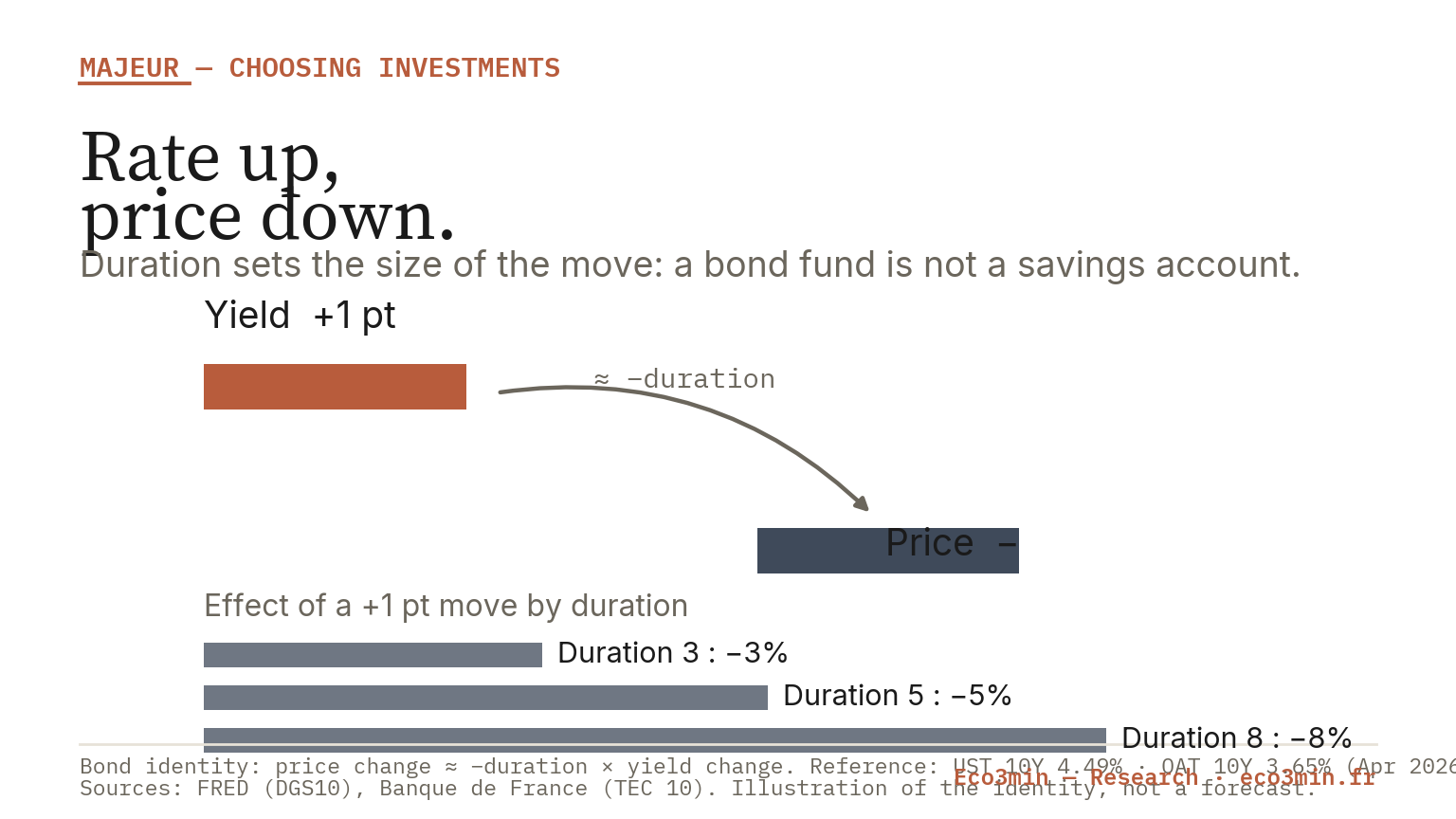
- When rates rise, existing bond prices fall, and the size of the drop is roughly the bond’s duration times the rate change: a 10-year duration loses about 10% on a 1-point rise.
- The US 10-year Treasury yield stood near 4.5% in early July 2026 (FRED, DGS10, July 2 2026), a level that makes the route decision matter again after years of near-zero yields.
There are several doors into the bond market: Treasuries bought straight from the government, brokered Treasuries and CDs, bond funds and ETFs, and savings bonds. The asset behind each is a loan with a coupon. What separates them is the clock.
Most bond coverage argues whether bonds are safe. This page assumes the decision to hold some is made, and maps the access routes and, above all, the one feature that decides how each behaves when rates move: whether it has a maturity date.
The missing link: access
A bond promises a date; a bond fund never matures. That single distinction organises the whole decision. A bond is a loan: you lend, you receive coupons, and at maturity you are repaid the face value, or par, unless the borrower defaults. The routes into that loan are not equivalent, because some preserve the maturity date and some dissolve it. One caution before the doors: this page treats bonds as an investment class, the yield-bearing ballast of a portfolio, not as a place to park cash. Short-dated Treasury bills used purely as a cash substitute are a treasury question rather than a bond-investing one, even though bills appear on both sides. For where bonds sit inside a portfolio, the pillar on bonds within portfolio allocation is the reference; this page stays on how you get in.
TreasuryDirect and brokered Treasuries
The most direct route for a US investor is the government itself. Through TreasuryDirect, you buy Treasury bills (maturities of a year or less), notes (two to ten years) and bonds (twenty to thirty years) at auction, at par, and hold them to a known date. There is no fund fee, no manager, and no price risk if you hold to maturity: the security returns face value on its maturity date, and the interim price swings do not touch that outcome. The trade-off is practicality. Building a diversified position, or a ladder of staggered maturities, means managing individual securities and reinvesting each one as it matures. The alternative is brokered Treasuries and brokered CDs, bought inside an ordinary brokerage account, which add convenience and secondary-market liquidity in exchange for a dealer spread. Either way, the defining feature is the maturity date: you know exactly when you get par back.
Two mechanical details are worth knowing before the first purchase. Auctions accept non-competitive bids, where a retail buyer simply agrees to take the yield the auction sets, so there is no need to name a price; the yield is discovered by the large competitive bidders and applied to everyone. And bills work differently from notes and bonds: a bill pays no coupon but is sold at a discount to face value, with the gain at maturity standing in for interest, while notes and bonds pay a fixed semi-annual coupon. The practical consequence for a buyer is that a direct Treasury locks in a yield to maturity on the day of purchase. Euro-area buyers face the same arithmetic on a different schedule, since the calendar behind French government bond auctions concentrates supply on Mondays and Thursdays. That locked yield is the quiet advantage of the direct route: whatever rates do afterward, the return you signed up for is the return you get, provided you hold to the date and the Treasury pays, which it always has.
Bond funds: the hold-to-maturity debate
A bond fund pools many bonds and never matures. It buys, holds and sells continuously to keep a roughly constant maturity profile, so there is no date on which you are guaranteed par. Its share price, the net asset value, moves with rates every day, and coupons are folded into that value rather than paid out at a fixed endpoint. This is the heart of the US debate between owning individual bonds and owning a fund, and it is settled by mechanics, not by taking a side. Hold a single bond to maturity and a rate rise is a paper loss that reverses by the maturity date. Hold a fund and the same rate rise is a durable mark-down of the share price, because the fund has no maturity to pull it back to par. The offset is real too: after a rate rise, the fund reinvests at the new higher yields, so over a horizon close to its duration the extra income roughly makes up for the price hit. The choice is therefore about your horizon and whether you need a guaranteed date, not about which is safer in the abstract.
The reinvestment offset is worth making concrete, because it is the part the “funds are riskier” camp usually omits. Suppose rates jump one point and a fund’s share price falls by roughly its duration. From that day, every maturing bond in the fund is replaced with a new one paying the higher rate, so the fund’s income stream steps up. The arithmetic that bond mathematicians use is that a fund’s total return recovers to where it would have been over a period roughly equal to its duration: a fund with a five-year duration is made whole, on a total-return basis, in about five years, provided rates then hold. Shorter than that horizon, a rate rise leaves you behind; longer, it leaves you ahead. This is why the individual-bond-versus-fund debate has a mechanical answer rather than a moral one: the direct bond fixes the outcome at a date, the fund converges to a similar outcome over its duration, and the right pick depends on whether you have a fixed liability to meet or an open-ended horizon to invest across.
Ladders: a technique, not a product
A ladder is not a separate instrument but a way of arranging direct bonds. You buy several with staggered maturities, one, two, three years and out, so that a rung matures every year and can be reinvested at whatever rate then prevails. The ladder keeps the maturity-date certainty of direct bonds while smoothing reinvestment risk across time: you are never forced to reinvest everything at a single rate, good or bad. It is the descriptive answer to a common worry, how to own individual bonds without betting the whole position on one entry point, and it sits naturally alongside a brokerage account that holds the rungs.
A ladder also behaves distinctively under a rate shock. When rates rise, the rungs already held keep their locked yields to maturity, so the paper loss on them reverses as each reaches par, while the next rung to mature is reinvested at the new, higher rate, gradually lifting the ladder’s overall yield. When rates fall, the reverse happens: existing rungs gain in price, but each maturing rung is reinvested at a lower rate. The ladder therefore turns a single, all-at-once reinvestment decision into a rolling series of small ones, which is its whole point. It gives up the diversification breadth and hands-off convenience of a fund in exchange for the date certainty of direct bonds spread across time, a middle path between the two families that keeps the maturity clock intact.
Bond ETFs and savings bonds
Bond ETFs are funds that trade like a stock, and they inherit the no-maturity behaviour of the classic fund, with the same rate sensitivity and the same reinvestment offset, plus intraday liquidity and a low expense ratio. One nuance separates the ETF wrapper from an old-style fund: because it trades on an exchange all day, its market price can drift slightly from the value of the bonds it holds, a gap that widens in stressed markets and narrows in calm ones, though for the large, liquid Treasury ETFs it stays small. This page stays on access; the separate question of which bond ETF suits which environment, and how short and long maturities behave differently, is delegated downstream to the reads on which bond ETF by regime and on short versus long bond ETFs, with the comparison of currency-hedged structures in euro funds versus bond ETFs. A different door entirely is the US savings bond, the Series I and EE, bought from the Treasury with rules of their own: the I bond’s rate tracks inflation through a formula, set out in the savings bond rate formula, and both carry purchase limits and holding rules that make them a niche rather than a core route. The EE bond, for its part, is guaranteed to double in value if held twenty years, a fixed-term feature that behaves less like a market bond than like a locked savings account, another reason these sit apart from the core routes.
Price, rates and duration, for a buyer
One mechanic underlies every route, and it is worth stating plainly because it is where “bonds are safe” breaks down. When rates rise, the price of existing bonds falls. The reason is simple: a bond issued last year at a 3% coupon is worth less once new bonds pay 4%, so its price drops until its yield matches the market. The size of that drop is captured by duration, a measure of a bond’s sensitivity to rate moves. As a rule of thumb, price change is approximately minus duration times the rate change, so a bond or fund with a duration of ten years falls about 10% when rates rise one percentage point, and rises about as much when rates fall. Duration, not the label “bond”, is what tells a buyer how much a position will move. The shape of the yield curve adds a second layer, since steepening and flattening change the relationship between short and long rates, developed in yield curve steepening and flattening.
Two refinements keep the rule of thumb honest. The duration approximation is linear, but the real price-yield curve bends, a property called convexity, so the actual price gain on a rate fall is slightly larger than the loss on an equal rate rise; for the size of moves most buyers face, the straight-line estimate is close enough. And duration is not maturity: a 10-year bond with a high coupon has a shorter duration than a 10-year zero-coupon bond, because more of its value arrives earlier. The single figure a buyer should ask for is therefore the position’s duration, since a short-duration fund and a long-duration fund labelled the same way, “bond fund”, can behave completely differently when rates move. A one-point rise costs a two-year duration about 2% and a twenty-year duration about 20%, from the identical headline of holding bonds.
“Bonds are safe” collapses two different things. A Treasury held to maturity carries almost no price risk to the holder, because par is returned on a known date. The same exposure inside a perpetual fund carries durable price risk, because there is no maturity to reverse a rate-driven mark-down. Safety depends on the route and the horizon, not on the asset class.
See it under a rate shock
Because the price-versus-rate relationship is arithmetic, its effect on the two routes can be shown directly. The tool below applies a rate shock to a bond held to maturity and to a bond fund of the same duration, and traces the capital value of each over time. The direct bond’s price dips on the shock and pulls back to par by maturity; the fund’s share price takes a durable mark. It isolates the maturity effect on capital value, so it does not net the fund’s higher reinvested income, and it names no product and picks no winner.
[eco3min_bond_shock_sim lang=”en”]The routes, side by side
The grid reduces the choice to its moving parts. Read it by column: the deciding question is whether a maturity date, liquidity, or hands-off simplicity matters most.
| Route | Entry | Liquidity | What happens if rates move | The trap |
|---|---|---|---|---|
| Direct Treasury (TreasuryDirect) | At auction, at par | Hold to maturity; secondary sale possible | Interim price moves; par returned at maturity | Managing and reinvesting each security yourself |
| Brokered Treasuries / CDs | Brokerage, dealer spread | Secondary market | Same maturity effect; spread on sale | Confusing a brokered CD’s terms with a Treasury’s |
| Bond fund / ETF | Brokerage, expense ratio | Daily (fund) or intraday (ETF) | Durable NAV mark; income offsets over the duration | Expecting a maturity date the fund does not have |
| Savings bonds (I / EE) | TreasuryDirect, purchase limits | Restricted early; penalty window | I bond rate resets with inflation | Treating a capped, rule-bound niche as a core holding |
No route dominates. A direct Treasury or a ladder gives date certainty at the cost of management; a fund gives simplicity and diversification at the cost of a maturity date; savings bonds give an inflation link inside tight limits. The binding constraint, a known date, daily liquidity, or hands-off breadth, is what should decide, and it depends on horizon more than on any yield printed today. The wider placement of bonds against equities and cash is the sub-pillar on choosing bond exposure by regime, read alongside bonds among the investment options.
Bonds read through the macro regime
Access explains how a bond behaves; the regime explains when bonds tend to work. The single most important variable is the direction of rates, because it drives both the coupon you can lock in and the price of what you already hold. Falling rates lift existing bond prices and reward duration; rising rates do the opposite. Bonds have historically found their footing in a disinflationary regime, when slowing inflation lets rates drift down, the environment mapped in the Atlas on bonds in disinflation, and they struggle when inflation forces rates up. Where the current setting sits is shown on the dashboard for the current rate regime.
The regime also decides which route is working with you rather than against you. In a rising-rate regime, the maturity date of a direct bond or a ladder is an asset, because it lets you recover par and reinvest at higher yields rather than sitting in a fund whose price keeps re-marking down. In a falling-rate regime, the fund and the longer-duration position are rewarded, because the price gains compound and reinvestment at ever-lower rates is the thing to avoid. Neither route is right in the abstract; each is suited to a different direction of travel, which is why reading the regime before choosing the door is the discipline this page argues for rather than a forecast it offers.
The real return matters as much as the nominal coupon: a 4% coupon in a 4% inflation year is flat in purchasing power, the distinction developed in a bond’s real return. And because no asset behaves the same across environments, the tool that shows bonds compared across regimes places them against equities and cash rather than in isolation. The level itself carries meaning: a 10-year yield near 4% is a different world from the sub-1% yields of the 2010s, a threshold read in the meaning of the 4 percent yield level.
A bond’s safety is not a property of the asset but of the route and the horizon: a maturity date reverses a rate shock, a perpetual fund does not.
The numbers
Two data points frame the decision today. The US 10-year Treasury yield stood near 4.5% in early July 2026, ending July 2 at about 4.49% with the 2-year near 4.14% (FRED, DGS10). That level, well above the near-zero yields that defined the 2010s, is what makes the route choice consequential again: duration now carries a meaningful coupon, and a rate move now has a meaningful price effect. The long series behind these levels is the downloadable the 10-year Treasury yield dataset. The second point is behavioural: with real yields back, the same maturity-date logic that once looked academic, direct bond versus fund, now changes outcomes by measurable amounts, which is why the route, not the yield headline, is where a bond decision is won or lost. A one-point move on a ten-year position is roughly ten points of price, a swing that was easy to ignore when the coupon was a rounding error and impossible to ignore now that it is not. The level has turned a technical footnote into the central choice, and it has done so symmetrically: the higher coupon rewards the buyer who locks it in, and the higher sensitivity punishes the buyer who misjudges duration.
Frequently asked questions
What are the main routes into bonds for a US investor?
Four main doors: Treasuries bought directly at auction through TreasuryDirect; brokered Treasuries and CDs inside a brokerage account; bond funds and ETFs; and US savings bonds (Series I and EE). The first two preserve a maturity date, so par is returned on a known day; funds and ETFs do not mature; savings bonds are a capped, rule-bound niche. The asset is similar across routes; the clock is what differs.
How do I buy Treasuries through TreasuryDirect versus a broker?
TreasuryDirect lets you buy bills, notes and bonds straight from the government at auction, at par, with no fee, and hold them to maturity. A broker offers the same securities on the secondary market inside an ordinary account, adding convenience and easier resale in exchange for a dealer spread. TreasuryDirect suits a buy-and-hold ladder; a broker suits an investor who wants everything in one account and values secondary-market liquidity.
How does holding a bond to maturity differ from holding a bond fund?
A single bond held to maturity returns par on a known date, so a rate-driven price move is a paper loss that reverses by then. A bond fund never matures, so a rate rise is a durable mark-down of its share price, partly offset over time as the fund reinvests at higher yields. Over a horizon close to the fund’s duration, the price hit and the extra income roughly cancel. Neither is safer in general; they suit different horizons.
What does duration mean for a buyer?
Duration measures how much a bond’s price moves when rates change. As a rule of thumb, price change is about minus duration times the rate change, so a duration of ten years implies roughly a 10% price fall on a one-point rate rise, and a similar gain on a one-point fall. It is the single number that tells a buyer how sensitive a position is, and it applies to both individual bonds and funds.
How have bonds behaved across rate regimes?
Bonds have historically done best when inflation was slowing and rates could drift down, a disinflationary regime that lifts existing prices and rewards duration, and worst when inflation forced rates up. The relationship runs through real yields rather than nominal coupons, so a high coupon in a high-inflation year can still lose purchasing power. The current setting is shown on the live regime dashboard.
This content is published for information only. It is not investment advice and does not recommend any security, fund or allocation. Yield levels reflect data available in early July 2026 and change daily. Sources: FRED (DGS10), July 2 2026; US Department of the Treasury.
Last updated — 21 August 2026
Disclaimer – Financial Information: The analyses, commentary, and content published on eco3min.fr are provided for informational and educational purposes only. They do not constitute investment advice or a solicitation to buy or sell financial instruments. Past performance is not indicative of future results. All investment decisions involve risk and are the sole responsibility of the reader.