
Euro funds or bond ETFs: two ways to take rate exposure

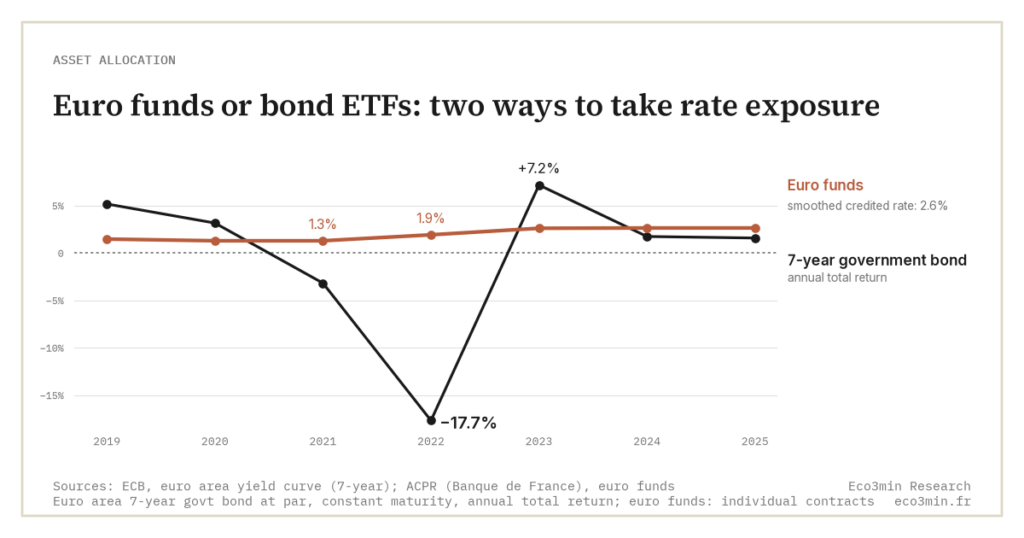
The euro fund and the bond ETF expose to the same raw material — rates — through two opposite channels. One smooths returns over time and reacts with a lag; the other tracks an index continuously and absorbs rises and falls at once.
TL;DR
Over 2020-2023 the same rate move hit a bond ETF as a visible 2022 drawdown, but reached a euro fund only later, its credited rate climbing as the portfolio renewed.
- The euro fund's inertia comes from a precise accounting mechanism: the insurer distributes mainly the coupons received and can draw on a profit-sharing provision, so the credited return reflects a historical portfolio rather than the rate of the day; the average euro-fund return reached 2.6% in 2023 (France Assureurs, 2024).
- The inertia cuts both ways and hides risk: a euro fund captures a rate rise and a rate fall alike on a lag, and its lack of displayed market value masks a rate risk that is deferred and smoothed rather than absent.
Two wrappers, the same rate exposure, two speeds of transmission. This page describes how each behaves across the real-rate regime, without naming a wrapper to prefer.
The French euro fund and the bond ETF offer exposure to the same raw material — rates — through two opposite channels. The criteria are reviewed in our decoding of the bond-buying question. The first smooths returns over time through the insurer’s accounting and reserve mechanism, at the cost of near-zero responsiveness to the rate regime; the second tracks a bond index continuously, absorbing rises and falls at once. After a decade of decline, the average euro-fund return climbed back toward 2.6% in 2023 (France Assureurs, 2024) as insurers rolled their bond portfolios into higher-yielding paper — with a built-in lag. This page describes how each wrapper reacts as real rates rise, plateau or fall. It describes two behaviours; it names no wrapper to prefer, since the trade-off depends on the regime and on each individual’s own situation.
Two channels for the same raw material
The bond ETF and the euro fund give access to the same underlying — a bond portfolio, hence a rate exposure — but along two opposite transmission logics. The ETF tracks a bond index and trades continuously: its net asset value reflects, at every instant, the market value of the securities held. When rates rise, that value falls; when they fall, it rises. Transmission is immediate and visible. The euro fund, the guaranteed-capital account at the heart of French life insurance, works the other way: it displays a guaranteed capital that does not fluctuate with the market, and credits an annual return smoothed by the insurer’s accounting. Related reading: our sub-pillar on investments across rate cycles.
This contrast in mechanics produces sharply different behaviour in the face of the same rate move. In 2022, when real rates climbed, a bond ETF saw its net asset value fall immediately, then offer a higher yield at purchase. On the ECB yield curve, a euro area 7-year government bond held at constant maturity lost 17.7% in 2022, then regained 7.2% in 2023. Over the same period, the return credited by euro funds never turned negative: 1.28% in 2021, 1.91% in 2022, then 2.60% in 2023 and 2.63% in both 2024 and 2025 (ACPR, individual contracts), as insurers renewed their portfolios. The same rate shock was thus experienced on a delay: painful and immediate for the ETF, painless but deferred for the euro fund.
Neither behaviour is intrinsically superior: they describe two ways of transmitting the rate to the holder. The ETF fully exposes the price move, which penalises it when rates rise but lets it rebuild a running yield quickly; the euro fund dampens that move, at the cost of slowness in capturing the new rates. Reading these two wrappers by regime amounts to understanding that their difference is not a question of quality, but of the speed of transmission.
The euro fund’s smoothing mechanism
The euro fund’s inertia is no accident, but the product of a precise accounting mechanism. The insurer does not mark its bond portfolio to instantaneous market value to compute the credited return: it distributes mainly the coupons received, and can draw on a reserve built in good years — the profit-sharing provision — to smooth leaner ones. The credited return therefore reflects a historical portfolio, accumulated across years of differing rates, not the rate of the day.
This smoothing shields the holder from market volatility but deprives them of responsiveness. A euro fund captures a rate rise slowly, at the pace of the renewal of its bond stock: old, low-coupon securities are replaced by better-paying ones only as they mature. That is why, after the 2022 rise, the credited return took time to recover, even as market rates had already climbed sharply.
The symmetry of this inertia is worth underlining, because it cuts both ways. The same mechanism that delays the euro fund’s response to a rise also delays its response to a fall. When market rates recede, the euro fund keeps crediting a return built on its better-paying historical stock, and then appears to hold up better than a repriced ETF — until renewal gradually erodes that advantage. The ETF, for its part, takes a rate rise as an immediate loss, but reflects a subsequent easing as an immediate gain. Neither wrapper is fast or slow in absolute terms: each is fast where the other is slow. Further reading: our analysis of what makes an ETF stand out.
This smoothing has a consequence for the perception of risk. Because the euro fund displays no fluctuating market value, it is often perceived as free of rate risk, when it carries the same bond exposure as an ETF — simply transmitted on a delay and masked by the insurer’s accounting. Rate risk does not disappear in a euro fund: it is deferred and smoothed. Conversely, an ETF’s displayed volatility makes its rate risk immediately visible, which can make it appear riskier than a euro fund exposed, at bottom, to the same raw material.
Each wrapper’s behaviour by real-rate regime
Reading the two wrappers by regime illuminates their opposition. In a regime of rising real rates, the bond ETF takes a fall in net asset value, the larger the longer its duration, then offers a higher yield at purchase. The euro fund, by contrast, crosses this phase almost without visible jolt: its displayed capital does not move, and its credited return recovers only slowly, with the renewal of the portfolio. The rise is thus immediate and apparent for the ETF, deferred and smoothed for the euro fund. Related analysis: our frame for bond ETFs by cycle.
In a plateau regime, when real rates level off, the ETF sees its price moves fade and its running yield become the main driver; the euro fund continues its gradual catch-up toward market rates, its credited return still rising as old securities are replaced. It is the regime where the gap in responsiveness between the two wrappers narrows most, both being carried mainly by running income.
In a regime of easing real rates, symmetry plays: the ETF, especially if long in duration, records an immediate gain in net asset value; the euro fund, through inertia, keeps crediting a return built on an older, better-paying stock, capturing the fall on a delay. Here again, the same rate move produces effects staggered in time depending on the wrapper, the ETF reflecting the easing at once, the euro fund later.
The 2020-2023 cycle drew this divergence in lived experience. In 2022, an ETF holder saw a visible drawdown on screen, while a euro-fund holder saw a stable balance and a credited rate that rose only from 1.28% to 1.91%. By 2023, the ETF holder could buy a markedly higher running yield, while the euro-fund rate had only begun its climb toward the renewed portfolio. The same underlying rate move produced two very different experiences of it — one front-loaded and visible, the other deferred and muted.
- The euro fund and the bond ETF expose to the same raw material — rates — through two channels of opposite transmission speed.
- The ETF tracks an index continuously and absorbs price moves at once; the euro fund smooths the return through the insurer’s reserve mechanism, and reacts with a lag.
- The average euro-fund return climbed back toward 2.6% in 2023 (France Assureurs, 2024), reflecting a gradual renewal of the bond portfolio toward the new rates.
- The inertia cuts both ways: the euro fund captures a rate rise and a rate fall alike on a delay, where the ETF reflects both immediately.
Two logics of access to capital
Beyond the speed of rate transmission, the two wrappers differ in the very nature of access to capital. The bond ETF trades continuously on a market: its value can swing sharply from one day to the next, but it is known at every instant and the security is sellable at market conditions. The euro fund guarantees nominal capital and displays no fluctuating market value, but that stability sits within a contractual frame specific to life insurance, with its withdrawal rules, its specific taxation and, in certain extreme market configurations, regulatory provisions that can temporarily frame redemptions. On the same theme: euro funds through the rate cycle.
These characteristics make no wrapper superior; they describe two distinct logics. One exposes market value and offers market liquidity; the other guarantees the nominal and offers accounting stability, within a particular contractual frame. The trade-off between the two depends on the rate regime, but also on the horizon, the liquidity constraints and the tax situation specific to each holder — dimensions that reach well beyond the rate reading alone and that do not reduce to a general preference.
Placed back in the comparison, the two wrappers emerge as two settings of the same rate exposure: not a good one and a bad one, but two speeds and two frames of access. It is this grid that allows one to do the work of placing both wrappers by regime, and to act on choosing by the rate regime with full awareness. The role of a defensive bond sleeve also depends on its correlation with equities, which flips with the inflation regime: the defensive sleeve and correlation is treated separately.
Last updated — 6 October 2026
Disclaimer – Financial and Legal Information: The analyses, commentary, and content published on eco3min.fr are provided for informational and educational purposes only. They do not constitute investment advice or a solicitation to buy or sell financial instruments. Past performance is not indicative of future results. All investment decisions involve risk and are the sole responsibility of the reader. Data, charts and calculated series are provided as is and may contain errors or lag behind their source: check any figure against the primary source cited before relying on it. Content describing laws, regulations or contracts reflects the law as of its publication date and does not constitute legal or tax advice; applying it to a specific situation requires a qualified legal or tax professional.
Read next
Full pillar →Which bond ETF for the rate regime
A bond ETF has no fixed behaviour: the same exposure can cushion a portfolio or erase several years…
Target-Date Funds vs Self-Directed Portfolios: The Mechanics of a Delegated Glide Path
A target-date fund is sold as a simple, set-and-forget win. It is first something narrower: a delegated glide…
What Guaranteed Savings Products Have Paid: Fixed Annuity and Stable Value Yields Through the Rate Cycle
US guaranteed savings products credit a rate that trails the bond market rather than tracking it. Through the…