
Short vs long bond ETFs: what maturity changes

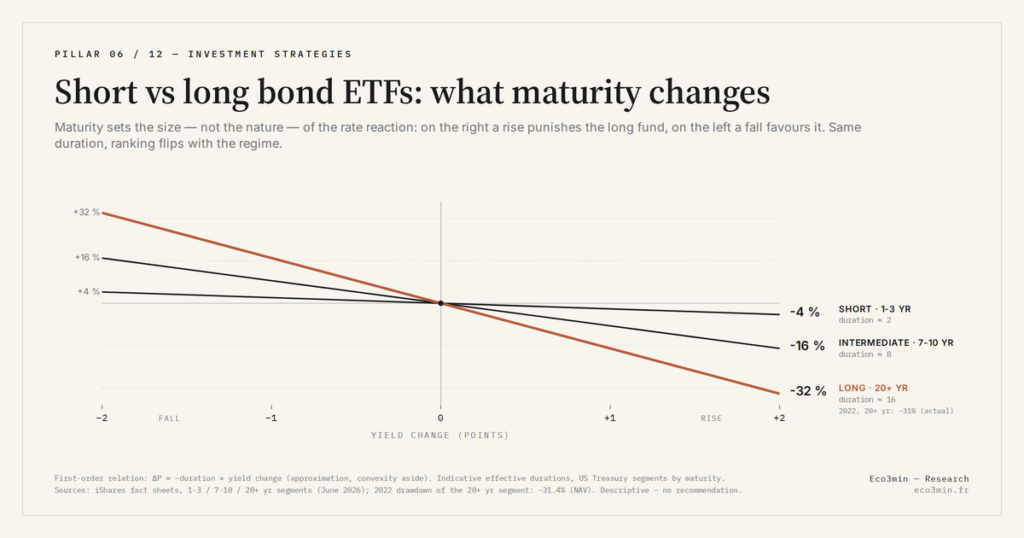
A bond ETF’s maturity sets its duration, and therefore the size of its reaction to rates. Short, intermediate and long do not describe three levels of risk, but three distinct behaviours depending on the direction of real rates.
TL;DR
Maturity moves a bond ETF's income and capital in opposite directions, and the outcome turns on the regime: an inverted curve can hand the short fund the higher purchase yield.
- Maturity sets the amplitude of the rate reaction, not its nature: at a duration near 8, a two-point rise means a fall of roughly 16%; at 15-16 years, on the order of 30%, as the iShares 20+ Year Treasury fund lost in 2022 (-31.4%).
- Long funds usually capture a higher purchase yield because the curve mostly slopes up, yet take the larger price swing; an inverted curve can flip that yield advantage to the short fund.
- A 30-year US Treasury gained 16.5% in 2020 and lost 29.2% in 2022, its worst year since at least 1978, while 3-month bills yielded 5.07% on average in 2023, against 2.06% in 2019.
- A short fund self-heals as rates climb: its quickly maturing securities are continuously reinvested at higher rates, offsetting the small capital loss, whereas a long fund takes years to rebuild what the revaluation cost it.
Choosing a maturity is choosing a sensitivity. This page describes what maturity actually changes in an ETF’s behaviour — income, capital, reaction by regime — without naming a segment to favour.
Short or long? The question sounds trivial; it is in fact the first regime lever in a bond holding. A bond ETF’s maturity sets its duration, and therefore how violently it reacts to rates. Through the 2022 tightening, long-dated government bond indices posted their worst calendar year since at least 1978 (-29.2% for a 30-year par Treasury, Eco3min calculation on the Federal Reserve GS30 yield, against -4.2% at 2 years), while money-market and ultra-short funds absorbed rising rates as added yield rather than capital loss. This page describes what maturity actually changes: price sensitivity, running income, and behaviour as real rates rise, plateau and ease. It builds on what duration measures without redefining it, and does not cover building a portfolio split between two extremes, which follows a distinct logic. It names no maturity to favour; it sets out how each segment has behaved across regimes, leaving the reader to read the present one. Read alongside: how a bond ETF behaves regime by regime.
Short, intermediate, long: three sensitivity profiles
A bond fund’s maturity sets the average duration of its securities, and therefore the size of its reaction to a rate move. Three broad profiles stand out. Short funds — money-market or bonds maturing within two or three years — show a low duration, often below one or two: their capital barely moves when rates shift, and their securities, maturing quickly, are rapidly replaced at the prevailing rate. Long funds — sovereigns or credit maturing beyond ten or fifteen years — show a high duration, often between fourteen and seventeen years (14.7 years for the iShares 20+ Year Treasury Bond ETF on October 2, 2026): their capital reacts sharply, because almost all their value sits in distant flows, highly sensitive to the discount rate. Intermediate funds occupy the space between, with a duration often near five to eight years. A companion piece: how the vehicle reshapes a bond position.
This gradation translates directly into price amplitude. An intermediate fund with a duration near eight falls by roughly sixteen percent for a two-point rise in rates, to a first approximation. A long-sovereign fund, with a duration of fifteen to sixteen, falls on the order of thirty percent on the same shock: the iShares 20+ Year Treasury Bond ETF lost 31.4% of its net asset value in 2022. A money-market fund with a duration below one sees its capital barely dented, and the rate rise translates for it mainly into a higher reinvestment yield. The same rate move thus produces results of entirely different magnitude, from the fund’s maturity alone.
What maturity does not change, by contrast, is the nature of the risk: in all three cases it is price risk tied to rates, independent of issuer quality. A fund of the highest-rated long sovereigns, free of any default risk, can fall further than a riskier-credit fund that is short in maturity. Maturity doses exposure to rates; it does not create a risk of another nature.
Running income and capital: maturity’s two opposite effects
Maturity acts on two distinct dimensions of a fund’s return, often in opposite directions. On running income, a long fund generally captures a higher yield at purchase than a short fund, because the yield curve is most often upward-sloping: lending long is paid more than lending short. On capital, conversely, it is the long fund that takes the largest price swing when rates move. A long fund therefore offers, schematically, more income but more capital risk; a short fund, less income but greater capital stability.
This trade-off between income and stability has no universal answer, because its outcome depends on the regime. In a period of stable rates, the long fund’s higher yield materialises without its capital risk being realised: carry dominates. In a period of rising rates, the same long fund sees its higher income more than offset by the capital loss. Maturity therefore sets not a level of performance but an exposure whose result reveals itself differently depending on the rate move. That is why reading a fund by its maturity alone, with no reference to the regime, does not suffice.
A technical nuance is worth stating: the slope of the yield curve can invert. When short rates exceed long rates — an inverted curve — the short fund temporarily offers a higher yield at purchase than the long fund, reversing the usual trade-off. In the United States, the 10-year yield stayed below the 2-year yield for 541 trading days between April 2022 and September 2024, by as much as 1.08 points on July 3, 2023 (Federal Reserve, DGS10 and DGS2). This configuration shows that the income advantage of long maturities is not a given: it depends on the shape of the curve at the moment of purchase.
One mechanism deserves spelling out for short funds: their capacity to self-heal in a rising regime. Because their securities mature quickly, a short fund continuously reinvests at higher rates as rates climb; the small capital loss on the securities held is rapidly offset by a higher reinvestment yield. A long fund, whose securities are replaced only slowly, does not benefit from this quick compensation: it carries the downward revaluation without reinvesting at the new rate for a long time. This difference in the speed of renewal explains why a short fund crosses a rate rise with almost no durable pain, where a long fund takes years to rebuild what it lost. It is the same property, read from the other side, that makes a short fund slow to benefit when rates fall: its quick renewal cuts both ways. Related discussion: how smoothing reserves stabilize the credited rate.
Behaviour by real-rate regime
Reading the maturity axis by regime illuminates the observed asymmetry. In a regime of rising real rates, long maturity is the dominant loss factor: it is what amplifies the downward revaluation, as long sovereigns showed in 2022. Short maturity cushions by capturing the rise as reinvested yield rather than capital loss. The faster the rise, the wider the gap in behaviour between short and long.
The 2020-2023 cycle played this mechanics out from end to end. In 2020-2021, in a regime of very low rates, long funds showed the best trailing performance, inherited from a decade of falling rates. In 2022, the abrupt climb in real rates inflicted on those same long funds their sharpest decline since at least 1978, while short funds cushioned. In 2023, those short funds offered a yield at purchase far above their pre-cycle level (3-month bills averaged 5.07% in 2023, against 2.06% in 2019 and 0.04% in 2021), captured through rapid renewal. The same trio of funds thus went through three distinct configurations in three years, driven by the rate regime alone, a reminder that trailing performance ranks maturities by the regime that has just elapsed. On this point: how investment vehicles behave regime by regime.
In a plateau regime, when real rates level off, the gap narrows sharply. For lack of a new rate move, running income becomes the main driver of return again, and long maturity stops penalising capital without delivering a gain. In this configuration, the long fund’s higher carry can become advantageous again, provided the curve is not inverted. The plateau is the regime where maturity matters least for capital, and most for income.
In a regime of easing real rates, symmetry plays in favour of long maturity: its high sensitivity, which penalised on the way up, now amplifies the appreciation. A long-sovereign fund becomes, in this phase, the most powerful factor of capital gain. Short maturity, for its part, benefits only marginally from the easing on its capital, but sees its reinvestment yield decline. Here again, the same rate move — the fall — produces opposite effects depending on maturity, exactly inverted relative to the rising regime.
- An ETF’s maturity sets its duration, hence the amplitude — not the nature — of its reaction to rates: short, intermediate and long describe three sensitivities, not three levels of default risk.
- Maturity acts in opposite directions on income (higher when long, outside an inverted curve) and on capital (more volatile when long); the trade-off between the two depends on the regime.
- In rising real rates, long maturity dominates the losses; in a plateau, the gap narrows and income takes precedence; in an easing, long maturity becomes the most powerful appreciation factor again.
Maturity is only one lever among several
Dosing maturity amounts to setting exposure to duration, but it is not the only selection axis for a bond holding. The credit segment is the other axis: the credit segment, independent of maturity: a fund can be short yet highly sensitive to credit stress, or long and of the highest standing. Conflating the two axes leads to attributing to maturity a behaviour that in fact stems from credit, or the reverse.
Likewise, maturity describes the duration of the securities held, but not the channel through which one is exposed. Between an ETF that reprices price moves immediately and a euro fund that smooths them over time, there are two concrete ways of dosing exposure through the wrapper, at comparable maturity. Maturity and wrapper are two distinct settings: one fixes sensitivity to rates, the other the speed at which that sensitivity is transmitted to the holder.
Placed within the whole, maturity emerges as a concrete application of duration, not an autonomous criterion. Reading a fund requires crossing its maturity with its credit segment, its wrapper and the prevailing rate regime. That is the purpose of the regime comparison of categories, which brings these axes together; and it is this grid that allows one to do the work of reading holdings through the cycle rather than naming a winning maturity in the abstract, which does not exist.
Last updated — 6 October 2026
Disclaimer – Financial and Legal Information: The analyses, commentary, and content published on eco3min.fr are provided for informational and educational purposes only. They do not constitute investment advice or a solicitation to buy or sell financial instruments. Past performance is not indicative of future results. All investment decisions involve risk and are the sole responsibility of the reader. Data, charts and calculated series are provided as is and may contain errors or lag behind their source: check any figure against the primary source cited before relying on it. Content describing laws, regulations or contracts reflects the law as of its publication date and does not constitute legal or tax advice; applying it to a specific situation requires a qualified legal or tax professional.
Read next
Full pillar →Which bond ETF for the rate regime
A bond ETF has no fixed behaviour: the same exposure can cushion a portfolio or erase several years…
Target-Date Funds vs Self-Directed Portfolios: The Mechanics of a Delegated Glide Path
A target-date fund is sold as a simple, set-and-forget win. It is first something narrower: a delegated glide…
What Guaranteed Savings Products Have Paid: Fixed Annuity and Stable Value Yields Through the Rate Cycle
US guaranteed savings products credit a rate that trails the bond market rather than tracking it. Through the…