DGS10 at 4%: Analytical Significance of a Regime Threshold


The 4% threshold on DGS10 is not an operational signal but an analytical reference: it marks the statistical frontier between the ZIRP regime and the post-2022 regime. Its meaning depends on its composition in real yield, breakeven and term premium — never on its nominal level alone.
TL;DR
Its real-yield, breakeven and term-premium composition is what gives a 4% ten-year Treasury meaning: the May 2026 split describes a normalized equilibrium, far from past yields near that level.
- May 2026's 4.2% broke down into roughly 1.95-2.00% real yield (DFII10), a 2.25-2.30% breakeven (T10YIE) and about +30 to +40 bps of ACM term premium, a different mix from January 2003 (real 2.3%, breakeven 1.8%) or September 2008 (real 1.7%, breakeven 2.1%).
- Between 2008 and 2022 the yield sat above 4% less than 3% of the time; it broke cleanly above in autumn 2022 and has held there since October 2023, a statistical regime break for operators used to ZIRP.
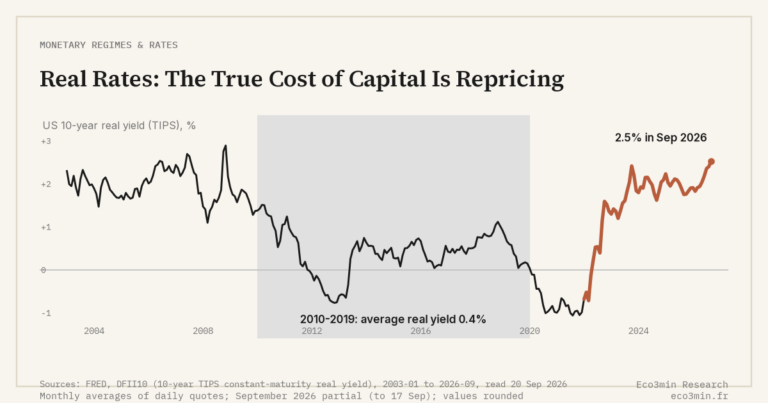
- The Holston-Laubach-Williams model puts r-star near 1% in Q4 2024 against 0.4% in the late 2010s, implying an equilibrium ten-year around 4.0-4.5% and reading 4% as the floor of a band rather than a target.
- FOMC members including Lorie Logan and Mary Daly cited the durable move above 4% as an autonomous tightening factor in late 2023, which institutionalized the level as a reference without making it an objective.
Reading 4% as a trigger means ignoring what the yield contains. Reading 4% as a regime state is the rigorous use.
1. Why 4% became a mental reference
The 4% threshold on DGS10 has taken a visible place in post-2022 macro commentary for both statistical and symbolic reasons. Statistically, 4% marks the frontier above which DGS10 spent only exceptional time between 2008 and 2022 — less than 3% of the time over this 14-year window. The clean breach of the threshold in autumn 2022, followed by stability above since October 2023, is therefore a major statistical break for operators accustomed to the ZIRP regime. Symbolically, 4% sits approximately as the median frontier between regimes 2 and 3 described in the DGS10 cycles history.
The threshold has also become a reference in Fed communication itself. Several FOMC members have explicitly mentioned DGS10’s durable move above 4% as an autonomous tightening factor that reduces the need for additional Fed Funds action. The November 2023 FOMC minutes and public remarks by Lorie Logan (Dallas Fed) and Mary Daly (San Francisco Fed) cited this level as contributing to restrictive financial conditions. This official use institutionalizes 4% as a reference, without making it an objective.
The May 2026 context, with DGS10 stable around 4.2%, places the yield slightly above the threshold, in a zone where the macroeconomic reach of DGS10 is observable but where interpretation must remain analytical.
2. Decomposing 4%: what the number hides
A 4% DGS10 has no unambiguous meaning. The same nominal value can describe several radically different macroeconomic configurations depending on its decomposition. The May 2026 4% decomposes approximately into 1.95-2.00% DFII10 (TIPS real yield), 2.25-2.30% T10YIE breakeven, and about +30 to +40 bps of ACM term premium. This configuration describes a coherent equilibrium: normalized real yield, inflation expectations anchored close to the Fed target after CPI/PCE translation, moderate term premium. Companion dataset: The ACM-model term-premium dataset.
Compare with other historical 4% DGS10 occurrences. In December 2000, just before the dot-com bubble burst, DGS10 was at 5.1% and breakeven was not measurable (TIPS launched in 1997 but thinly traded). In January 2003, DGS10 at 4.1% combined DFII10 at 2.3% and T10YIE at 1.8%. In September 2008, DGS10 at 3.8% combined DFII10 at 1.7% and T10YIE at 2.1%. Each configuration carries a distinct economic reading despite the nominal proximity.
Rigorous analysis therefore requires always cross-referencing DGS10 with its decomposition — this is precisely the real/breakeven decomposition of the yield that distinguishes a 4% cyclical equilibrium from a 4% inflation stress. The nominal number alone is an aggregate that erases the underlying macroeconomic information.
3. What the DGS10/DFF slope says about 4%
The 4% threshold gains additional meaning when related to the Fed Funds Rate. In May 2026, DGS10 at 4.2% with a Fed Funds Rate target at 4.25-4.50% produces a slightly negative DGS10/DFF slope — a configuration documented by the DGS10/Fed Funds dynamics as statistically rare. The same 4.2% value with a Fed Funds Rate at 1% in 2014 would have described an economy exiting ZIRP, a radically different configuration.
It is this articulation of threshold + slope + composition that produces an analytical reading. A 4% DGS10 with Fed Funds at 5% and positive term premium signals end-of-tightening with anticipation of future cuts. A 4% DGS10 with Fed Funds at 1% and positive term premium would signal an expansionary mid-cycle with progressive normalization. A 4% DGS10 with Fed Funds at 4% and negative term premium would signal a stable plateau at the end of a neutral phase.
These readings are not equivalent and do not call for the same macroeconomic interpretations. The 4% alone contains none of this information — the reading grid must be explicitly assembled with the other published series (DFF, DFII10, T10YIE, ACM term premium).
4. Why 4% says nothing operational
This section is essential to avoid the most common reading mistake: turning an analytical reference into an action signal. The 4% threshold on DGS10 says nothing, by itself, about portfolio implications for anyone. Its breach upward or downward triggers no universal allocation rule. Several reasons structure this absence of operational signal.
First, an investor’s risk-return profile depends on variables absent from DGS10: investment horizon, drawdown tolerance, taxation, liquidity constraints, existing duration exposure. A 4% DGS10 has different implications for a pension fund with long liabilities (10-20 years), for a universal bank holding HTM Treasuries, or for an individual saving in Treasuries via a current account. No single reading of the threshold applies to these situations. Related Q&A: our breakdown of bond duration.
Second, the 4% threshold has no mechanical property. A DGS10 moving from 3.9% to 4.0% does not materially change the economic characteristics of the underlying Treasury. The 10 bps move modifies yield-to-maturity by 0.1 point and effective duration by a negligible fraction. The fact that the breach coincides with a mental threshold confers no additional physical property.
Third, media attention to the 4% threshold sometimes creates short-term self-reinforcement dynamics (speculative positioning, algorithmic hedging, headlines echoing the threshold) that amplify volatility around the level without changing its underlying informational content. These dynamics are noisy but do not validate the threshold as a signal.
Rigorous use of 4% therefore consists of treating it as an observable state of the current macroeconomic regime, not as an allocation trigger. The transmission of monetary policy to corporate balance sheets is sensitive to DGS10’s position within its regime; individual investment decisions depend on personal and professional parameters absent from the yield.
Academic literature on “mental thresholds” in finance documents the phenomenon of numerical salience — round levels (3%, 4%, 5% on DGS10; 1,000, 5,000 on the S&P 500) attract more attention than intermediate levels regardless of their informational content. This salience has no economic basis but influences short-term positioning behavior. Worth reading alongside: the maturity question behind bond buying. Distinguishing the 4% threshold as an analytical reference (useful for situating a yield in its regime) from the 4% threshold as a salience phenomenon (which temporarily amplifies volatility without adding information) is a minimal discipline of yield reading.
Other mental thresholds have structured macro commentary at different times. The 5% threshold on DGS10 long marked the upper comfort frontier for equity operators in regime 2 — its breach in June 2007 accompanied the cycle peak, and its breach in October 2023 marked the post-COVID peak. The 3% threshold marked the lower monetary neutrality frontier of 2018-2019. None of these thresholds has mechanical significance: they emerge from the conjunction of numerical salience and historical repricing points observed ex post.
A worthwhile context for the May 2026 4% is its relation to the policy debate on r-star. The Holston-Laubach-Williams model places r-star around 1% in Q4 2024, against the 0.4% baseline of the late 2010s. The implied DGS10 equilibrium under standard term structure logic — r-star + steady-state inflation + term premium — therefore lies around 4.0-4.5% if one applies a 2% steady inflation and 50 bps positive term premium. The current 4.2% sits within this implied range, which is itself a regime statement rather than a forecast. Different r-star models (Lubik-Matthes, Wicksellian estimates by various central banks) produce ranges from 0.6% to 1.4%, and the corresponding equilibrium DGS10 estimates vary by 80 bps. The 4% level is therefore best read as the floor of a band rather than a precise target. Related framing: our analysis of rates feeding into earnings.
5. The threshold within regime 3
Regime 3 opened in 2022 modifies the interpretation of the 4% threshold. In regime 2 (1981-2021), a 4% DGS10 would have been read as a low yield in historical context. In regime 3, the same 4% sits near the mean observed since 2022 (4.1%) and fits within a structurally different equilibrium. This reference translation forbids mechanical historical comparisons.
Three structural factors explain why 4% is plausible as a new regime 3 floor. The r-star revised to 0.9-1.1% by the NY Fed in June 2024 mechanically implies a higher DGS10 equilibrium than under regime 2. The reintroduction of a positive term premium around +30 to +50 bps adds about 40 bps to what the yield would have been under regime 2 with the same expectations. The U.S. fiscal trajectory (deficit ~6.5% of GDP, debt-to-GDP ~120%) maintains structural upward pressure on the term premium. A parallel read: gold’s monetary function in light of federal finances.
Together, these factors suggest that the 4% threshold could function durably as a DGS10 floor under regime 3, barring a return to regime 2 conditions (strong disinflation, negative term premium, ZIRP). This observation is analytical, not prescriptive: it describes what the data suggest about the probable future distribution of DGS10, without constituting an allocation recommendation for anyone.
Reading the breach of the 4% threshold by DGS10 as an allocation signal — “buy Treasuries above 4%” or “lighten long bonds below 4%”. The 4% threshold is an analytical regime reference, not an operational rule. Its meaning depends on its composition (real + breakeven + term premium), on its relation to the Fed Funds Rate, and on the current macroeconomic regime. No universal rule derives from the nominal level alone; allocation implications depend on the personal profile, investment horizon, and parameters absent from the yield. Read alongside: the suite of Eco3min macroeconomic analysis tools.
Last updated — 12 July 2026
Disclaimer – Financial Information: The analyses, commentary, and content published on eco3min.fr are provided for informational and educational purposes only. They do not constitute investment advice or a solicitation to buy or sell financial instruments. Past performance is not indicative of future results. All investment decisions involve risk and are the sole responsibility of the reader.
Read next
Full pillar →Real Rates: The True Cost of Capital Is Repricing
Why real rates are reasserting themselves as markets' anchor and how to recalibrate investment and financing decisions facing…
Real Interest Rates: The Quiet Signal Reshaping Markets
Real interest rates: why their persistence in positive territory in 2026 is reshaping the rules for bonds, equities,…
OAT-Bund Spread: A Quiet Gauge of French Sovereign Risk
OAT-Bund spread: how this yield gap has become a key signal on French sovereign risk, fiscal policy and…