T10YIE and 10-Year Inflation Expectations: How Markets Price Future Inflation

T10YIE has become the reference measure of long-term market-implied inflation expectations. Yet it is the regime reading, not the absolute level, that makes it the central indicator for understanding current Federal Reserve policy.
TL;DR
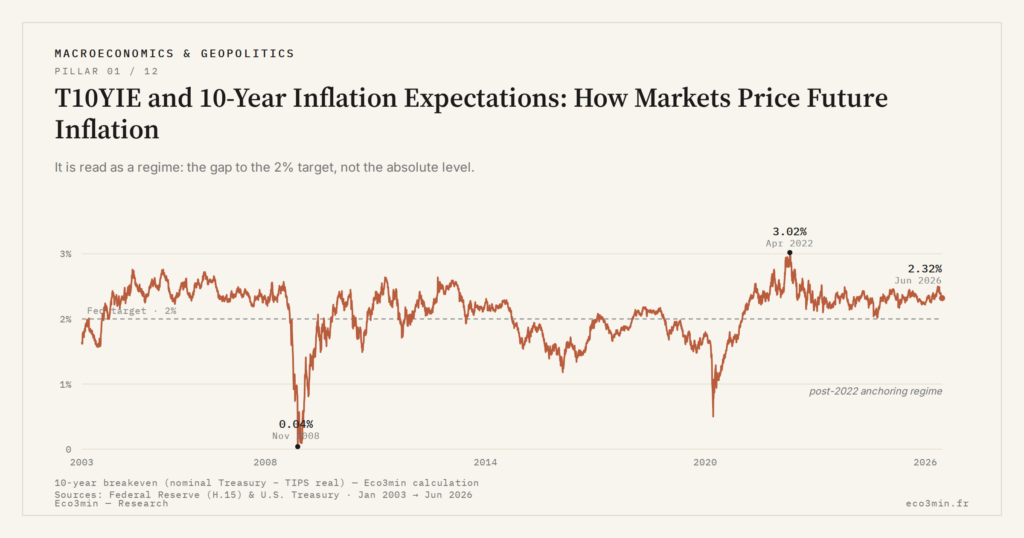
Averaging 2.11% from 2003 to 2025 and ranging from a post-Lehman 0.04% to 2.99% in 2022, the 10-year breakeven reveals more through its regime than its level.
- Defined as DGS10 minus DFII10 (10-year nominal Treasury minus 10-year TIPS), it has been published daily by the St. Louis Fed since January 2, 2003.
- When the 10-year Treasury yield rose 261 basis points in 2022, the New York Fed attributed roughly 80% to the real-yield leg and only 20% to the breakeven.
- Its 2.11% average sits 22 basis points below the Philadelphia Fed's Survey of Professional Forecasters, the gap reflecting liquidity and inflation risk premia.
- Powell's recurring 'well-anchored' phrasing reads T10YIE directly: under an implicit 2.5% the Fed tolerates flexibility, above it the tightening tone hardens, as in 2022.
This page sets the full frame: calculation mechanics, two decades of historical readings, the articulation with the Fed’s reaction function, and the state of the 2024-2026 regime, within the Macro-Financial Regimes pillar.
1. What T10YIE actually measures — origin and mechanics of the FRED series
The 10-Year Breakeven Inflation Rate, FRED ticker T10YIE, has been published daily by the Federal Reserve Bank of St. Louis since January 2, 2003. Underlying series: the FRED T10YIE series for the 10-year breakeven inflation rate. Its construction is mechanical: it equals the difference between the 10-year constant maturity Treasury yield (FRED series DGS10) and the 10-year constant maturity TIPS yield (FRED series DFII10). how an inflation-linked bond actually works sets this observation in the cycle. The series is computed from the par yield curves published by the Treasury Department, which guarantees that at every date both yields correspond exactly to the same residual maturity.
This difference carries an imperfect but established name: breakeven inflation. The term comes from the accounting idea that if average inflation over the next ten years equals exactly T10YIE, a nominal Treasury investor and a TIPS investor will earn the same nominal return over the decade. Above that level, TIPS outperform; below, nominals do. This reading is rigorously correct if one ignores two residual premia that markets in practice embed: a liquidity premium between the two segments and an inflation risk premium. These premia are usually a few basis points, sometimes as much as 50 basis points during stress episodes, but they systematically bias the raw reading of the figure.
The origin of the series deserves a reminder. TIPS were first issued by the Treasury in January 1997, when the market remained shallow and liquidity limited. The Federal Reserve waited until 2003 to publish the breakeven series — that is, the time needed for the TIPS segment to reach a size allowing stable pricing. This historical dimension matters: before 2003, long-term inflation expectations could only be estimated from surveys — the Survey of Professional Forecasters, Michigan Consumer Sentiment, the BlueChip panel — whose biases and lags have been documented since Mankiw and Reis (2002).
The move to a real-time market-based measure changed the nature of the debate itself. Before 2003, the Fed could estimate expectations from monthly surveys, with a lag and a cross-respondent dispersion that was hard to interpret. Since then, it has had access to a figure updated daily, aggregated by the arbitrage of thousands of bond managers, and readable without methodological ambiguity. It is this transition that has turned T10YIE not into one indicator among others but the reference barometer of long-term inflation expectations — to the point where how the T10YIE is calculated has become a recurring teaching question on fixed-income desks.
That said, T10YIE is not a pure measure of expectations. The pricing mechanism implies that two parasitic components are blended in. The first is the liquidity premium: nominal Treasuries are the most liquid instrument in the world, whereas TIPS, despite a market size that now reaches 2.2 trillion dollars in outstanding amount according to the Treasury Bulletin (Q4 2025), remain significantly less liquid. This liquidity gap translates into a TIPS yield slightly higher than it should be in theory, hence a mechanically underestimated breakeven. The second component is the inflation risk premium: nominal Treasuries command compensation for the risk of inflation surprise, which adds to the expectations themselves. These two premia can offset or accumulate, which makes T10YIE imperfect as a direct proxy of expectations stricto sensu. On this point: every US inflation second wave.
A rigorous reading must therefore treat T10YIE as an estimate of expectations augmented with noise, not as their pure measure. This is precisely the nuance that distinguishes an expert macro reading from a journalistic one: the raw figure is enough to grasp a trend, but analyzing the gap to the Fed target requires separating what comes from expectations, from the risk premium, and from the liquidity premium.
An additional historical note is worth emphasizing. When TIPS were launched in 1997, the Federal Reserve initially favored survey-based measures of expectations over the new breakeven series. The Greenspan-era Fed considered the TIPS market too immature for its pricing to be reliable, and the FOMC minutes of that period mention SPF as the primary reference. The shift toward T10YIE as the dominant indicator only occurred in the mid-2000s under Bernanke, who had written extensively on the desirability of market-based expectations indicators in his pre-Fed academic work. This intellectual lineage explains why the FOMC today treats T10YIE with the institutional weight it carries — it is not merely an external indicator, but a measure that the Fed itself helped legitimize and that its own communication then incorporates by feedback.
One last operational point: T10YIE is published with a one-business-day lag, reflecting the Treasury’s computation of par yield curves at end-of-session. For real-time analytical use, market participants typically rely on dealer-screen breakeven quotes throughout the trading day, which differ from FRED T10YIE by a few basis points due to the par yield curve adjustment. The discrepancy is small but matters for high-frequency event studies — a fact regularly noted in Federal Reserve Board working papers on FOMC announcement effects.
2. The accounting construction: why DGS10 minus DFII10 captures expectations
The accounting identity DGS10 = DFII10 + T10YIE is not a simple mathematical artifact: it is the direct translation of the no-arbitrage condition between nominal Treasuries and TIPS of the same maturity. An investor who buys a nominal Treasury earns a certain nominal yield of DGS10. An investor who buys an equivalent-maturity TIPS earns a certain real yield of DFII10, plus realized CPI inflation over the decade. For both instruments to coexist in equilibrium, the expected nominal yield on the TIPS — that is, DFII10 plus average expected inflation — must equal DGS10. Hence T10YIE as an estimator of expectations. For more detail: our analysis of the copper/gold ratio and long-term rates.
This identity has a major consequence for the macro reading: when DGS10 rises by 50 basis points, two opposite scenarios are possible. Either DFII10 rises (real tightening, improved growth prospects, expanding term premium), or T10YIE rises (drifting expectations, widening inflation premium). These two scenarios call for entirely different readings in monetary policy and asset allocation. This is why every analyst of the US Treasury curve now starts by decomposing each nominal move into its real and expectations components — as detailed in the nominal yield versus real yield decomposition.
The 2022 episode provides the textbook case. Between January and October 2022, DGS10 went from 1.63% to 4.24%, a rise of 261 basis points. According to Federal Reserve Bank of New York calculations published in August 2022, about 80% of that move came from the DFII10 real-yield leg (actual and anticipated Fed tightening) and only 20% from the T10YIE breakeven (expectations which touched 2.99% in April before retreating). This decomposition was fundamental in calibrating Fed communication: anti-inflation credibility remained largely intact, and the challenge was transmitting real tightening to the economy, not re-anchoring expectations that had never truly drifted.
To understand what flows through T10YIE, it is useful to return to TIPS mechanics themselves. The principal of a TIPS is indexed to the CPI-U published by the Bureau of Labor Statistics, with a two-month lag and a linear interpolation convention. The coupon, expressed as a percentage of the indexed principal, therefore tracks realized inflation. At maturity, the holder receives the maximum of the indexed principal and the initial nominal principal — a deflation protection planned at the 2009 issuance update but not activated for any TIPS held over the 2010-2020 decade. This mechanism of understanding TIPS guarantees that a TIPS held to maturity offers a certain real return — net of US sovereign default risk, considered negligible for modeling purposes.
The breakeven is therefore not a market opinion: it is the equilibrium price that maintains indifference between nominal and TIPS over the considered horizon. A plain-language account of this equilibrium is given in what breakeven inflation rates mean. This property makes it a more robust indicator than any survey, because it is built by real arbitrage covering billions of dollars every day. According to Federal Reserve statistics, average daily volume on the TIPS segment is around 25 billion dollars in 2025, enough to keep pricing distortions transitory.
One useful note: T10YIE does not aggregate the inflation expected over the next ten years on equal weights. Mathematically, it is the geometric average of expected annual inflations, weighted by the effective duration of the two bonds. This means the early years carry more weight than the later ones — a nuance whose importance shows up during phases where the market clearly distinguishes near term from long term, as observed in the 5Y/10Y breakeven curve slope.
Treating T10YIE as a 10-year market inflation forecast. It is an implicit projection, yes, but augmented by an inflation risk premium and netted of a TIPS liquidity premium. Reading T10YIE as an economist consensus means ignoring two structural biases that can account for 20 to 40 basis points of gap against true expectations depending on the regime. Direct extension: Inflation Explained: Regimes, Structural Drivers, and Macro-Financial Implications.
3. The 2003-2025 historical average and its regime dispersion
Over the full publication period — January 2003 to end-2025 — the arithmetic mean of T10YIE in daily data comes to 2.11%, according to FRED series downloaded in May 2026. This figure is remarkably close to the 2% target adopted by the Federal Reserve in January 2012 in its Statement on Longer-Run Goals. The proximity is not accidental: it reflects the effectiveness of expectations anchoring over two decades marked by major shocks — the 2008 crisis, the 2013 taper tantrum, the 2014-2015 European deflation, the 2020 pandemic, the 2021-2022 inflation shock.
But the average masks considerable dispersion. The historical low was hit on November 24, 2008, at 0.04% — in the middle of the post-Lehman collapse, in a context where cyclical deflation seemed possible and the TIPS liquidity premium had widened dramatically. The high was crossed on April 21, 2022, at 2.99%, during the post-COVID inflation episode. Between these extremes, the standard deviation of daily 2003-2025 observations sits around 0.38 percentage points.
This dispersion organizes into identifiable regimes. The 2003-2008 period shows a T10YIE average of 2.47%, in a context of economic expansion and rising commodity prices. The 2009-2015 period comes in at 1.98%, marked by post-crisis deleveraging and repeated deflation fears that led the Fed to launch three successive rounds of Quantitative Easing. The 2016-2019 phase shows remarkable stability around 1.84%, despite Fed rate hikes from late 2015 to late 2018. The 2020 COVID shock plunges T10YIE to 0.50% in March, before a rapid rebound. The 2021-2022 period sees the breakeven spike toward 2.99%, then the 2023-2026 regime stabilizes it in a 2.2-2.4% corridor above target.
This regime segmentation is more instructive than the global average. It shows that T10YIE does not oscillate around a fixed value but migrates between attractor points that reflect macroeconomic phases. A T10YIE at 2.3% in 2014 would have been read as a feared disinflation signal by the Fed; the same number in 2026 is qualified “well-anchored” by Powell. The absolute level says little without the regime context. This dimension justifies the in-depth analysis of reading the 2024-2026 anchoring regime.
Another useful reading concerns the speed of variation. Daily T10YIE moves are usually contained to a few basis points, but can reach 20 to 30 basis points during stress episodes or FOMC surprises. The most violent move over a one-week window was observed in March 2020, when T10YIE lost 92 basis points in five sessions, simultaneously reflecting cyclical deflation expectations and a collapse in TIPS liquidity. These stress episodes temporarily contaminate the reading, which justifies tracking through a 5- or 20-day moving average rather than daily for structural macro analysis. A companion study: our framework for reading inflation regimes.
A comparison with surveys closes the section. The Survey of Professional Forecasters from the Philadelphia Fed publishes quarterly the expected 10-year CPI inflation. Over 2003-2025, its average comes in at 2.33%, that is 22 basis points above the average T10YIE — a gap explained precisely by the liquidity and inflation risk premia that arbitrageurs embed in bond prices. This comparison shows T10YIE as a market measure that converges with surveys over the long run but reacts faster to regime inflections. This real-time market dimension is what makes it the reference measure for central banks, as illustrated by the mechanisms of how inflation expectations form, documented since the foundational work of Phelps and Friedman.
4. T10YIE in the Fed’s reaction function
Since the post-COVID inflation episode, Jerome Powell has systematically included in every FOMC statement the formula “longer-term inflation expectations remain well-anchored.” This line is not neutral boilerplate: it tells markets explicitly that the Fed reads long-term inflation expectations — and particularly T10YIE — as a real-time signal of the 2% target’s credibility. The mechanism has been documented in central-bank literature at least since Ben Bernanke (2007, Constraints on the Conduct of Monetary Policy): if expectations drift durably above target, the Fed must tighten further, hold longer, and accept a higher cost in terms of growth and employment.
This logic has a direct operational consequence: T10YIE becomes an input to the Summary of Economic Projections (SEP) that the Fed publishes each quarter. Although the SEP does not mention breakeven explicitly, FOMC members repeatedly refer in individual speeches to their reading of T10YIE as a calibration parameter for their own projections. Loretta Mester (Cleveland Fed, November 2022), John Williams (New York Fed, February 2023), and Christopher Waller (Board of Governors, March 2024) have each cited T10YIE in public interventions as a signal they monitor closely.
The asymmetry of the Fed’s reaction function in the face of T10YIE is instructive. As long as the breakeven stays below 2.5%, the Fed considers the target’s credibility preserved and accepts some flexibility in the disinflation path. Above that threshold, Fed communication explicitly hardens and the pace of tightening accelerates. This asymmetry was fully visible in 2022: the first 75-basis-point hike, in June 2022, came two months after T10YIE crossed 2.99% in April. The chronological sequence is not coincidental, as analyzed in the dedicated article on T10YIE in the Fed’s reaction function.
The symmetry is less perfect on the downside. When T10YIE drops below the 2% target, as happened during most of 2014-2016 and again in 2019-2020, the Fed adopts a pedagogical tone but does not react with the same speed it does to an overshoot. This asymmetry reflects an implicit preference of central banks for an upside de-anchoring risk — which erodes purchasing power, destabilizes nominal contracts and demands costly tightening — over a downside de-anchoring risk that can be countered by unconventional tools (QE, forward guidance, negative rates). This preference is documented for instance in the writings of Janet Yellen during her tenure as Fed Chair.
An important dimension is the effect of communication itself. When Powell qualifies T10YIE as “well-anchored,” he does not merely describe a state: he acts on that state. Public declaration of anchoring by the central bank mechanically reinforces anchoring by signaling to markets that the Fed stands ready to tighten if the breakeven drifts. This mechanism, sometimes called the credibility loop, is one of the foundations of modern monetary policy and constitutes the main channel by which communication substitutes for actual action in a wide range of situations.
Examining the quarterly dot plot published by the Fed allows mapping this interaction. When T10YIE drifts above 2.5%, the median dots for Fed funds expected at 1 and 2 years shift significantly upward over the following two quarters. This correspondence is not mechanical but it is systematic enough that macro strategy desks treat it as a reliable heuristic. Conversely, a T10YIE drifting toward 1.8% generally triggers a downward adjustment of the dots — or, failing that, a more dovish Powell communication at the press conference.
The empirical literature on the FOMC reaction function has gradually formalized this dependency. Estimating extended Taylor rules including T10YIE alongside the unemployment gap and core PCE inflation, several papers from the Federal Reserve Board (notably Clarida, Gali, and Gertler in the late 1990s for the original framework, then updated specifications by Bernanke and Woodford) have shown that the coefficient on long-term inflation expectations in policy-rule regressions has gradually risen since 2008. This evolution reflects the institutional consolidation of inflation targeting and the recognition that anchored expectations are the cornerstone of monetary policy credibility under the dual mandate.
5. The April 2022 spike and the return to anchoring
The April 2022 episode deserves specific treatment because it has since served as implicit reference to every reading of T10YIE. On April 21, 2022, the 10-year breakeven touched 2.99%, its highest level since July 2008 — that is, before the Lehman Brothers bankruptcy. The progression was rapid: in early January 2022, T10YIE was trading around 2.55%; it gained 44 basis points in three and a half months, against the backdrop of US annual CPI inflation hitting 8.5% in March 2022 according to the Bureau of Labor Statistics — the highest since 1981.
The context makes the episode readable. The Fed had initially qualified post-COVID inflation pressures as “transitory” at the July 2021 FOMC statement; Powell abandoned that qualification on November 30, 2021, during testimony before the Senate. The first Fed funds hike — a modest 25 basis points — came on March 16, 2022, that is five months after the rhetorical pivot. During that five-month window, markets began to fear that the Fed was behind the curve and that long-term inflation expectations might begin to drift — exactly what the rise of T10YIE toward 2.99% measured.
The Fed response was calibrated to bring T10YIE back below 2.5%. Three elements compose this response. First, the first 75-basis-point hike on June 15, 2022 — which breaks the usual pattern of 25- or 50-basis-point hikes and signals to markets that the Fed is ready to accept an economic cost to re-anchor expectations. Then, Powell’s Jackson Hole speech on August 26, 2022, where he explicitly invokes a “painful” cost of disinflation and indicates that the Fed will tighten “until the job is done.” Finally, the sequence of four consecutive 75-basis-point hikes between June and November 2022, which lifts the Fed funds rate from 1.00% to 4.00%.
The result on T10YIE was immediate. From the April 21, 2022 peak, the breakeven retreated progressively: 2.73% end-June 2022, 2.40% end-August 2022, 2.21% end-December 2022. The 2.5% bar — implicit threshold of the Fed reaction function — was crossed downward in mid-August 2022, four months after the peak. At that point, the Fed considered the emergency phase over and the remainder of the tightening could be calibrated at the classical pace of 25-50 basis points per meeting.
This episode is analyzed in detail in the dedicated article on the April 2022 breakeven spike. Three lessons emerge. First: the breakeven can drift well before realized inflation poses a durable problem, because it embeds a 10-year projection that depends on Fed credibility, not on the monthly CPI print. Second: the return to anchoring is faster than the drift, provided the Fed takes qualitatively new actions (the shift to 75 basis points per meeting being the paradigmatic example). Third: the breakeven does not mechanically revert to the 2.1% historical mean, but to an equilibrium level that depends on residual post-cycle expectations. Adjacent reading: how an agricultural shock reaches the CPI.
A useful observation: the 2022 episode showed that the mere absence of major de-anchoring — T10YIE topping at 2.99% rather than 4% or 5% — counts as a monetary policy success. This is a counterintuitive reading: a 44-basis-point move over three and a half months is, in central-banking history, a test rather than a failure. For comparison, during the 1970s inflation, 10-year expectations retrospectively estimated by the Cleveland Fed had exceeded 8% on multiple occasions.
One additional layer worth noting: market participants progressively learned during 2022 to distinguish breakeven moves driven by genuine expectation drift from moves driven by changing inflation risk premia. Research notes from major dealer desks — Goldman Sachs, JPMorgan, Morgan Stanley — published throughout the second half of 2022 increasingly emphasized this decomposition, contributing to a more sophisticated reading of the T10YIE signal that the Fed itself echoed in its subsequent communication. This iterative refinement of the analytical framework around T10YIE is one of the durable legacies of the 2022 episode: the indicator that emerged from the crisis is the same one, but its reading is now more nuanced than it was beforehand.
6. The 2024-2026 regime: three readings of the 2.2-2.4% corridor
Since the return below 2.5% in late 2022, T10YIE has been trading in a narrow corridor between 2.2% and 2.4%, according to FRED monthly data 2023-2026. Powell systematically qualifies this zone as “well-anchored” in every FOMC statement. This qualification is technically accurate relative to the April 2022 spike but it masks an important editorial question: the corridor sits structurally above the Fed’s 2% target.
Three readings coexist on this point, none of them definitively settled today. First reading: it is genuine anchoring with a persistent post-cycle inflation premium. Under this view, T10YIE reflects the 2% market-expected average plus an inflation risk premium of about 20-40 basis points compensating for the memory of the 2021-2022 shock and the residual possibility of another shock. The Fed remains calibrated to mechanically pull expectations back to target, and the corridor would converge toward 2.1-2.2% as the risk premium erodes.
Second reading: the market has tacitly re-anchored expectations at a slightly higher level, around 2.2-2.3%, consistent with a new post-pandemic macroeconomic equilibrium marked by partial deglobalization, more volatile energy costs, and a structurally more generous fiscal policy. Under this view, the Fed’s 2% target remains the official goal, but the market no longer fully believes it and prices a slightly higher equilibrium. This would be a discreet but real credibility failure of the target.
Third reading: T10YIE embeds a liquidity premium that has durably widened since 2022, without any real change in expectations. Under this view, true expectations would remain around 2% but the raw T10YIE reading would be biased upward by technical factors related to the TIPS market. This hypothesis is less documented than the first two but is defended by some economists at the Federal Reserve Board.
Distinguishing between these three readings is the central challenge of 2024-2026 macro analysis. Implications for monetary policy and allocation are opposed. Under the first, the Fed can start cautious easing; under the second, it must maintain a restrictive bias longer to truly re-anchor expectations; under the third, the raw T10YIE reading overstates the problem and there is no de-anchoring to fight.
Complementary surveys help arbitrate. The Philadelphia Fed Survey of Professional Forecasters showed, at Q1 2026, a median expected 10-year CPI inflation of 2.40%, that is in the upper end of the T10YIE corridor. The University of Michigan survey showed 3.1% over 5-10 years for the same period — significantly higher than the professional surveys but consistent with the documented behavioral biases of household surveys. These data points suggest that the second reading — tacit re-anchoring at a slightly higher level — is probably the most accurate, without allowing a definitive verdict. The underlying FRED T10YIE dataset remains the primary reference for replicating this analysis.
To characterize the current T10YIE regime, systematically cross three measures: the raw level of the 10-year breakeven, the interquartile range on a 90-day rolling window, and the gap to the Philadelphia Fed SPF. If the three converge toward the 2% target, anchoring is genuine. If T10YIE drifts in isolation, it is most likely the liquidity premium. If T10YIE and SPF drift together, it is a tacit re-anchoring to a new level.
7. T10YIE versus realized inflation: reading the gap
An often overlooked dimension of T10YIE is its relationship with realized CPI inflation. T10YIE projects expectations over ten years; CPI measures what actually happened over the last twelve months. The gap between the two series is not a bug to be corrected: it is a signal in its own right. Over 2003-2026, the average gap between T10YIE and trailing 12-month CPI comes in at +0.3 percentage points according to Eco3min calculations on FRED T10YIE and CPIAUCSL series.
But this positive average gap masks considerable volatility. The historical range goes from -2.5 percentage points (July 2022, when CPI peaked at 9.1% trailing) to +2.2 percentage points (May 2020, when trailing CPI had dropped to 0.1% in the middle of the COVID shock). This dispersion reveals the very nature of T10YIE: it anticipates a long-run average and smooths punctual shocks, whereas realized CPI tracks cyclical fluctuations. When real inflation rises rapidly, T10YIE stays relatively stable because it already embeds the expectation of a return to the Fed target. Conversely, coming out of a deflationary shock, T10YIE recovers faster than trailing CPI.
This property makes the T10YIE − CPI gap an indicator of mismatch between market and public statistics. When T10YIE durably exceeds trailing CPI — as in 2024-2026 where the gap oscillates around +0.7 points — markets are pricing an acceleration that the published figure has not yet captured. Conversely, when T10YIE is below trailing CPI — as in 2022 where the gap reached -5 points — markets are pricing a deceleration that monthly data have not yet revealed. This dynamic justifies the in-depth analysis of the gap between expectations and realized inflation.
The analytical reading of the gap requires distinguishing its level and its direction of change. A positive gap that is widening — T10YIE rising and trailing CPI flat — signals an expectations drift not yet visible in the data. A positive gap that is narrowing — T10YIE flat and trailing CPI rising — signals on the contrary that the market remains calibrated on the return to target while the statistic still reflects the shock. These two configurations call for opposite macro readings.
A useful complement comes from other expectations indicators. The 5-Year, 5-Year Forward Inflation Expectation Rate (FRED T5YIFR), which measures expectations over years 6 through 10 in isolation, complements T10YIE by filtering out the noise of the first five years. T5YIFR was named by Bernanke in 2004 as the reference indicator for anchoring of very-long-term expectations and is still used in Fed internal comparisons. The T5YIFR vs T10YIE slope informs the temporal structure of expectations — but this analysis belongs to the term-structure work that lies beyond the present article’s scope.
A final dimension concerns the inflation risk premium that markets embed on top of expectations. According to the New York Fed decomposition published in 2024, this premium has oscillated between 25 and 60 basis points over 2003-2025, with phases where it collapses near zero (notably 2009-2015) and phases where it exceeds 50 basis points (notably 2022-2024). This premium is not directly observable: it is extracted by factor models that isolate the expectations component stricto sensu. Its variation explains why T10YIE can diverge from SPF even when true expectations are stable.
An international comparison closes this part of the analysis. The euro area has its own equivalent indicator, the 10-year inflation-linked swap rate, which the European Central Bank watches with the same attention the Fed gives to T10YIE. The ECB has notably formalized in its 2021 strategy review the explicit role of long-term inflation expectations in its policy stance, mirroring the Fed approach. Over 2003-2025, the euro-area 10-year swap rate has averaged around 1.85%, against the ECB target of “below but close to 2%” until 2021 and then symmetrically 2%. The fact that two of the world’s largest central banks have converged toward this market-implied expectations framework reinforces the analytical value of T10YIE beyond the US case. A US-zone comparison of breakeven curves remains a powerful tool for relative regime analysis between dollar and euro inflation dynamics. This observation aligns with the analysis in our sub-pillar on inflation regimes.
T10YIE is not an inflation forecast but an indicator of the Fed target’s credibility, and this nuance changes everything for macro reading.
8. T10YIE compared to other inflation expectations indicators
T10YIE is not the only measure of long-term inflation expectations. Three families of indicators coexist and their comparison enriches macro reading. The first is professional forecaster surveys — the Philadelphia Fed Survey of Professional Forecasters, the BlueChip Economic Indicators panel, the Bloomberg consensus. These surveys typically poll 30 to 50 economists each quarter on expected CPI inflation at various horizons.
Over 2003-2025, the SPF shows an average 10-year expectation of 2.33%, that is 22 basis points above the 2.11% T10YIE average. This gap is precisely the premium embedded by Treasury arbitrageurs — a combination of inflation risk premium and TIPS liquidity premium. The SPF’s volatility is significantly lower than T10YIE’s: its standard deviation over the period stands at 0.15 percentage points versus 0.38 for T10YIE. Professional forecasters adjust their views slowly, smooth shocks, and remain attached to a long-run average view. Markets, by contrast, integrate shocks in real time and react to every FOMC inflection.
The second family is household surveys. The reference is the University of Michigan Consumer Sentiment survey, which publishes monthly an expected inflation at 5-10 years. Its 2003-2025 average comes in around 2.87%, that is 76 basis points above T10YIE. This structural gap has been documented since the work of Olivier Coibion and Yuriy Gorodnichenko: households have systematically higher expectations than professionals, they integrate gasoline and food prices with a weight higher than their share in the CPI basket, and their expectations are more volatile. The Michigan peak was reached in June 2022 at 3.3% at 5-10 years, the same month as the recent T10YIE peak — useful corroboration but not substitution.
The third family is inflation derivatives — inflation swaps, breakeven options. Inflation swaps quoted in the OTC market provide a measure close to the breakeven but explicitly net of the TIPS liquidity premium, because these swaps do not bear on physical securities. The structural gap between 10-year inflation swap and T10YIE — called ASW spread in the jargon — typically oscillates between 15 and 40 basis points and constitutes a direct proxy of the TIPS liquidity premium. Over 2022-2024, this spread widened to about 50 basis points, partially validating the third reading of the current regime mentioned above.
A complementary dimension comes from extraction models. The New York Fed has published since 2015 a decomposition based on the ACM model (Adrian, Crump, Moench) which separates T10YIE into three components: pure inflation expectations, inflation risk premium, real risk premium. According to this decomposition published in April 2024, pure 10-year inflation expectations stood around 2.1% in Q1 2024, against a raw T10YIE of 2.35% — that is a total premium of 25 basis points. This complex method is not directly usable by a non-specialist, but it provides a reference on the magnitude of the raw T10YIE bias.
The practical lesson is that no single measure perfectly captures inflation expectations. T10YIE keeps a decisive advantage — daily availability and transparency of construction — but does not exempt from systematic cross-checking with other measures. The T10YIE + SPF + Michigan + ASW spread triangulation remains the reference practice on global macro desks. To dig deeper into how inflation expectations form, the theoretical detour clarifies the reading of the figures.
One subtlety often missed in financial-press commentary: the divergence between different expectations measures is informative in itself. When T10YIE and SPF agree but Michigan diverges upward, the most likely interpretation is that household perceptions have been disturbed by visible price categories (gasoline, groceries) without expert consensus shifting. When T10YIE diverges from SPF while Michigan stays stable, it is typically a TIPS market signal — liquidity or risk premium — rather than a true expectations revision. Reading the structure of divergences across measures is therefore as analytically valuable as reading T10YIE itself, especially during regime transitions when no single measure provides a clean read.
9. Methodological limits and academic controversies
Using T10YIE as the central barometer of long-term inflation expectations is not without academic controversy. Four methodological limits deserve examination before any binding macro conclusion.
The first limit is TIPS illiquidity in stress episodes. As shown by the March 2020 shock, when TIPS market liquidity collapses — typically because hedge funds running basis trade strategies unwind their positions — the DFII10 yield mechanically rises, which pushes T10YIE down independently of any expectations change. The 92-basis-point T10YIE collapse in March 2020 did not reflect a sudden revision of 10-year expectations: it was a temporary TIPS market malfunction. The Fed had clearly identified it and had to announce QE expansion to TIPS to stabilize prices.
The second limit is the non-linearity of the T10YIE-expectations relationship. The breakeven is a measure of expectations only to the first order of Jensen’s inequality. To the second order, the convexity of the TIPS payoff at maturity — particularly the nominal floor guarantee in case of cumulative deflation — introduces a second-order term that becomes significant during episodes of high expected-inflation volatility. According to Gurkaynak, Sack, and Wright (Federal Reserve Board, 2010), this convexity term can represent up to 15 basis points during high-volatility phases but remains negligible under normal regimes. A related question: our note on bond convexity.
The third limit concerns the CPI basket itself. TIPS are indexed on the non-seasonally-adjusted CPI-U, which includes energy and food. The evidence is brought together in this question on immigration labor market inflation. For 10-year inflation expectations, the market is actually more interested in a core measure, less sensitive to transitory energy shocks. This creates a structural but variable bias: T10YIE integrates the energy component, which theoretically cancels out in the long run but can weigh temporarily. It is one of the reasons why Bureau of Labor Statistics and Fed economists look simultaneously at T10YIE and the SPF surveys on core inflation.
The fourth limit is the deepest and the least publicly discussed: T10YIE is, by construction, an expectation read through the eyes of bond-market participants — pension funds, life insurance managers, foreign central banks, macro hedge funds. This population has specific portfolio biases and a utility function that is not that of the median American household. A T10YIE that drifts can therefore reflect a revision of inflation expectations, but also a sovereign-wealth-fund allocation rotation, a change in CTA or risk-parity-fund demand, or a modification of prudential regulation affecting TIPS demand from insurers.
A particularly lively controversy concerns the Fed’s own use of T10YIE. Some economists — notably Jeremy Stein (Harvard, former Fed Board) — point out that the Fed risks circularity when it calibrates policy based on T10YIE: markets embed Fed decisions in T10YIE, the Fed reads T10YIE to decide, and the loop can produce oscillations that do not reflect real evolution of expectations. This circularity risk is the central argument for never taking T10YIE as a single decision variable but as one input among others in the Fed’s reaction function.
These limits do not disqualify T10YIE as an indicator — on the contrary, they clarify its proper reading. A 10-year breakeven is a measure of the Fed target’s credibility augmented by measurable technical noise. Ignoring this turns every daily variation into overinterpretation; overweighting it loses the central signal. The balance lies in systematic triangulation with other indicators and in regime-based reading rather than raw level reading.
Three observations without extrapolation
First: T10YIE is a market measure, not an economist opinion. Its analytical interest comes from its arbitrage construction and its daily refresh, which make it a real-time barometer of expectations that other measures (surveys, structural models) cannot match. But this same property exposes it to market noise that requires temporal filtering for structural macro analysis.
Second: regime reading trumps level reading. A T10YIE at 2.3% in 2014 and a T10YIE at 2.3% in 2026 do not say the same thing, because the macro context has changed, because the Fed target is not interpreted the same way by the market, and because the liquidity and inflation risk premia oscillate in different ranges depending on the regime. Comparative analysis over time therefore requires always specifying the regime.
Third: the Fed reaction function to T10YIE is explicit and asymmetric. The Fed tolerates a moderate overshoot as long as the breakeven stays below 2.5%, but hardens its tone and action significantly above. This empirical rule, calibrated by the 2022 episode, now serves as implicit reading frame for any future monetary cycle. The 2.2-2.4% corridor of the 2024-2026 regime fits precisely inside the Fed tolerance band, which explains the “well-anchored” rhetoric without invalidating the gap to the 2% target.
- T10YIE = DGS10 − DFII10. It is a market-based measure of 10-year inflation expectations, augmented by an inflation risk premium and netted of a TIPS liquidity premium — together these two premia can account for 20 to 40 basis points of gap against true expectations.
- Historical 2003-2025 mean: 2.11%. High: 2.99% (April 2022). Low: 0.04% (November 2008). The dispersion organizes into identifiable regimes, not oscillation around a fixed value.
- The 2.5% level is the implicit threshold of the Fed reaction function. Below it, the Fed tolerates flexibility in the disinflation path. Above it, communication and action explicitly harden.
- The 2024-2026 regime — a 2.2-2.4% corridor — admits three competing readings: genuine anchoring with residual risk premium, tacit re-anchoring at a higher level, or widening TIPS liquidity premium. Complementary surveys (Philadelphia Fed SPF) suggest the second reading without definitively closing the debate.
Last updated — 26 August 2026
Disclaimer – Financial Information: The analyses, commentary, and content published on eco3min.fr are provided for informational and educational purposes only. They do not constitute investment advice or a solicitation to buy or sell financial instruments. Past performance is not indicative of future results. All investment decisions involve risk and are the sole responsibility of the reader.
Read next
Full pillar →Hidden Unemployment: Reading the Real Labor Market in 2026
Headline unemployment is stabilizing while broad underemployment still runs above pre-2020 levels. Reading the gap between official rates…
2026 Economic Outlook: Key Trade-Offs After the End of Cheap Money
2026 ushers in a more constrained macro regime where real rates stay positive, fiscal space narrows and geoeconomic…
Monetary Strain and Geopolitical Tensions: Key Risks for the 2026 Economy
Recent market turbulence, central bank caution and rising geopolitical tensions form a complex picture for 2026. Persistent inflation,…