
Inflation and Demographics: The Invisible Pressure on Pensions
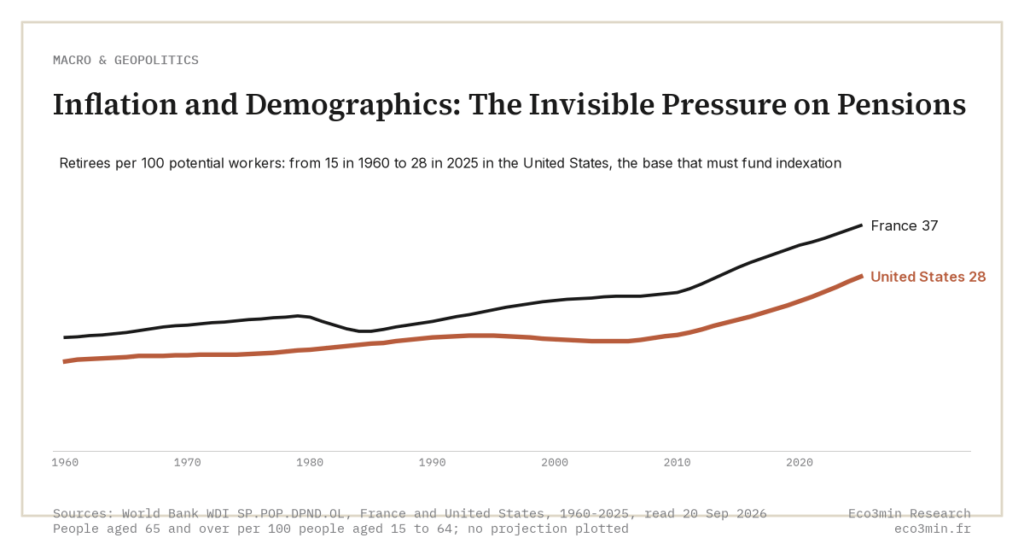
An inflation regime that lasts ten years redistributes wealth across generations as much as it does across income groups. The mechanism is mechanical, runs through pension systems, and operates regardless of stated indexation rules.
Pension benefits indexed to inflation appear to insulate retirees, but the indexation is almost always partial and lagged. Combined with longer life expectancies and rising healthcare costs, the result is a structural pressure that no advanced-economy pension system has fully addressed.
The 2021-2024 episode reopened the financial sustainability question for pension systems built during decades of low inflation. The point is set out at length in this analysis of fertility decline pension systems. The numerical impact differs sharply between pay-as-you-go public systems, defined-benefit corporate plans, and individual savings vehicles, but the direction is the same: every system designed for a 2% world is structurally exposed to a 5% world.
Three channels of pressure
Inflation pressures pension systems through three distinct channels operating on different timescales. The first is benefit erosion: nominal pension payments lose purchasing power between revisions, and the gap is rarely fully recouped even when indexation triggers. The second is liability revaluation: defined-benefit pension funds with long-duration nominal liabilities see the present value of those obligations rise sharply when inflation expectations re-anchor higher. The third is intergenerational redistribution through pay-as-you-go financing: contributions paid by current workers in nominal currency fund benefits to retirees whose claims also rise nominally, but the timing mismatch produces wealth transfers across cohorts. Related framing: the two-sided bet behind the deduction.
The three channels operate together and are difficult to separate empirically. Their joint effect was particularly visible in 2022-2023 across most advanced-economy systems, when several years of accumulated inflation surprise compressed real benefit levels even before indexation revisions caught up.
The benefit erosion channel
Most advanced-economy public pension systems index benefits to some measure of price or wage inflation, but with substantial frictions. France revises pension benefits annually based on a formula tied to forecast inflation; the United States Social Security uses a CPI-W-based COLA applied annually; Germany uses a wage-based formula with a sustainability factor. Each formula has gaps. France’s 2024 increase of 5.3% applied to most pensions partially compensated 2023 inflation but left the 2022 surge unreversed. The U.S. Social Security 8.7% COLA for 2023 was the largest since 1981 — itself an indication that previous adjustments had been smaller than realised inflation in years where the gap simply persisted.
The mechanical pattern: a one-year inflation surge of 5-8 percentage points above the rate priced into the benefit formula produces a permanent loss of real purchasing power equal to the gap, even with full subsequent indexation. The benefit base from which future percentage increases apply is permanently lower in real terms. Cumulative real benefit losses across the 2021-2024 episode were estimated by the OECD at 5-12% of pre-inflation real benefit level for most advanced-economy public systems, with substantial variation depending on indexation rules and frequency.
The liability revaluation channel
The generational accounting framework developed by Alan Auerbach, Jagadeesh Gokhale and Laurence Kotlikoff in the 1990s computes the lifetime net present value of taxes paid minus benefits received for each birth cohort. Applied to pension systems under inflation, the framework reveals that even a partially indexed system redistributes resources across cohorts based on the timing and magnitude of inflation surprises. The OECD‘s Pensions at a Glance 2023 publication used a related methodology to project the impact of the 2021-2024 inflation surge on long-term pension sustainability across 38 member countries, finding that systems with full automatic indexation faced larger immediate fiscal pressure but smaller intergenerational redistribution, while systems with partial indexation showed the inverse pattern.
For defined-benefit corporate pension funds, the inflation episode produced a complicated balance-sheet picture. Nominal pension liabilities rose with discount rate adjustments — a higher inflation environment typically pushes long-term discount rates higher, which actually reduces the present value of future nominal liabilities. The net balance-sheet effect for many large U.S. and U.K. corporate pension plans was favourable in 2022-2023, with funded ratios improving by 5-15 percentage points. Pension funds in continental Europe, with different liability structures, saw mixed outcomes.
The interaction between inflation, real interest rates, and the pension liability discount factor is the dominant short-term effect for defined-benefit funds. The longer-term effect, the additional real cost of paying inflation-indexed benefits over decades, is only partially captured in mark-to-market liability valuations and accumulates more slowly through actuarial revisions.
The intergenerational redistribution channel
The pay-as-you-go (PAYG) structure of most public pension systems creates a direct intergenerational mechanism under inflation. Current workers contribute in current-period nominal wages, which adjust to inflation with a lag. Current retirees receive benefits indexed (with friction) to inflation. The mismatch between the timing of contribution adjustments and benefit adjustments produces a wealth transfer in either direction depending on which side adjusts faster, and adjusts more fully.
The 2021-2024 European pattern was that benefit indexation, while imperfect, generally adjusted faster than contribution-base wages, particularly in the early phase of the inflation surprise. The result was a transitory transfer from current workers to current retirees, mechanically reducing the system’s surplus or widening its deficit. Over 2024-2026, as wage adjustments catch up and benefit indexation normalises, the direction may partially reverse, but the cumulative wealth transfer across the inflation episode is unlikely to be fully neutralised.
The longer-term sustainability question is more structural. As populations age, the ratio of contributors to beneficiaries declines, raising the implicit per-worker tax required to maintain benefit levels. Inflation surprises that compress benefit levels mechanically reduce the implicit tax, but at the cost of real benefits below the legislated path. The political economy of correcting the gap typically produces a benefit revision that adjusts only partially, leaving the cumulative gap permanent. This is the structural condition documented across decades of pension reform debates and visible in the long-term sustainability projections of every major OECD pension system.
The Modigliani life-cycle complication
Beyond the public pension system, the inflation regime affects the broader savings architecture for retirement. Franco Modigliani’s life-cycle hypothesis, that households accumulate savings during working years and dis-save during retirement, predicts a specific savings-to-income trajectory. Inflation distorts the trajectory in two ways: it erodes the real value of accumulated savings (the cumulative cost documented in the analysis of inflation and savings inertia), and it raises the savings rate required to achieve a given real retirement income.
The 2021-2024 episode produced a measurable shift in retirement savings adequacy across advanced economies. Workers within ten years of retirement, with savings concentrated in nominal fixed-income instruments, faced the largest real losses. The OECD estimated that the average pre-retirement household saw real net retirement wealth decline by 8-15% over 2022-2024 in countries with low equity allocation in retirement savings, and by 2-6% in countries with higher equity allocation. The dispersion across allocation patterns was as wide as the dispersion across countries. Behind that dispersion sits the cohort arithmetic set out in the count of Americans aged 65 and over against children.
Healthcare cost compounding
A specific component of retiree consumption, healthcare, has historically inflated faster than headline CPI in most advanced economies. The structural drivers (technology cost growth, demographic demand pressure, regulated pricing) are largely independent of monetary policy and persist through both inflation and disinflation regimes. For a structured reading of the mechanism, see our analysis: Inflation Explained: Mechanisms, Measurement, History and Effects. The mechanism is taken apart in Eco3min’s framework for reading inflation regimes. For retirees whose pension benefits are indexed to general CPI but whose actual consumption basket is healthcare-heavy, the experienced inflation rate exceeds the indexation rate by a measurable margin year after year.
U.S. CPI for medical care has averaged 1-2 percentage points above headline CPI over the past three decades (BLS data). The cumulative effect across a 25-year retirement period reduces real benefit purchasing power by roughly 25-50% beyond what general CPI indexation captures. This is the silent variant of the regressive incidence documented for the wider household income distribution: retirees face a structurally higher inflation rate than their indexation formula compensates, with the gap compounding over the retirement horizon.
“Pensions are indexed to inflation, so retirees are protected.” This is partially true and structurally misleading. Indexation is almost always partial: the index used (general CPI rather than retiree-specific consumption), the timing (annual revision against monthly inflation), and the formula (full COLA versus capped or sustainability-adjusted formulas) all leave gaps that compound over the retirement horizon. The OECD documented that even fully indexed systems typically deliver real benefit growth 0.5-1.5 percentage points below the inflation rate experienced by retirees over multi-year periods.
Inflation redistributes wealth across generations as silently as it does across income groups — through indexation gaps that compound for as long as a retirement lasts.
What the next decade implies
The dominant policy consensus expects inflation to revert to target by 2026-2027 in most advanced economies. The mechanisms described here suggest that the cumulative damage from the 2021-2024 episode has already been done: indexation gaps are typically not retroactively corrected, real pension benefit bases are permanently lower, and the intergenerational wealth transfer of the period is unlikely to fully reverse. The next inflation episode, whatever its date, will operate on a pension system whose structural exposure has not been materially altered.
The specific risk for the 2025-2035 window is the interaction between continued ageing, higher real interest rates (which raise the required pension fund discount rate), and the political pressure to restore real benefit levels eroded by 2021-2024. Each of these dynamics points toward higher fiscal pressure on public pension systems, regardless of the inflation rate prevailing in any given year. The structural sustainability question that links pension financing to broader fiscal dynamics will likely dominate pension policy debate in advanced economies through 2030.
- Inflation pressures pension systems through three channels: benefit erosion (partial indexation creates permanent real losses), liability revaluation (mark-to-market effects can be favourable short-term), and intergenerational redistribution (PAYG timing mismatches transfer wealth across cohorts).
- The OECD estimated cumulative real benefit losses of 5-12% across most advanced-economy public pension systems over the 2021-2024 episode, with substantial variation depending on indexation frequency and formula.
- The Auerbach-Gokhale-Kotlikoff generational accounting framework reveals that even partially indexed systems redistribute resources across cohorts based on inflation surprise timing — losses are typically not recouped retroactively.
- Healthcare cost inflation runs structurally 1-2 percentage points above headline CPI, compounding indexation gaps for retirees whose consumption basket is healthcare-heavy over a 25-year retirement horizon.
The pension channel sits inside the wider system mapped in the complete guide to inflation mechanics, measurement and effects. It connects across the distributive and fiscal channels documented elsewhere in the cluster (debt erosion, regressive consumption incidence, and state-side fiscal beneficiaries) each operating on a different timescale than the multi-decade pension horizon. The household-level mechanics are anchored by the real return on savings accounts framework, by the consequences of sustained negative real rates on retirement wealth accumulation, by the underlying mechanics of purchasing-power erosion, and by the canonical real-versus-nominal returns framework. For the institutional context on pension architecture, the sub-pillar on financial tools and decision frameworks situates the household-level retirement question within the broader macro-financial regime.
Last updated — 6 October 2026
Disclaimer – Financial and Legal Information: The analyses, commentary, and content published on eco3min.fr are provided for informational and educational purposes only. They do not constitute investment advice or a solicitation to buy or sell financial instruments. Past performance is not indicative of future results. All investment decisions involve risk and are the sole responsibility of the reader. Data, charts and calculated series are provided as is and may contain errors or lag behind their source: check any figure against the primary source cited before relying on it. Content describing laws, regulations or contracts reflects the law as of its publication date and does not constitute legal or tax advice; applying it to a specific situation requires a qualified legal or tax professional.
Regulated and tax values: the rates, indices, caps and brackets with legal effect cited on this page are set by official decision, change over time and apply according to individual circumstances. Only the official publication in force on the relevant date is authoritative (for example the Journal officiel, INSEE, Banque de France, the IRS or the Social Security Administration). To revise a rent, sign or challenge a contract, or file a return, check the value at the source or with a professional.
Read next
Full pillar →Shelter Inflation: Why Housing Dominates the CPI
Shelter inflation: why a single component representing roughly one-third of the U.S. CPI basket dominates the headline number,…
The 1930s Deflation: How Falling Prices Engineered a Depression
From 1929 to 1933, US prices fell 27% cumulatively, GDP contracted 29%, and unemployment reached 23.6% — the…
The Great Moderation (1990-2007): Why Inflation Disappeared
From the early 1990s to 2007, US output volatility fell by approximately 50%, inflation volatility by 70%, and…