
The Volcker Shock (1979-1982): How the U.S. Broke Inflation
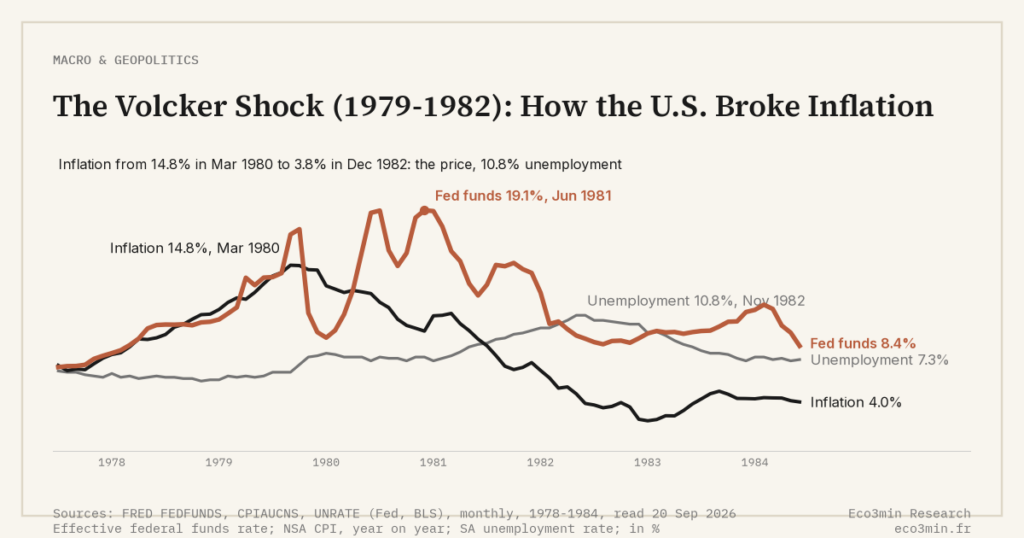
From 13.3% inflation in November 1979 to 3.8% by December 1982, the Volcker Federal Reserve achieved one of the largest disinflations in monetary history — at the cost of 10.8% unemployment and a 16-month recession.
A central bank that demonstrated, by enduring political and economic costs, that inflation could be broken. The episode produced the empirical foundation for the credibility-based theory of monetary policy that has shaped every central bank framework since.
The Volcker disinflation is routinely described as a triumph of monetary tightening. The more accurate reading is that Volcker did not break inflation by raising rates — he broke it by demonstrating that the Federal Reserve would tolerate an unprecedented recession to do so. The mechanism was credibility, not the level of the federal funds rate.
The starting position: a decade of accommodation
When Paul Volcker was appointed Federal Reserve Chairman on August 6, 1979, US inflation was running at 11.8% annual and accelerating. Core CPI had risen from 3% in 1972 to over 11% by mid-1979, with the second oil shock (1979) adding momentum. This climb in stages is traced in the only durable escalation — the 1970s — set against the complete series. The previous Fed chairmen — Arthur Burns (1970-1978) and G. William Miller (March 1978-August 1979) — had presided over an era of accommodative monetary policy widely interpreted as politically constrained: real federal funds rates had been negative for most of the decade, with brief tightening episodes followed by reversals once unemployment rose.
The intellectual diagnosis was contested. Monetarists led by Milton Friedman argued that inflation was a monetary phenomenon requiring monetary tightening. Keynesian economists pointed to supply shocks and wage-price dynamics, suggesting that monetary policy could not address the underlying problems without producing intolerable unemployment. The expectations literature — building on Lucas, Sargent, and Wallace — proposed a third reading: inflation persistence reflected agents’ rational expectation that the Fed would not endure the costs of disinflation, an expectation that itself made disinflation more costly.
The credibility framework formalised by Goodfriend and King (2005) reconstructs the Volcker disinflation as a regime change verified through observed Fed behaviour rather than announced policy. The methodology compares pre-1979 expected inflation paths (extracted from breakeven rates and survey measures) with realised paths after the regime change, isolating the contribution of credibility to the disinflation trajectory. The result: roughly half of the disinflation came not from monetary tightening per se but from the re-anchoring of expectations once agents observed that the Fed would tolerate recession to deliver lower inflation. The framework reframes monetary policy as fundamentally about credibility commitment, not interest rate manipulation.
October 6, 1979: the procedural revolution
The decisive moment came on Saturday, October 6, 1979, when Volcker announced a major change in operating procedure: the Federal Reserve would target nonborrowed reserves rather than the federal funds rate, allowing market-determined rates to rise without political constraint. The Fed funds rate, which had been 11.4% on October 5, rose to 13.8% within weeks and reached 17.6% by April 1980. After a brief recession-driven decline in mid-1980 (during which Volcker faced significant political pressure including from the Carter White House), rates resumed climbing, peaking at 22.4% in July 1981 (effective Fed funds, intraday peaks reached above 20% sustained).
The economic cost arrived rapidly. Unemployment, at 5.9% when Volcker took office, rose to 7.5% by mid-1980 (first recession), declined briefly, then rose again to a peak of 10.8% in November-December 1982 — the highest level since the Great Depression. The 1981-1982 recession lasted 16 months (July 1981 to November 1982), the longest postwar recession until the 2008 financial crisis. Real GDP contracted by 2.7% peak to trough. Manufacturing employment fell by 2.5 million jobs. Latin American sovereign debt crises followed, with Mexico’s August 1982 default triggered directly by US dollar interest rates.
The credibility break and its measurement
The disinflation evidence is unambiguous. CPI inflation fell from 13.5% in 1980 to 3.2% in 1983 — a 10.3 percentage point reduction in three years. Core CPI followed: from 12.4% peak in 1980 to 3.7% by 1985. Long-term inflation expectations, measured through the University of Michigan consumer survey, declined from 9.7% in early 1980 to 4.5% by mid-1983. Eco3min lays this out in our reading of price dynamics. The 10-year Treasury yield, which had peaked at 15.8% in September 1981, declined to 10.2% by December 1983 as inflation expectations re-anchored.
The mechanism documented by subsequent research was specifically credibility-based. Lindsey, Orphanides, and Rasche (2005), reviewing the October 1979 reform internally at the Federal Reserve, argued that the procedural change served primarily a signalling function: by committing to a monetary aggregate target rather than an interest rate, the Fed announced that it would no longer ease in response to political pressure. The signal was credible only because it was costly — the Fed accepted recession and unemployment levels that would have triggered policy reversal under prior frameworks. The expectations re-anchoring described by inflation expectations models requires precisely this kind of observable cost-bearing.
The Volcker episode is routinely described as proof that aggressive rate hikes can break inflation. The more accurate reading is that rate hikes were a means, not the mechanism. The mechanism was the demonstration that the Fed would endure costs to deliver disinflation. Subsequent disinflation episodes — Greenspan 1989-1991, Trichet 2008, Powell 2022-2024 — have all involved rate hikes, but none has approached the level (effective rates above 20%) or the duration (sustained for 14 months) of the Volcker tightening. The reason is that subsequent episodes inherited the credibility built by Volcker; they did not need to rebuild it from scratch.
The Phillips curve experiment
The Volcker disinflation also constituted the largest natural experiment on the Phillips curve in postwar US data. The unemployment cost of disinflation — measured by the “sacrifice ratio,” the cumulative unemployment-years required per percentage point of inflation reduction — was substantial: roughly 2.5 percentage point-years of unemployment per percentage point of disinflation, depending on the methodology. This number was higher than rational expectations theorists (Lucas, Sargent) had predicted but lower than traditional Keynesian models (which had suggested permanent disinflation might require permanently higher unemployment). The relationship between unemployment and inflation documented by the Volcker episode supported a modified rational expectations view: credibility reduces but does not eliminate the cost of disinflation.
The episode also produced the modern central bank doctrine of operational independence. The Fed’s resistance to political pressure during 1980-1982 — including from the Reagan administration after January 1981 — became the template for the formal independence frameworks adopted by the Bank of England (1997), the European Central Bank (1998), the Bank of Japan (1998), and successive emerging market central banks. The understanding that central banks raise rates to fight inflation only when they can credibly commit to doing so traces directly to the Volcker experience.
What Volcker teaches about disinflation
The episode confirms three lessons about disinflation with high empirical confidence. First, disinflation requires verifiable cost-bearing by the central bank, not merely announced policy intentions. Second, the costs are real but bounded: sacrifice ratios, while substantial, are smaller under credibility-based frameworks than under purely backward-looking models. Third, the institutional arrangements that permit credible commitment — operational independence, clear mandate, fiscal coordination — are themselves the durable contribution of the Volcker era, more important than the specific policy actions.
The episode is also informative about what disinflation does not require. The 1979-1982 tightening did not require fiscal contraction (Reagan-era deficits actually rose during the disinflation). It did not require wage-and-price controls (which Volcker explicitly rejected). It did not require coordinated international monetary action (the dollar appreciated sharply against other currencies, reflecting the unilateral nature of the policy). The framework that emerged — that monetary policy alone, credibly executed, can deliver disinflation — has been validated and refined in every subsequent inflation episode, including the 2022-2024 cycle in advanced economies. The historical record of US real interest rates documents the sharp swing from negative real rates in the late 1970s to peak positive real rates above 8% in 1981-1984, the visible signature of the regime change. The underlying detail is gathered in our study of the 1979-1982 Volcker shock.
Volcker did not break inflation by raising rates — he broke it by demonstrating that the Fed would tolerate a recession to do it.
The institutional legacy
The Volcker disinflation produced more than the immediate price stability of the 1980s. It established the empirical case for inflation targeting, central bank independence, and forward guidance — frameworks that structured the subsequent Great Moderation period (1990-2007) and that continue to organise contemporary monetary policy. The 2% inflation target currently adopted by the Federal Reserve, the European Central Bank, the Bank of England, and most other major central banks descends directly from the credibility-anchored framework that Volcker’s actions made operationally possible. The understanding of why the Fed targets 2% inflation rather than zero is itself a Volcker-era inheritance.
The long-run perspective matters: against the 113-year history of US inflation documented in long-run CPI data, the post-1982 period stands out as the most sustained low-inflation regime since the gold standard era. The detail of this logic is set out in the regimes where gold actually protects. Whether this regime survives the structural shifts of the 2020s — deglobalisation, demographic transition, fiscal pressures — is the central question of contemporary monetary policy. The analysis is carried further in our examination of inflation regime shifts. The relationship between real rates, inflation, and asset valuations established by the Volcker break and refined over four decades is documented in the real interest rates vs CAPE ratio dataset, which captures the long-run macro-financial signature of the regime change.
- Volcker reduced US inflation from 13.5% (1980) to 3.2% (1983), a 10.3 percentage point disinflation in three years.
- The Fed funds rate peaked at 22.4% in July 1981 (effective rate); unemployment peaked at 10.8% in November-December 1982 — the highest level since the Great Depression.
- The October 6, 1979 procedural change — targeting nonborrowed reserves rather than the funds rate — was primarily a signalling commitment to credibility, not a technical reform.
- Roughly half of the disinflation reflected re-anchoring of expectations, not the direct effect of tightening (Goodfriend-King 2005 framework).
- The episode established the empirical basis for inflation targeting and central bank independence — the institutional architecture that has organised monetary policy ever since.
For the complete lens, see the complete guide to inflation.
Last updated — 22 September 2026
Disclaimer – Financial Information: The analyses, commentary, and content published on eco3min.fr are provided for informational and educational purposes only. They do not constitute investment advice or a solicitation to buy or sell financial instruments. Past performance is not indicative of future results. All investment decisions involve risk and are the sole responsibility of the reader.
Read next
Full pillar →Reflation: Definition, Episodes and Market Implications
Reflation: a deliberate policy effort to lift prices toward target after a deflationary or sub-target period — and…
The 1930s Deflation: How Falling Prices Engineered a Depression
From 1929 to 1933, US prices fell 27% cumulatively, GDP contracted 29%, and unemployment reached 23.6% — the…
Why Central Banks Systematically Miss Inflation Forecasts
Central-bank inflation forecasts: systematically biased in the same direction across decades — and the empirical pattern reveals more…