Gold Protects in Some Regimes, Not Others: The Real Rate Behind the Inflation Story

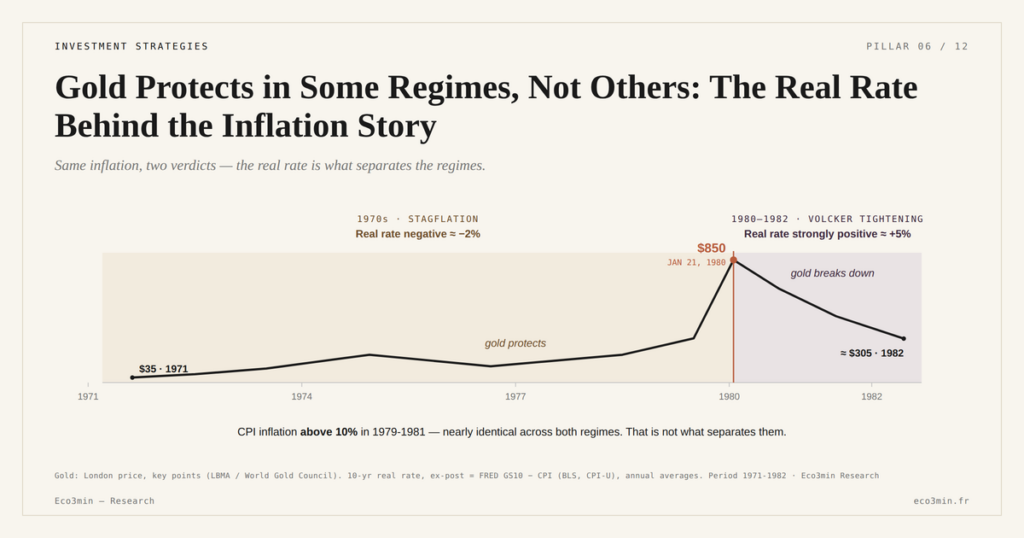
Gold has not protected against inflation in every regime: it surged in the 1970s, then fell between 1980 and 1982 while prices still rose. The factor that separates these episodes is the real rate.
TL;DR
Gold's inflation hedge holds only while real returns stay low; once a central bank drives real rates above inflation, the metal's carrying cost turns prohibitive and it breaks down.
- Through the 1970s gold ran from 35 dollars an ounce in 1971 to about 850 by January 1980 as inflation topped 13%, but much of that came in a final blow-off retraced within two years.
- It collapsed from 1980 to 1982 as Volcker's Fed drove real rates above 8% despite still-high inflation, and broke down again during the 2013 taper, the real rate rather than the price level marking the divide.
This piece replaces the reflex “gold hedges inflation” with a more exact reading: it protected depending on the real-rate regime, not every time prices rose.
“Gold hedges inflation” is repeated so often that few people test it. When they do, it cracks. Through the 1970s, gold did surge as prices spiralled. But from 1980 to 1982, inflation stayed high and gold collapsed — because the Federal Reserve, under Paul Volcker, had driven real rates to record highs. What separates the two episodes is not the inflation rate: it is the real rate. Gold protects when inflation erodes real returns; it breaks down when the central bank pushes those returns back above inflation. This piece recasts “does gold hedge inflation?” as “in which real-rate regimes has gold protected?”. A related read: our study on gold and real rates.
Two decades, two opposite verdicts
The best refutation of the myth fits in a single comparison. Through the 1970s, US inflation at times topped 13%, and gold ran from 35 dollars an ounce at the closing of the gold window in 1971 to around 850 dollars in January 1980. A spectacular protection, seemingly true to the story. Then the scenery flips: between 1980 and 1982, inflation stays high, but gold sheds most of its gains. If inflation alone drove the metal, the two sequences would be incomprehensible; read through the regime, they form a whole — exactly as the analysis governed by the real rate sets out.
What separates the two is the real rate. In the 1970s, nominal returns failed to keep pace with rising prices: real rates were nil or negative, and gold, which cost nothing to carry, captured the flight from eroded safe assets. From 1979, the Federal Reserve’s tightening drove real rates to record highs, exceeding 8% in real terms at times. Inflation had not vanished, but holding gold had suddenly become very costly — and the metal broke down. The same inflation therefore produced opposite outcomes, depending on whether the real return accompanied it or dominated it.
This reading is not confined to a distant episode. Whenever one isolates a period of high inflation, gold’s behaviour turns out to be governed by where the real rate stands, not by the inflation figure itself. Protection is neither automatic nor absent: it is conditional. It is that conditionality, not some intrinsic virtue of the metal, that should guide the reading.
A recent echo confirms the mechanics. Between 2020 and 2021, inflation accelerated while real yields plunged into negative territory: gold played its protective role and set records. Then, in 2022, the Federal Reserve raised rates faster than inflation, taking real yields back to positive — and the protection many expected from gold against the strongest inflation in forty years first proved hesitant, in 2022, as real rates climbed. Here again, it is the direction of the real rate, not the inflation figure alone, that decided.
The 1970s gains flatter the story in another way too. A large part of the run came in the final blow-off into the January 1980 peak, much of which was retraced within two years. Anchoring on the peak alone, rather than on the round-trip a holder actually lived through, inflates the sense of protection. Looking across the whole episode, the metal rewarded those positioned before the real-rate collapse and disappointed those who arrived near its end — a reminder that “protection” measured at a single point can mislead as much as the inflation figure itself.
Why inflation alone misleads
The myth rests on a common reasoning error: people remember the episodes where gold rose during inflation, and forget those where it fell despite it. “Gold rose during a period of inflation” slides into “gold protects against inflation.” The first is a one-off observation; the second, a general law the data do not support. Between the two sits a selection bias: one samples the years that confirm the story and ignores the rest.
To settle it cleanly, one has to reason on the real price of gold — its price relative to the general price level — not on the nominal price. Over the very long run, that real price fluctuates around averages rather than rising mechanically with inflation, which can be observed on the CPI-adjusted real gold price. The formal statistical demonstration — decomposing the gold-inflation relationship by horizon, measuring the famous “golden constant” — belongs to a dedicated analysis, the empirical gold–inflation test, to which this article delegates the quantification. Here the point stays qualitative: inflation alone is not enough to predict protection.
That delegation is deliberate. Confirming or refuting a statistical relationship requires a methodological apparatus — sub-periods, horizons, controlling for the real rate — that goes beyond this satellite’s scope. What matters here is the consequence for a holding: as long as one credits gold with unconditional protection, one is exposed to disappointment in the regimes where the real rate climbs, as in 1980-1982 or, more recently, in 2013 during the Federal Reserve’s taper.
The selection bias is reinforced by collective memory. The 1970s have become the cultural archetype of “gold against inflation,” while the 1980-1982 collapse has all but vanished from the popular story. Added to this is a confusion between nominal and real price: people readily cite the metal’s nominal records without adjusting for accumulated inflation, which overstates the apparent protection. Measured against purchasing power, gold’s record over some decades is markedly less flattering than the raw figure suggests.
What this changes for a portfolio’s protection
The consequence is direct: the protection gold offers is not a given, it is a state of the regime. In a phase where inflation surprises higher without real returns following — a central bank behind the curve, rates held low — gold has historically cushioned the loss of purchasing power. In a phase where the central bank raises rates above inflation, that protection vanishes. Recasting the question this way rejoins the sub-pillar’s thesis, where the right holding depends on the regime rather than on absolute qualities.
A second confusion must also be avoided: protecting against inflation and diversifying a portfolio are not the same thing. An asset can cushion monetary erosion without decorrelating from equities, and vice versa. Gold has sometimes delivered one without the other. That distinction — between conditional inflation protection and diversification, itself unstable — is precisely the ground of when gold truly diversifies, which closes the cluster. Protection by regime is therefore only one of the two functions often ascribed to the metal, and the only one treated here.
In practice, the useful question for a holder is not “is there inflation?” but “is the central bank ahead of it or behind it?”. When policy rates rise more slowly than prices, real returns fade and the footing turns supportive; when they rise faster, the footing closes. This reading frame does not say what gold will do tomorrow — it cannot — but it points to which parameter to watch in order to understand, after the fact, why it protected or did not.
When protection held, and when it gave way
Three observations, without extrapolation. First, gold protected purchasing power in regimes where inflation rose without a real-rate response — the 1970s are the archetype. Second, it gave way when the central bank pushed real returns back above inflation, in 1980-1982 as in 2013. Third, the discriminating test is never the inflation figure but where the real rate stands: it is the real rate, not consumer prices, that separates protective regimes from adverse ones.
Observing that gold rose during a period of inflation and concluding it “hedges inflation” confuses a one-off observation with a general law. That inference ignores the episodes where gold fell despite high inflation, as in 1980-1982. The variable that separates protection from breakdown is not the price level, but the real rate.
Frequently asked questions
Does gold hedge inflation?
Not systematically. Gold preserved purchasing power in regimes where inflation rose without real returns following, but it fell when real rates climbed back above inflation. Protection is conditional on the real-rate regime, not secured by the mere presence of inflation. That is precisely the variable isolated in what set the two price shocks’ winners apart.
Why did gold fall in the early 1980s despite high inflation?
Because the Federal Reserve, under Paul Volcker, raised policy rates enough to drive real rates to record highs. Gold’s holding cost became prohibitive, and the metal broke down — even as inflation stayed high. The real rate dominated inflation in setting gold’s behaviour.
Are inflation protection and diversification the same thing for gold?
No. Cushioning monetary erosion and decorrelating from an equity portfolio are two distinct functions. Gold has sometimes delivered one without the other; its ability to diversify also depends on the regime and is covered in a separate analysis. In depth: reading investment vehicles against the cycle.
Which indicator separates the regimes where gold protected?
Where the real interest rate stands, not the level of inflation. When real returns are low or negative, gold has historically cushioned the loss of purchasing power; when they climb back above inflation, that protection fades. The inflation figure alone cannot settle it.
Last updated — 12 July 2026
Disclaimer – Financial Information: The analyses, commentary, and content published on eco3min.fr are provided for informational and educational purposes only. They do not constitute investment advice or a solicitation to buy or sell financial instruments. Past performance is not indicative of future results. All investment decisions involve risk and are the sole responsibility of the reader.
Read next
Full pillar →Beneficiary Designations, the Step-Up in Basis, and the 10-Year Rule: How US Accounts Transfer at Death
At death, most US financial accounts pass outside the will, straight to a named beneficiary, under tax rules…
The Fee Stack in Variable Annuities: M&E Charges, Riders, and Subaccount Costs
A variable annuity does not carry one fee, but a stack of them. Mortality and expense charges, subaccount…
The Conventional 401(k)-Match-First Funding Order: Where It Comes From, How It Works
The question of what order to fund accounts in usually draws a fixed list, presented as a rule…