Momentum and Position Sizing: The Hidden Risk in Allocation
In 2026, momentum is increasingly a position-sizing question rather than a standalone return driver. Positive real rates and selective liquidity tighten the margin for error in concentrated factor exposures.

Momentum: in 2026, the principal risk is no longer the signal itself but the position size attached to it within a diversified portfolio.
TL;DR
Momentum's role changes in a positive-real-rate regime: from return driver to risk amplifier, where an oversized trending position can turn a sector rotation into a portfolio-wide drawdown.
- Momentum reverses asymmetrically: trends build gradually but unwind sharply, and a higher cost of capital reprices excessive expectations more quickly.
- In euphoric phases, leading momentum positions correlate with one another, producing an illusion of diversification that collapses into a collective loss when the trend turns.
- Whether momentum stays peripheral or becomes central to portfolio risk is gauged by its contribution to total volatility, concentration across the top three to five positions, and cross-correlation between trending holdings.
This content is strictly informational and educational. It does not constitute investment advice or a personalized recommendation.
Momentum: a factor that mostly shifts risk
In 2026, momentum remains present in market discussions. But in an environment of positive real rates, more selective liquidity, and increased dispersion in performance, it acts less as a standalone return driver and more as a relative-risk amplifier.
Within the broader framework of investment strategies and their allocation logic, momentum is not a structural pillar. It operates as a secondary factor whose impact depends entirely on the overall framework and the risk hierarchy in place.
This reading is consistent with the analysis of real policy rates: when the cost of capital becomes structuring, sectoral and factor rotations accelerate, and trend stability declines.
Why position sizing has become central
Since the post-2022 monetary regime change, markets no longer respond homogeneously. Outperformance concentrates in a reduced number of assets, and reversals are sharper.
In this context:
- an overweight position in a “trending” asset concentrates risk;
- drawdowns linked to sector rotations are more abrupt;
- the contribution to overall volatility becomes disproportionate.
Momentum stops being a simple directional signal: it becomes a weighting and risk-contribution problem.
The question is not whether momentum “works” but how to assess the share of total risk it represents when market regimes become unstable.
This logic aligns with the framework set out in the analysis of investment discipline: portfolio stability matters more than the search for episodic outperformance.
Momentum and the asymmetry of reversals
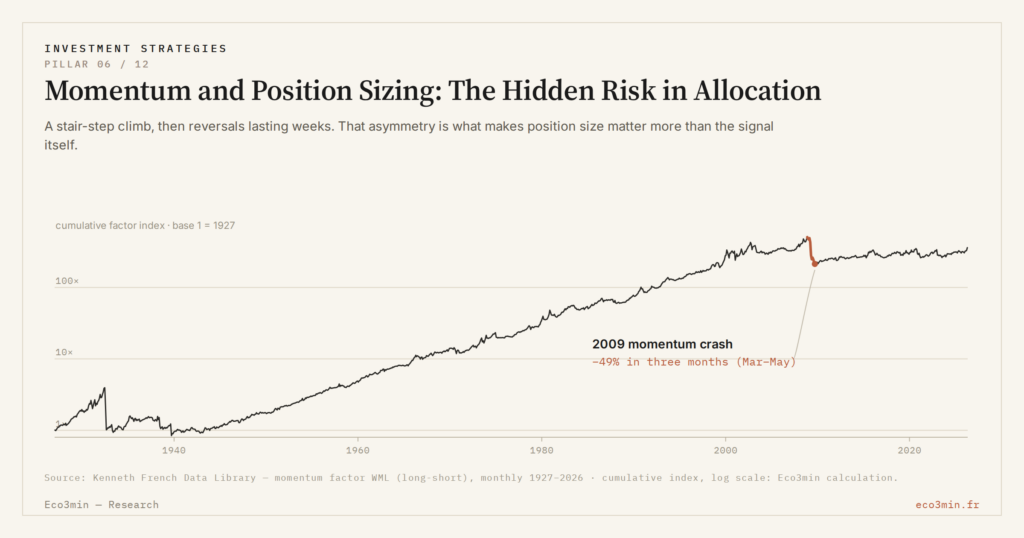
Momentum displays a structural asymmetry:
- upward phases are gradual;
- reversals are often rapid and violent.
In an environment of positive real rates:
- the cost of capital penalizes excessive expectations more quickly;
- index flows reverse rapidly during rebalancings;
- risk tolerance declines.
Excessive momentum exposure can thus turn a sectoral correction into a portfolio shock.
Momentum and internal correlation
In euphoric phases, momentum-leading assets tend to become correlated with each other. This creates an illusion of diversification: several different positions exposed to the same latent factor.
When the trend reverses, correlation rises further, and the loss becomes collective.
The relevant question is therefore not nominal weighting but marginal contribution to risk.
What consensus overlooks
Momentum is often treated as a stable style factor. In reality, it is a regime-dependent factor. Its robustness varies with:
- the level of real rates;
- sectoral dispersion;
- the depth of liquidity.
When the cost of capital rises, the margin for error narrows.
Useful indicators for framing momentum
- Momentum’s contribution to total volatility;
- Concentration of performance across the top three to five positions;
- Average rotation speed of trending assets;
- Cross-correlation between “momentum” positions.
These indicators do not signal when to enter or exit. They measure whether momentum remains a peripheral factor or becomes central in the structure of risk.
Conclusion
In 2026, momentum is not obsolete. It remains informative. But in a fragmented and more demanding market regime, it becomes above all a question of position-sizing discipline.
The real risk is not the signal itself but the size of the capital attached to it.
Takeaway: in an environment less tolerant of error, risk management precedes directional conviction. Momentum can contribute to performance, but only when it remains proportionate to the overall portfolio architecture. A related perspective: our breakdown of aligning portfolio exposure with the economic cycle.
Last updated — 12 July 2026
Disclaimer – Financial Information: The analyses, commentary, and content published on eco3min.fr are provided for informational and educational purposes only. They do not constitute investment advice or a solicitation to buy or sell financial instruments. Past performance is not indicative of future results. All investment decisions involve risk and are the sole responsibility of the reader.
Read next
Full pillar →Beneficiary Designations, the Step-Up in Basis, and the 10-Year Rule: How US Accounts Transfer at Death
At death, most US financial accounts pass outside the will, straight to a named beneficiary, under tax rules…
The Fee Stack in Variable Annuities: M&E Charges, Riders, and Subaccount Costs
A variable annuity does not carry one fee, but a stack of them. Mortality and expense charges, subaccount…
The Conventional 401(k)-Match-First Funding Order: Where It Comes From, How It Works
The question of what order to fund accounts in usually draws a fixed list, presented as a rule…