Position Sizing: The Quiet Parameter That Sets Real Portfolio Risk
Position sizing is the most underestimated lever of portfolio risk. How to calibrate stakes in 2025 to limit drawdowns without sacrificing return potential.

Position sizing: how to calibrate stake size to limit drawdowns without sacrificing portfolio return potential.
TL;DR
The same investment idea can produce very different portfolio outcomes depending on how much capital each decision commits, the parameter most top-down allocation work overlooks.
- Volatility makes sizing decisive: daily index moves of ±3–4% can turn a poorly calibrated line into a forced exit.
- Equal nominal amounts carry different risk: volatility and correlation, not headline value, drive a position's actual contribution to drawdown.
The numerical examples and rules cited in this article are provided strictly for educational and illustrative purposes. They do not constitute investment advice or a personalized recommendation, and must be adapted to each individual situation.
Solid investment ideas can still deliver a mediocre portfolio. The reason often lies elsewhere: position sizing. In 2025, with markets near their highs, volatility returning in clusters and ETF flows running heavy, the question is no longer just what to buy, but how much to commit to each decision.
Position sizing is not a standalone technique but the concrete expression of a stable decision framework applied consistently over time.
This logic is developed in the reference analysis on investment discipline, which underpins the strategies covered on Eco3min.
This quiet parameter is the direct link between the broad principles of
investment strategies
and their concrete translation into a real portfolio.

Three Key Takeaways
- Current volatility puts sizing at the center: daily index moves of ±3–4% are enough to turn a poorly calibrated position into a source of stress or forced exit.
- The consensus underestimates this lever: many approaches focus on top-down allocation (equities, bonds, cash) but overlook the cumulative impact of a few oversized positions.
- A simple rule is more robust than intuition: moving from “gut-feel” sizing to a quantified cap sharply reduces the dispersion of outcomes between good and bad decisions.
What This Reveals at a Deeper Level
The macro context partly explains why sizing has returned to the foreground. As of late 2025, policy rates remain elevated and real rates are positive again, raising the cost of errors and reducing the market’s tolerance for excess. This dynamic is examined in more detail in
this analysis on the role of real policy rates.
In practice, cash earns yield again, dispersion widens, and every sizing decision becomes an explicit trade-off between assumed risk and opportunity cost.
At the micro level, index concentration in a handful of large caps amplifies this effect: an oversized position in an asset highly correlated with the market can erase several months of gains elsewhere, while an undersized one limits the impact of a sound thesis. On this, see our reference page on portfolio risk management and survival before performance.
Practical Implications for a Diversified Portfolio
- Define a clear envelope: a simple structure (long-term core, satellites, risk sleeve) bounds the maximum size per line according to risk level.
- Reason in risk rather than nominal amount: two assets of equal nominal value can carry very different risks depending on volatility and correlation.
- Link sizing to overall drawdown: when a portfolio drifts far from its peak, mechanically reducing the size of new positions has historically prevented further deterioration during adverse phases.
Quiet Signals to Watch
- Unstable implied volatility: frequent VIX round-trips signal a choppy regime poorly suited to concentrated positions.
- Rising sectoral correlations: stacking similar lines often amounts to a single disguised bet.
- More fragile microstructure: short-dated options and frequent gaps reinforce the case for conservative sizing on speculative assets.
Plausible Scenarios and Sizing Adjustments
- Controlled slowdown: gradual increase of maximum size on core assets, while keeping strict caps on risk segments.
- Macro or credit shock: rapid reduction of unit sizes and a temporary rise in cash allocation.
- Regime volatility: a series of small test positions rather than a single concentrated bet.
In this framework, sizing is not an optimization tool but a coherence mechanism: it allows a strategy to be applied without being distorted under stress or volatility.
Bottom Line
- Position sizing is the most underestimated parameter of realized performance.
- One or two miscalibrated lines can dominate the entire risk profile.
- Formalizing simple sizing rules turns a theoretical strategy into a process that can actually be steered.
In an environment where rates, volatility and correlations shift quickly, position sizing acts as a silent shock absorber: it does not guarantee performance, but it conditions the ability to stay invested long enough for sound decisions to bear fruit.
Last updated — 4 July 2026
Disclaimer – Financial Information: The analyses, commentary, and content published on eco3min.fr are provided for informational and educational purposes only. They do not constitute investment advice or a solicitation to buy or sell financial instruments. Past performance is not indicative of future results. All investment decisions involve risk and are the sole responsibility of the reader.
Read next
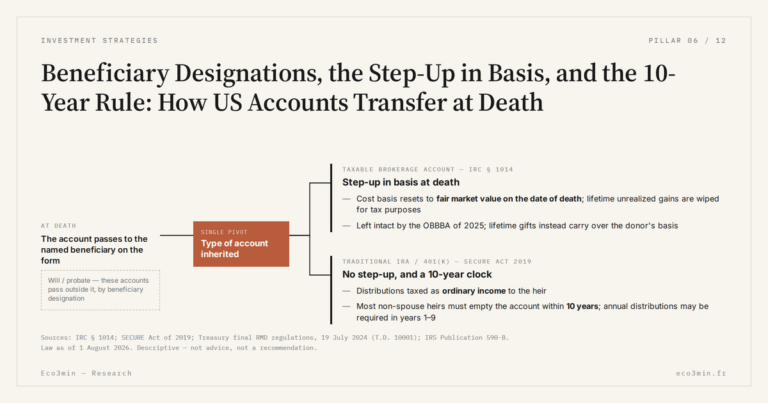
Full pillar →Beneficiary Designations, the Step-Up in Basis, and the 10-Year Rule: How US Accounts Transfer at Death
At death, most US financial accounts pass outside the will, straight to a named beneficiary, under tax rules…
The Fee Stack in Variable Annuities: M&E Charges, Riders, and Subaccount Costs
A variable annuity does not carry one fee, but a stack of them. Mortality and expense charges, subaccount…
The Conventional 401(k)-Match-First Funding Order: Where It Comes From, How It Works
The question of what order to fund accounts in usually draws a fixed list, presented as a rule…