Restrictive Monetary Policy: Effects After the Rate Peak
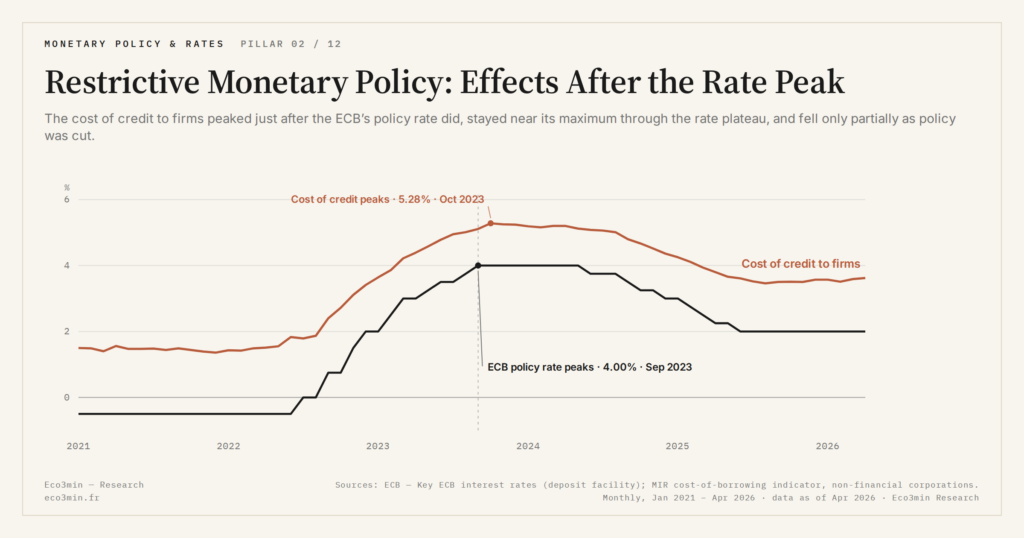
The effects of restrictive monetary policy often appear after rates stabilize, through bank balance-sheet inertia. The cost of liabilities, asymmetric adjustment and credit transmission explain the lag.

Restrictive monetary policy rarely acts where it is expected to. Its most durable impact often appears after rates have stabilized, through lagged and asymmetric transmission channels.
TL;DR
After the rate peak, tightening migrates into bank balance sheets: liabilities reprice faster than fixed-rate loans, squeezing margins and quietly contracting credit for quarters with no further hikes.
- By late 2025 the average rate on euro-area household term deposits reached about 2.7%, against under 0.5% in 2021, compressing net interest margins even with no new hikes.
- Since autumn 2025, loan supply to SMEs contracted a cumulative 5% to 7% year-on-year while policy rates held steady across several meetings, a continuous erosion rather than a shock.
- Euro-area growth held near 0.5% in 2025 as inflation receded toward 2%, with the main drag on activity shifting from prices to financing conditions.
- Loans booked at fixed or slow-resetting rates keep earning on old terms while liabilities adjust quickly, turning monetary tightening into a balance-sheet phenomenon.
When policy rates stop rising, the financial tightening does not disappear immediately. It often extends through bank balance sheets, where the adjustment between assets and liabilities unfolds slowly and asymmetrically.
The central point of friction is not the level of rates itself, but the way banks pass through a structurally higher refinancing cost onto their balance sheets. When policy rates stop rising, financial conditions can continue tightening through accounting, prudential and behavioural inertia.
This lag explains why the real economy often absorbs the shock after the most visible phase of tightening. The general mechanism is set out in the reference analysis on the transmission of monetary policy to the real economy. The point here is more specific: understanding why a restrictive monetary policy continues producing effects even after rates have stopped surprising. The wider picture is drawn in our examination of how rate cycles reshape corporate results.
The quiet trigger: the cost of bank liabilities
In the euro area, the cumulative rise in policy rates since 2022 has progressively raised the cost of remunerated deposits and market funding. By late 2025, the average rate paid on household term deposits stood at around ≈2.7%, against less than 0.5% in 2021. This shift weighs directly on net interest margins, even absent further rate hikes.
The key point is temporal: loans extended at fixed or slowly resetting rates continue to earn under older conditions, while liabilities adjust more rapidly. Monetary tightening then becomes a balance-sheet phenomenon, not merely a matter of rate policy.
Implicit consensus and alternative reading
This inertial tightening after rates have stabilized fits within the mechanisms and lagged effects of restrictive monetary policy, which show that the core of the adjustment runs through balance sheets and credit conditions rather than fresh rate decisions.
Part of the consensus expects that stabilizing policy rates is sufficient to stabilize financial conditions. This reading assumes a rapid and symmetric adjustment between bank assets and liabilities.
Conflating rate stabilization with looser financial conditions. A pause in policy rates does not imply an immediate easing of credit.
The analysis diverges on one specific point: the adjustment is asymmetric and lagged. Banks tend to preserve their solvency ratios by progressively tightening lending standards, even absent further monetary impulse. This behaviour extends the restrictive effect well beyond the rate peak.
What is quietly shifting
Since the autumn of 2025, credit surveys have shown a cumulative contraction in the supply of loans to SMEs of roughly ≈5% to 7% year-on-year, even as policy rates have stayed stable across several meetings. This is not a sharp shock, but a continuous erosion of financing access.
Restrictive monetary policy thus becomes self-reinforcing: less credit, less investment, hence weaker demand, which retroactively validates the banks’ caution.
Observable macroeconomic implications
At the macro level, this lag explains why disinflation can coexist with belatedly slowing activity. In 2025, euro area growth stayed close to ≈0.5%, even as inflation receded toward 2%. The main drag was no longer prices, but financing.
For firms, the impact is heterogeneous: large groups with access to bond markets cushion the shock better than borrowers reliant on bank credit. For households, the channel is indirect: more uncertain employment, deferred consumption trade-offs.
What readers really want to know
Behind the question on restrictive monetary policy, the real concern is not whether rates will rise further, but whether the tightening is already behind us. The main risk is that the most binding effects often appear once attention has eased.
Relevant monitoring indicators
- Lending rate / policy rate gap: measures the degree of effective transmission.
- New lending volumes on a rolling 3- and 12-month basis.
- Average cost of bank deposits, a key indicator of margin pressure.
Alternative scenarios to keep in mind
This scenario assumes that the implicit prudential tightening continues. It could be invalidated by regulatory loosening, a positive liquidity shock or a stronger-than-expected rebound in credit demand. Conversely, an exogenous shock to funding costs could amplify these lagged effects. On the same question: how your credit score affects borrowing costs.
- Monetary tightening can persist after the rate peak, even without further hikes in policy rates.
- The key channel runs through bank balance sheets, with rapid liability adjustment and slow loan-asset response.
- The main risk is not a sharp shock, but a discreet, gradual and cumulative tightening of credit conditions.
Reading perspective
Restrictive monetary policy is not reducible to a rate level. Its most lasting influence runs through slow, often invisible channels that keep acting after the visible peak of tightening has passed. This is not the base-case scenario today, but it deserves attention precisely because it is less visible.
To place this analysis within a broader view, the pillar page on monetary policy and rates details the general mechanisms and their macroeconomic interactions.
Last updated — 12 July 2026
Disclaimer – Financial Information: The analyses, commentary, and content published on eco3min.fr are provided for informational and educational purposes only. They do not constitute investment advice or a solicitation to buy or sell financial instruments. Past performance is not indicative of future results. All investment decisions involve risk and are the sole responsibility of the reader.
Read next
Full pillar →Real Rates: The True Cost of Capital Is Repricing
Why real rates are reasserting themselves as markets' anchor and how to recalibrate investment and financing decisions facing…
Real Interest Rates: The Quiet Signal Reshaping Markets
Real interest rates: why their persistence in positive territory in 2026 is reshaping the rules for bonds, equities,…
OAT-Bund Spread: A Quiet Gauge of French Sovereign Risk
OAT-Bund spread: how this yield gap has become a key signal on French sovereign risk, fiscal policy and…