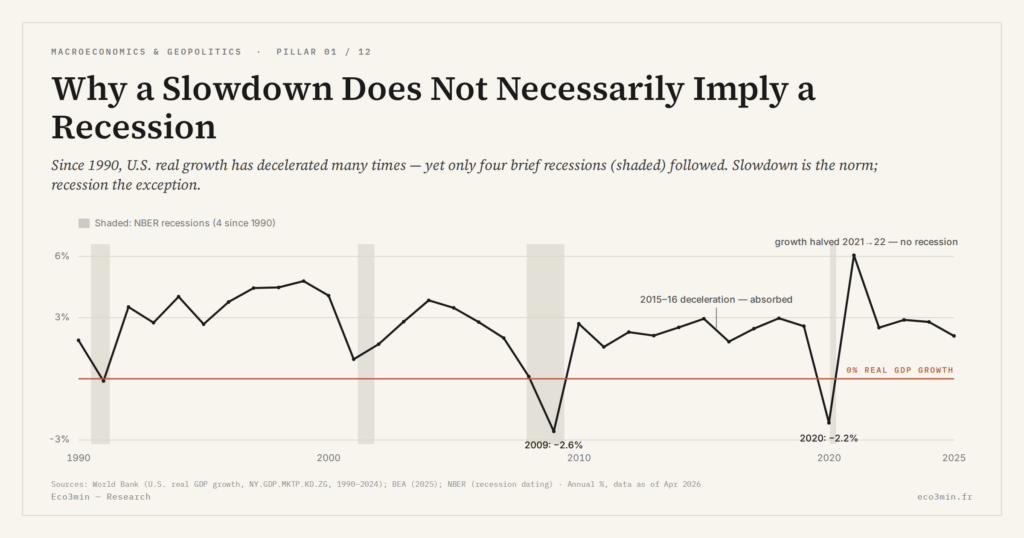
Why a Slowdown Does Not Necessarily Imply a Recession
Slowdown becomes recession only when internal absorption mechanisms fail — inventory drawdowns, labour market resilience, credit deceleration without contraction. Most slowdowns observed since 1990 did not fail, and the texture of the slowdown matters more than its existence.

TL;DR
Internal buffers (inventory drawdown, labour-market inertia, orderly credit normalisation) absorb most decelerations before activity contracts, which is why fewer than half of slowdowns since 1990 became recessions.
- Inventory swings distort the read: the BEA put inventories' contribution to US GDP growth between −0.3 and +0.5 points across Q2 to Q4 2025, a routine adjustment that looks like a turning point only in isolation.
- Employment inertia holds demand up, with euro-area household consumption near 54% of GDP (Eurostat), as firms trim overtime, freeze hiring and use attrition before net job cuts arrive late.
- Normalisation differs from rupture by texture: the OECD recorded G7 private-sector credit growth slowing from 6.2% to 3.8% year-on-year between early 2024 and mid-2025, a deceleration rather than a contraction.
The buffers that absorb a slowdown
When growth decelerates, several internal adjustments fire before contraction materialises. Inventory cycles play a leading role: firms run down excess stock, which mechanically weighs on production without signalling a drop in final demand. The US Bureau of Economic Analysis estimated that the contribution of inventories to GDP growth oscillated between −0.3 and +0.5 percentage points between Q2 and Q4 2025 — a classic adjustment that, read in isolation, looks like a turning point but is not one. The labour market is the second buffer. As long as employment holds, household consumption — around 54% of euro-area GDP according to Eurostat — sustains a base of domestic demand that does not collapse with the first signs of weakness. Firms tend to favour the progressive adjustment logic described in real cycle analysis rather than immediate mass layoffs: overtime reductions, hiring freezes, attrition. Net job cuts arrive late, well after the first indicators have already begun to recover.Normalisation versus rupture: an operational distinction
The market default treats every slowdown as transitory. That reading carries its own symmetric risk: missing a genuine reversal because the narrative is already written in favour of soft landing. The operational distinction comes from the texture of the slowdown, not its existence. Post-expansion normalisation differs from structural rupture on three markers: bank credit decelerates without contracting, corporate margins recede moderately without triggering a defaults wave, and investment flows slow without reversing. The OECD noted in November 2025 that private-sector credit growth in G7 economies had decelerated from 6.2% to 3.8% year-on-year between early 2024 and mid-2025. A significant slowdown — but credit was still expanding. This is what cyclical normalisation looks like at scale. The configurations specific to each phase of the cycle help situate this kind of signal in its mechanical context rather than projecting an alarmist reading onto it.When the buffers reach their limits
These absorption mechanisms are not unlimited. Their effectiveness depends on the depth of the slowdown, its duration and the debt accumulated during the preceding expansion. If the slowdown extends beyond three or four quarters, the margin narrows fast: hiring freezes turn into restructuring plans, the most vulnerable households cut consumption, and automatic fiscal stabilisers weigh on public finances without offsetting the demand shock. An exogenous shock — monetary tightening sharper than expected, an abrupt reversal of capital flows, a confidence crisis on the bond market — can also accelerate the transition into contraction. The fundamental dynamics of the business cycle show that the boundary between an absorbable slowdown and an effective recession is never fixed: it depends on the initial state of the financial system, the level of household and corporate leverage, and the responsiveness of public policy. That endogenous variability is precisely what makes real-time diagnosis difficult and why most forecasts get the turning point wrong.What this dynamic implies in practice
A slowdown is not an unambiguous signal. Its trajectory depends on how internal adjustments — inventories, employment, credit — interact with external constraints — monetary policy, financial conditions, demand shocks. The robust diagnostic identifies the texture of the slowdown before speculating on its outcome. Projecting a recession onto every deceleration is statistically the wrong default: the base rate of slowdowns becoming recessions is well below 50% across OECD economies since 1990.Last updated — 23 June 2026
Disclaimer – Financial Information: The analyses, commentary, and content published on eco3min.fr are provided for informational and educational purposes only. They do not constitute investment advice or a solicitation to buy or sell financial instruments. Past performance is not indicative of future results. All investment decisions involve risk and are the sole responsibility of the reader.
Read next
Full pillar →Monetary Tightening: How Central Banks Are Reshaping Financial Markets
After more than a decade of ultra-accommodative policy, monetary tightening has reintroduced the real cost of capital as…
Hidden Unemployment: Reading the Real Labor Market in 2026
Headline unemployment is stabilizing while broad underemployment still runs above pre-2020 levels. Reading the gap between official rates…
2026 Economic Outlook: Key Trade-Offs After the End of Cheap Money
2026 ushers in a more constrained macro regime where real rates stay positive, fiscal space narrows and geoeconomic…