Why Crypto-Asset Cycles Are More Extreme Than Equity Cycles
Fragmented liquidity, dominant narratives and the absence of cash-flows explain why crypto-asset cycles are structurally more violent than those of equity markets.
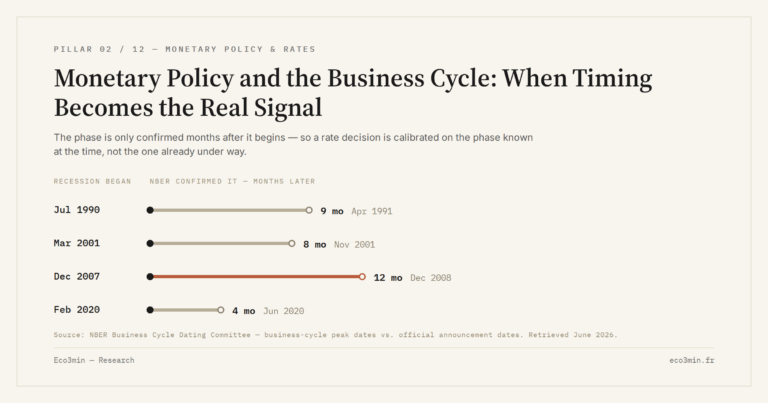
This tag covers the analysis of business cycle phases: expansion, peak, slowdown, recession and recovery. It helps locate the economy in its temporal dynamic and anticipate coming inflections. Knowing where we stand in the cycle is fundamental to interpreting monetary policy decisions and market moves. Cycles never repeat identically, but their mechanisms remain readable.
Fragmented liquidity, dominant narratives and the absence of cash-flows explain why crypto-asset cycles are structurally more violent than those of equity markets.
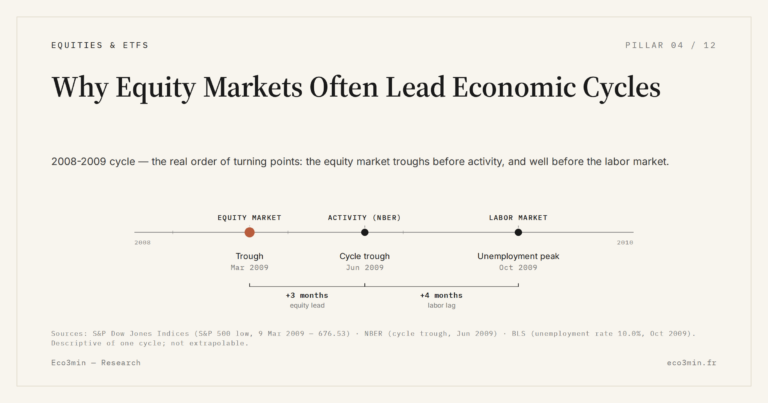
Equity markets often turn before economic cycles materialize in macroeconomic statistics. This forward-looking mechanism, structural to financial markets, explains the persistent timing gap between equity prices and economic data.
Not every slowdown signals a crisis. Four observable signals — sectoral diffusion, credit flow direction, corporate margin trajectory and investment dynamics — separate a cyclical normalization from a genuine regime break, and their combination matters more than any single intensity.
Most cycle-reading errors are horizon errors, not data errors. An isolated quarter does not deliver the same diagnosis as a three-to-five-year sequence — and higher data frequency does not substitute for horizon discipline.
A solid labor market during a slowdown does not refute the slowdown — it confirms how recent it is. Payrolls move quarters after the rest of the cycle, and the headline rate hides composition shifts that already point the other way.
The word "recession" often dominates economic debate well before any contraction materializes. False alarms outnumber actual downturns, reflecting a structural media bias toward downside risk over stability scenarios.
Economic sentiment can deteriorate while official indicators still look strong. The gap reflects a structural lag between real-time dynamics and delayed aggregate data — and reading direction matters more than reading the absolute level.
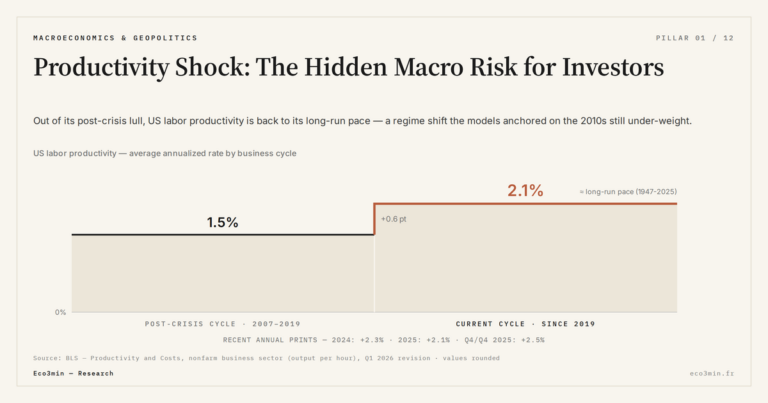
Labour productivity growth in G7 economies halved between 2015-2025 (0.8% per year) versus the previous decade (1.5%) — a regime change, not a cyclical dip. With weaker productivity, growth has to be built from debt and labour input, and the cycle becomes structurally more fragile to shocks.
GDP and final demand can tell two different stories about the same quarter. The gap lives in inventories and net exports — components that move first and reverse fast. Final demand isolates the durable spending decisions of households and firms, and it reads the cycle more cleanly at turning points.
Investment is the main engine of the economic cycle owing to its volatility and its amplifying effect on activity. Its variations precede and magnify the inflections of overall output through the accelerator mechanism.