0DTE Options: The Quiet Link Distorting Markets
0DTE options: how these zero-day-to-expiry contracts reshape liquidity, intraday volatility and the signals broadcast by equity indices.

0DTE options: how these zero-day-to-expiry contracts reshape liquidity, intraday volatility and the signals broadcast by equity indices.
TL;DR
Zero-day-to-expiry (0DTE) options now drive a growing share of major-index volume; their intraday hedging mechanics reshape moves without lifting one-month implied volatility. A parallel read: our analysis of foreign-exchange markets and monetary regimes.
- Since mid-2024, more than 40% of S&P 500 option volume on some days involves contracts expiring within 24 hours; in December 2025 activity stayed high while one-month implied volatility fell back near 14%.
- Their intraday hedging can amplify moves, especially near the most heavily positioned strikes.
- The main risk is not a 'programmed crash' but jaggier volatility and intraday index signals that are harder to read.
Why 0DTE options are becoming a real topic now
Since mid-2024, market-operator data show that on certain days, more than 40% of S&P 500 option volume involves contracts maturing within 24 hours. In December 2025, the trend remained elevated, even as one-month implied volatility fell back around ≈14%, close to its 2016–2019 average. This gap — strong ultra-short activity but moderate overall volatility — suggests that markets are still only partially pricing in this micro-structural shift. Read alongside: our breakdown of market microstructure and the mechanics of price formation.
What is changing without making noise is that intraday index dynamics increasingly depend on zero-day option flows, and less only on traditional “cash” orders.
0DTE options: what exactly are we talking about?
0DTE options are listed options that expire on the same day they are traded. In practical terms, at the market open a few hours remain before they expire, generally at the close.
They have grown alongside:
- the proliferation of daily expirations on major indices (S&P 500, Nasdaq 100, sometimes on certain index ETFs) since 2022–2023;
- lower per-trade transaction costs and the rise of very short-term trading tools;
- institutional demand to hedge or adjust risk over a few hours rather than several days.
An option with only one day of life concentrates much of its sensitivity within an extremely narrow price band. That is where the amplifying effect on markets plays out.
The key mechanism: intraday hedging by market makers
The heart of the matter is not so much the directional bet placed by the end user, but the reaction of market makers who sell these options and have to hedge in real time.
When a market maker sells a 0DTE option:
- they end up short the option and therefore exposed to high sensitivity to the underlying price;
- to neutralise this exposure, they adjust their portfolio of stocks or futures: this is delta hedging (and sometimes gamma hedging, which is more complex).
The closer the option is to the underlying’s price (at-the-money) and the closer expiry, the more:
- gamma (the sensitivity of delta to price) is high;
- the market maker must buy or sell aggressively in index futures as soon as price moves a little.
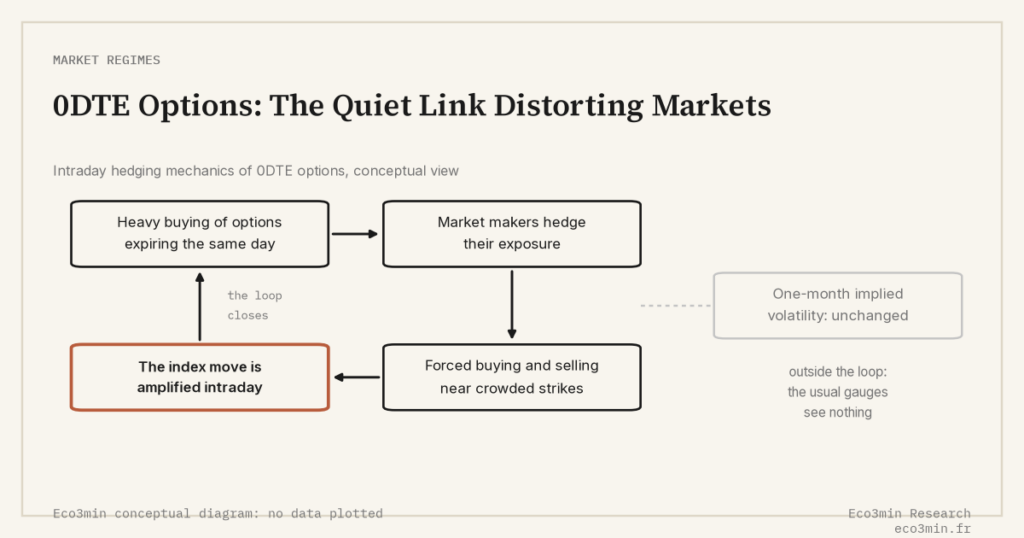
This automatic-reaction mechanism creates a feedback loop: the price move triggers hedging adjustments, which in turn influence the price again, especially when liquidity is thin at that moment.
How 0DTEs can amplify a market move
To understand the amplification, consider the typical sequence on a heavy 0DTE-volume day:
- Many participants buy 0DTE puts to hedge same-day risk or position for a quick decline.
- Market makers sell those puts and hedge by selling index futures.
- If the market starts dropping toward the puts’ strike, high gamma forces them to extend the hedge further, hence to sell more futures.
- This additional selling flow accentuates the decline, which can trigger other orders (trend algos, stops, etc.).
The same phenomenon can occur on the upside with 0DTE calls: in that case, hedging adjustments lead to futures buybacks that can amplify an intraday rally.
What matters here is not just gross volumes, but the concentration of these flows around certain price levels and within a very short time window.
More “segmented” volatility within the day
Dominant projections often consider that the rise of 0DTEs has only a limited impact on overall market stability, arguing that medium-term implied volatility has not exploded. This reading is partial: it focuses on annual or one-month volatility, and not on how volatility distributes within a single session.
An alternative interpretation is that 0DTE options contribute to more jagged intraday volatility: phases of near-frozen prices, then abrupt accelerations as the underlying approaches the strikes most loaded with same-day expiring options.
Historical perspective: why this is different from earlier “gamma trades”
Markets have already experienced episodes where short-dated options played a central role. But two elements distinguish the 2023–2025 period:
- the frequency of expirations: previously, most index options expired weekly or monthly; today, there is often an expiration for each business day;
- the democratisation of tools: access to 0DTEs no longer concerns only institutional desks but also smaller players, via simpler interfaces.
For order of magnitude: between 2019 and 2021, the share of 24-hour-or-less options on certain major indices often stayed below 10–15%. Between 2023 and 2025, several sessions regularly exceed 35–40%, according to aggregated statistics published by exchanges and clearing houses. Because most of that retail options flow is routed rather than exchanged directly, its growth also feeds the routing economics behind a zero-commission account.
This does not mechanically imply more systemic risk, but a different risk profile: shorter and more violent moves, sometimes disconnected from classical macroeconomic news.
What participants are really trying to understand
Behind the question “do 0DTE options amplify markets?”, the real query is simpler: does the intraday price of indices remain a good barometer of fundamental information, or is it increasingly influenced by technical flows tied to very-short-dated options?
For many economic actors — investors, companies or individuals — the issue is not to trade 0DTEs themselves, but to assess whether sharp index moves should be read as signals or as micro-structural noise.
Concrete indicators to track the impact of 0DTEs
A simple way to structure the reading is to track a few accessible KPIs:
- Share of 0DTE volume in total option volume on a given index: a level durably above 30–40% suggests a market highly sensitive to intraday flows.
- Options-to-futures volume ratio on the index: if ultra-short option volume rises faster than futures volume, pressure on market makers builds.
- Gap between intraday volatility and one-month implied volatility: if daily ranges (e.g. the high-low band on the S&P 500) stay elevated while implied volatility remains moderate, this can reflect the 0DTE effect.
This reading frame usefully complements broader analyses of the rate structure and volatility, such as those proposed in the general framework on monetary policy and real rates.
Common misreadings of 0DTE options
- Confusing volume with systemic risk: high 0DTE volume does not necessarily imply crash risk. The real issue is the hedging structure and the depth of the order book on the underlying.
- Assuming 0DTEs are purely speculative: a non-trivial share of flows corresponds to tactical hedges on portfolios. Ignoring this leads to overstating the “casino” dimension.
- Reading every violent move as fundamental information: some volatility spikes or air pockets can be largely technical, tied to end-of-session gamma adjustments.
What consensus sees… and what it underestimates
Part of the consensus expects the rise of 0DTE options to remain a micro-structural phenomenon — annoying for intraday traders but without lasting impact on broad equity markets. This view rests on the observation that global indices continued to evolve relatively orderly between 2023 and 2025, despite rising volumes. This reasoning intersects with our framework on the transmission of rates to financial markets, which explains why corrections do not mechanically follow monetary tightening.
An alternative, more cautious reading emphasises second-round effects: if intraday moves become more erratic, they can influence:
- managers’ risk models (VaR, stress tests), which may tighten;
- technical thresholds tracked by trading algorithms;
- corporate executives’ perceptions when indices become more volatile around their results releases.
This suggests the issue is not only end-of-day stability, but how capital flows structure themselves against a more unstable intraday backdrop. This dimension connects with broader analyses on the fundamentals of financial markets.
Possible scenarios around the role of 0DTEs
Scenario 1: gradual integration, contained risk
In this scenario, market participants refine their hedging and risk-management models. Market makers adjust their quotes, regulators may strengthen transparency on exposures, and the share of 0DTEs stabilises at high but manageable levels.
The impact then narrows to more segmented intraday volatility: calmer sessions most of the time, but with stress phases around expirations and the most loaded strike levels.
Scenario 2: stress episode where 0DTEs act as accelerator
In a sharper shock — for instance a macro surprise or a geopolitical event — heavy concentration of very-short-dated option positions could amplify the move down or up over a few hours. The role of 0DTEs would then be that of a directional amplifier, without necessarily originating the shock.
Past episodes (such as the extreme volatility sessions of 2018 or 2020) showed that technical flows can temporarily reinforce moves. If the same kind of stress occurred with even larger 0DTE volumes, the intraday reaction could be more jagged, before a gradual return to levels driven by macro fundamentals, as the analyses in the macroeconomic barometer regularly show.
Scenario 3: regulatory or market adjustment
A third scenario rests on a change of frame: limits on certain practices, additional constraints on market-maker risk management, or changes in product structure (for example, different standardisation of expirations). The market could then shift part of the activity toward other maturities or other instruments (futures, variance swaps, structured products). Shifting the activity does not remove the signal, it moves where the signal has to be read, which is the whole difficulty in reading direction out of options market positioning.
This scenario shows that 0DTEs are not a structural fatality but a response to a specific combination of interest rates, transaction costs and appetite for short-term trading — a context already explored on the pages devoted to macroeconomics and geopolitics.
Factors that could limit the impact of 0DTEs
Several elements could reduce the magnitude of the associated risk:
- More legible monetary policy: when policy-rate paths are better anchored, intraday volatility shocks tend to be less frequent.
- Sufficient liquidity in futures: if order books stay deep, gamma-hedging adjustments absorb flows better.
- Better distribution of positions: if 0DTE open interest is less concentrated around a few strikes, the amplification mechanism dilutes.
Conversely, an environment combining more volatile rates, reduced liquidity and heavy concentration of positions would form a cocktail more conducive to exacerbated moves.
Implications for investors, companies and individuals
For investors, the issue is mainly to distinguish a move tied to 0DTE option flows from a move driven by a real revision of macro expectations or earnings. In other words, not to over-interpret every intraday wick as a regime change in the economy.
For companies, more volatile intraday indices can complicate the management of communication windows (results, strategic announcements) and impair short-term valuation legibility, even when the medium-term trend remains consistent with fundamentals.
For individuals, the rise of 0DTEs is a reminder that reading markets requires a minimum understanding of micro-structure and derivatives, beyond index charts alone. Sharp moves can be impressive, but they do not always reflect a durable shift in the financial or economic cycle.
The broader stakes around market structure, capital flows and the role of derivatives can be placed in the frame of the analyses available on the dedicated financial-markets page.
Frequently asked questions on 0DTE options
Can 0DTE options trigger a flash crash on their own?
0DTE options can amplify moves already underway via market-maker hedging, but they do not on their own create a fundamental shock. A flash crash generally involves a combination of factors: thin liquidity, an information shock, and amplifying behaviour from algorithms or derivatives. Thin liquidity is partly a venue question: a growing share of size never posts to a public book at all, which is the share of volume that never reaches a displayed order book.
How can one identify the market levels most sensitive to 0DTE flows?
The most sensitive levels are often those where open interest on same-day expiring options concentrates near the index’s current price. Some operators publish position maps by strike, which help to spot potential intraday volatility “nodes”.
Do 0DTE options change the relevance of classical technical indicators?
They can make some signals noisier in the very short term, particularly around round numbers or daily expirations. Indicators based on daily or weekly data remain less affected, however, because they smooth out part of these micro-structural oscillations.
Why are 0DTE volumes concentrated mainly on major indices and not on all stocks?
Major indices offer better liquidity, greater market depth and lower transaction costs, which makes market-maker hedging easier. On individual stocks, this kind of product would be riskier to manage and less efficient cost-wise.
3 takeaways
- 0DTE options shift part of risk into the intraday window, making indices more sensitive to hedging flows around certain price levels.
- Their rise does not automatically imply more crashes, but more jagged volatility and market signals that are sometimes harder to read.
- Understanding 0DTEs is mainly about learning to distinguish micro-structural noise from genuine macro and financial regime changes.
Last updated — 20 September 2026
Disclaimer – Financial Information: The analyses, commentary, and content published on eco3min.fr are provided for informational and educational purposes only. They do not constitute investment advice or a solicitation to buy or sell financial instruments. Past performance is not indicative of future results. All investment decisions involve risk and are the sole responsibility of the reader.
Read next
Full pillar →Euro Below Parity in 2022: What Parity Means
In September 2022, the euro fell below parity with the dollar, to around 0.95, a low not seen…
Eurozone Fragmentation: Sovereign Spreads and the Euro
The euro is issued by a monetary union without a complete fiscal union: nineteen sovereign debts coexist under…
The Euro’s Energy Import Bill: the Gas Shock and the Currency
In 2022, the surge in gas prices turned the euro area's historic current-account surplus into a deficit and…