Why Rate Hikes Do Not Always Weigh on Markets
Rising rates do not mechanically push markets down. The reaction depends on the monetary regime, the real cost of capital and the economy's absorption capacity. A structural reading of rate transmission to financial markets.

One idea dominates market commentary: when interest rates rise, markets fall. The relationship is presented as self-evident, almost mechanical. Yet historical observation neither systematically validates it nor confirms it consistently across cycle phases.
TL;DR
In a normalisation phase, rising nominal growth can absorb a higher cost of capital, so a rate hike weighs on markets mainly when the economy is already disinflating or slowing.
- The same nominal hike can be restrictive or easily absorbed depending on context: in a normalisation phase, rising nominal growth and incomes offset a higher cost of capital.
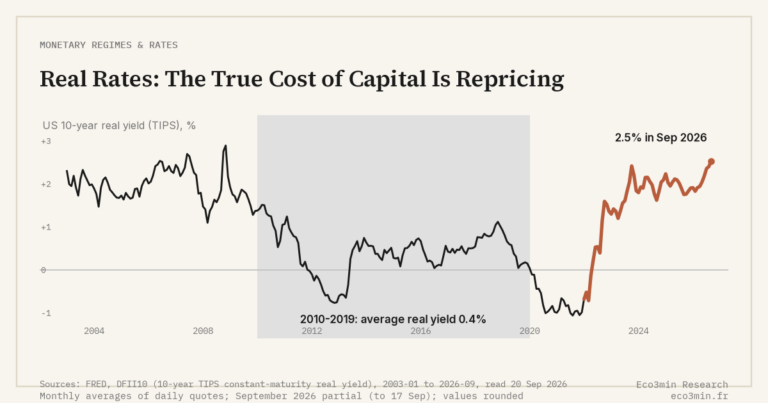
- Real rates drive the effect more than nominal levels: a hike can coexist with easing in real terms when inflation rises faster.
- A higher risk-free rate forces risky assets to offer a larger premium; absent that, the repricing runs through prices and sharpens selectivity.
This confusion does not stem from a lack of information, but from an oversimplified reading of the role of rates. Markets do not react to an isolated variation, but to what it reveals about the monetary regime, the cost of capital and underlying economic constraints. A closer look: Concentration, Dispersion, and Passive Investing: How Index Markets Are Changing.
Understanding why a rate hike sometimes weighs on markets — and sometimes does not — therefore requires moving beyond the binary reflex to analyse the structural mechanisms at work.

Interest rates as the architecture of the cost of capital
Interest rates structure the entire financial economy by setting the cost of capital. They shape borrowing capacity, the hierarchy of expected returns and the value assigned to future cash flows. Related reading: Why Financial Markets and the Real Economy Are Out of Sync.
When rates rise, two general effects are commonly cited: credit becomes more expensive and financial assets see their valuations adjusted. These effects exist, but they are not enough to explain the sometimes contradictory reactions of markets. Further reading: What Is Liquidity and Why It Drives Financial Markets.
The reason is straightforward: a rate hike is never read in isolation. It always sits within a broader context — inflation, growth, prevailing financial conditions and the credibility of monetary policy. It is this entire framework that conditions how assets respond.
Why some rate hikes weigh on equity markets
In many cases, a rate hike places pressure on equity markets. It raises the discount rate used to value future cash flows, which mechanically reduces the value of companies whose profitability is expected over a distant horizon.
It also shifts the relative trade-off between asset classes. When the risk-free return rises — these relative readjustments sit at the heart of our reading of cross-asset correlations under macro regimes — risky assets must offer a higher premium to remain attractive. Failing that, the adjustment occurs through prices. A complementary angle is covered in Why Crypto Adoption Does Not Automatically Lift Prices.
In this framework, a rate hike acts as a reminder of financial discipline. It exposes the business models most sensitive to the cost of capital and sharpens market selectivity. Tech reporting metrics are a prime example — one of them is audited in why ARR sometimes overstates tech value.
Why this reading is incomplete
Reducing the analysis to a simple opposition between rising rates and falling markets nevertheless leads to numerous interpretive errors. The history of financial cycles shows that some monetary tightening phases have coincided with resilient or even buoyant markets.
The key lies in distinguishing between the nominal level of rates and their real effect on the economy. No asset embodies that distinction like gold, whose behaviour is retraced in gold as a monetary asset across real-rate and confidence regimes. A rate hike can reflect an economy in a normalisation phase, where nominal growth and incomes rise enough to absorb a higher cost of capital.
Conversely, a rate hike in a disinflationary or slowing environment can become highly restrictive, even if absolute levels remain moderate. This gap explains why market reactions sometimes appear counter-intuitive.
- A rate hike is not mechanically negative for markets.
- The impact depends on the monetary regime, real rates and the economy’s capacity to absorb them.
- Market reactions reflect a global framework, not an isolated move in rates.
Common errors in reading rates
- Interpreting a rate hike as an automatically negative signal for markets, without accounting for the underlying economic regime.
- Focusing on the nominal level of rates while ignoring the trajectory of inflation and real rates.
- Reacting to the announcement of a monetary decision rather than to its cumulative effects on the cost of capital and financial constraints.
Several recurring confusions surface in the analysis of rates and their impact on markets.
The first consists of focusing on monetary policy announcements rather than on their cumulative effects. Markets price in trajectories well before formal decisions — a central mechanism in our sub-pillar on market expectation dynamics. Markets internalise anticipated paths well before the formal decisions arrive. That anticipation now has an intraday vehicle — the case documented in the market distortions introduced by 0DTE options.
The second is to overlook the role of inflation. A rate hike can coexist with monetary easing in real terms if inflation rises faster. The asset class most directly affected by this dynamic remains the bond market, the first to absorb the shock. Conversely, nominal stability can mask a real tightening when inflation recedes.
Finally, many analyses understate the role of the global regime: rates themselves do not determine the trajectory of markets, but rather the way they reconfigure financial constraints and allocation behaviours.
Moving from a simplistic reading to a regime reading
To overcome these limits, a more structural reading is required. Rates should be analysed as an indicator of monetary regime rather than as an immediate directional signal. Related analysis: the regime reading of currency markets.
This approach prompts attention to where rates stand relative to the real cost of capital, to the economy’s capacity to absorb that constraint and to the gradual adjustments it triggers in valuations and flows.
From this perspective, markets do not react to the rate hike as such, but to what it reveals: a shift in the framework, a change in the hierarchy of returns and a reshaping of financial trade-offs. These mechanisms call for a global reading of how financial markets operate, going beyond the analysis of a single signal taken in isolation. On the same theme: the hierarchy of returns a strong dollar imposes.
This analytical lens is developed in greater detail in the analysis devoted to real policy rates as a central indicator of the monetary regime, which clarifies why some tightening phases weigh heavily on assets while others are absorbed without rupture.
In recent cycles, it is not rate moves themselves that explain the major market phases, but the way in which they durably reshape the cost of capital and allocation constraints.
Linking the general mechanisms to financial markets
Once this regime reading is in place, it becomes possible to connect rate variations to observed market behaviour. Price adjustments, performance dispersion and rotation across assets then take on a new coherence. In the same vein: Market Rotation 2026: Capital Flows, Sector Shifts, and Hidden Signals.
The impact of interest rates on financial markets does not depend solely on their direction, but on the way they redefine economic and financial constraints. It is this articulation between the cost of capital, expectations and market regimes that makes sense of the sometimes paradoxical reactions of assets.
These mechanisms fit within the broader workings of financial markets, where rate variations, macroeconomic expectations and liquidity constraints interact to shape allocation behaviours and price formation. The pillar page dedicated to financial markets places these dynamics within a global reading of market regimes, beyond immediate reactions to monetary decisions.
This analysis is developed further in the article Impact of interest rates on financial markets, which details how these mechanisms translate concretely across different asset classes, without resorting to a binary reading of monetary decisions.
Conclusion — When a rate hike becomes a misleading signal
The relationship between rising rates and falling markets is neither automatic nor universal. It depends on the monetary regime, the real level of rates and the economy’s capacity to absorb the cost of capital. A closer look: Eco3min’s account of dollar-driven global imbalances.
When rates are analysed in isolation, they become a misleading signal. When they are placed within a regime reading, they instead illuminate the deeper dynamics of financial markets.
In modern cycles, it is not the rate hike that destabilises markets, but the moment when it reveals a constraint that the prior regime had rendered invisible.
Last updated — 12 July 2026
Disclaimer – Financial Information: The analyses, commentary, and content published on eco3min.fr are provided for informational and educational purposes only. They do not constitute investment advice or a solicitation to buy or sell financial instruments. Past performance is not indicative of future results. All investment decisions involve risk and are the sole responsibility of the reader.
Read next
Full pillar →Eurozone Fragmentation: Sovereign Spreads and the Euro
The euro is issued by a monetary union without a complete fiscal union: nineteen sovereign debts coexist under…
The Euro’s Energy Import Bill: the Gas Shock and the Currency
In 2022, the surge in gas prices turned the euro area's historic current-account surplus into a deficit and…
The ECB-Fed Rate Differential: the Driver of EUR/USD
The rate differential between the ECB and the Fed is the first-order driver of EUR/USD. But it is…