Accommodative Monetary Policy: The Pre-Crisis Lever
Accommodative monetary policy is often deployed before a visible recession, as a preventive lever to restore credit transmission. Analysis of the mechanisms, weak signals and limits behind this quiet shift.

Accommodative monetary policy is not reserved for outright recessions. It is often activated when the economy slows without rupture, financial strains build and credit begins to contract pre-emptively.
TL;DR
Central banks often ease pre-emptively while policy rates stay high, slowing balance-sheet runoff and steadying interbank rates to keep credit flowing before a slowdown hardens into a shock.
- By late 2025, new corporate lending was contracting near 6% year-on-year even with policy rates elevated, so the operative signal is the cumulative drag on financing rather than the rate level.
- Slower balance-sheet runoff, softer official communication and steadier short-term refinancing together mark a shift toward preserving financing channels, even without visible rate cuts.
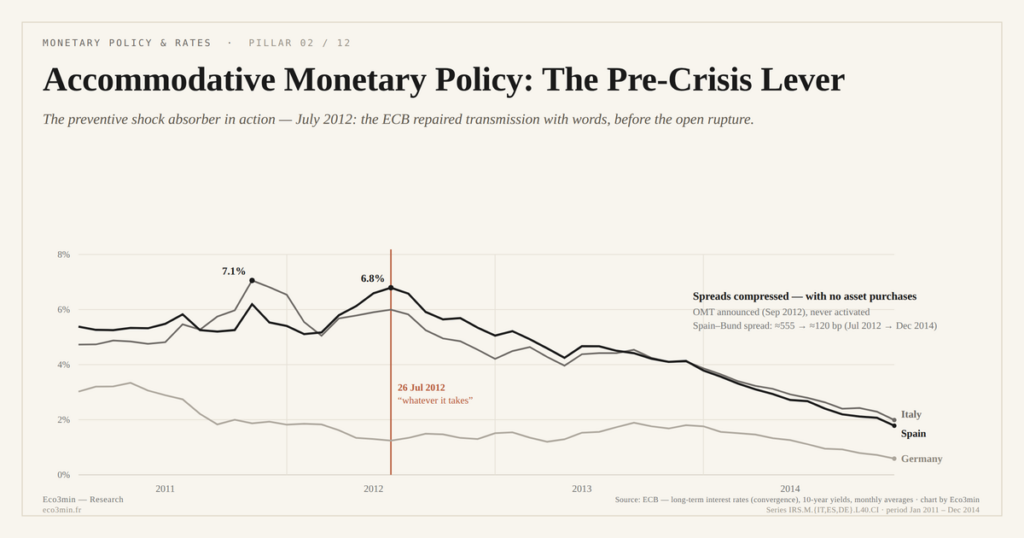
- Between 2012 and 2014, accommodative measures aimed less at reviving growth than at preventing lasting financial fragmentation, the same preventive logic acting upstream of any recession.
The triggering mechanism is neither spectacular nor immediate. It involves a precise institutional adjustment: lowering the marginal cost of liquidity for the banking system, in order to prevent financial frictions from turning an ordinary slowdown into a deeper macroeconomic shock.
This general framework is detailed in the reference analysis on how monetary policy acts on the real economy. The angle here is deliberately narrower: understanding when and why central banks shift to an accommodative stance even before macro indicators clearly deteriorate.
The tipping point: when the risk is no longer inflation but credit transmission
Accommodative monetary policy is generally deployed when the cost of credit becomes a standalone drag on activity. By late 2025, in several advanced economies, policy rates remained elevated in level, yet new corporate lending volumes were contracting by roughly ≈6% year-on-year, according to bank credit aggregates. Adjacent reading: The decomposition of the earnings lag behind monetary tightening.
The key signal is therefore not the level of rates, but their cumulative effect on financing demand. When solvent firms postpone investment and households make sharper consumption trade-offs, monetary policy ceases to be restrictive by intent but remains so through inertia.

Dominant consensus and analytical divergence
This preventive shift does not challenge the hierarchy of monetary objectives, as set out in the analysis on why central banks target inflation rather than growth, but shows how that priority can accommodate quiet credit support when systemic risk rises.
The base-case scenario held by many participants assumes that an accommodative stance is justified only in the event of a confirmed recession or explicit financial stress. This reading favours a late reaction, conditional on clearly weakened macro indicators.
The analysis diverges on one specific point: central banks often seek to act before such signals become visible. The objective is not to stimulate growth at all costs, but to restore fluidity in the credit channel and prevent a self-reinforcing spiral of bank caution.
What is quietly shifting
Since late 2025, several quiet adjustments have been observable: a slower pace of balance sheet runoff, a softer tone in official communications, and stabilizing short-term refinancing conditions. Taken in isolation, none of these elements constitutes a spectacular accommodative pivot.
Taken together, they signal a strategic shift: the priority is gradually moving from the fight against inflation toward the preservation of financing mechanisms. This transition is often underestimated because it is not immediately accompanied by visible rate cuts.
- The slowdown in quantitative tightening does not amount to easing, but it limits pressure on bank liquidity.
- Central bank communication is becoming more conditional, signalling heightened attention to transmission channels.
- Stabilization in short-term interbank rates reduces the risk of endogenous credit tightening.
- The gap between policy rates and effective lending rates remains the main indicator of latent tension.
Historical perspective
Historically, the most effective accommodative monetary policies have been deployed in intermediate phases of the cycle. Between 2012 and 2014, for instance, unconventional measures were aimed less at strongly reviving growth than at preventing lasting financial fragmentation.
The parallel is not mechanical, but instructive: the goal is not to create a positive shock, but to reduce the probability of a broader negative one.
What readers are really asking
Behind the interest in accommodative monetary policy lies a simple question: is it a support signal or an admission of economic fragility? The real question is not whether growth will rebound quickly, but whether the financial system is being stabilized before strains become visible.
Indicators to watch for an accommodative stance
- New lending volumes to firms and households, year-on-year.
- Short-term bank refinancing conditions.
- Gap between policy rates and effective lending rates.
Alternative scenarios and limits
This scenario assumes that disinflation continues without a fresh supply shock. It could be invalidated by an inflationary resurgence or by an exogenous shock to energy or supply chains. Conversely, unexpected fiscal tightening could strengthen the case for a more accommodative monetary stance.
Reading perspective
Accommodative monetary policy is not always a spectacular support signal. It is often used as a preventive shock absorber in phases when the economy slows without breaking. This is not the base-case scenario today, but it deserves attention because it acts upstream of visible imbalances.
To place this reading within a broader framework, the pillar page dedicated to monetary policy and rates outlines how the different monetary stances articulate over the cycle.
Three key takeaways
- An accommodative stance often aims to restore credit transmission, not to brutally stimulate growth.
- It can be deployed before any visible recession.
- Its effectiveness depends above all on the behaviour of banks and borrowers.
Last updated — 12 July 2026
Disclaimer – Financial Information: The analyses, commentary, and content published on eco3min.fr are provided for informational and educational purposes only. They do not constitute investment advice or a solicitation to buy or sell financial instruments. Past performance is not indicative of future results. All investment decisions involve risk and are the sole responsibility of the reader.
Read next
Full pillar →Real Rates: The True Cost of Capital Is Repricing
Why real rates are reasserting themselves as markets' anchor and how to recalibrate investment and financing decisions facing…
Real Interest Rates: The Quiet Signal Reshaping Markets
Real interest rates: why their persistence in positive territory in 2026 is reshaping the rules for bonds, equities,…
OAT-Bund Spread: A Quiet Gauge of French Sovereign Risk
OAT-Bund spread: how this yield gap has become a key signal on French sovereign risk, fiscal policy and…