AI Altcoins: The Fragile Link in the Artificial Intelligence Narrative
AI altcoins: why these crypto-assets tied to artificial intelligence concentrate more risk than the broader AI narrative.

Markets are betting on AI. AI altcoins are betting on the market. Between the two, the economic link is more fragile than it looks.
TL;DR
Since early November 2025, tokens labelled 'AI' have gained 80–150% in weeks against bitcoin's ≈25%, a surge that prices the AI narrative far faster than these projects' actual on-chain adoption.
- Aggregate market value of AI-labelled tokens passed ≈$35bn in early December 2025, up from ≈$20bn in July, while bitcoin dominance held near 50–52%, pointing to rotation within crypto rather than only new money.
- The label spans three very different models: decentralised compute and infrastructure tokens, utility tokens granting access to AI services, and purely narrative tokens whose link to AI is essentially branding.
- One gauge is the ratio of token trading volume to real protocol activity; when volume runs 20–30 times estimated usage-transaction value over 24 hours, speculative flows dominate.
- In the 2022 stress phase, some altcoins fell 70–90% within months; lacking solid cash flows, AI tokens can become the adjustment variable when liquidity reverses.
AI Altcoins: Why This Crypto Segment Concentrates So Much Risk
In this analysis, AI altcoins are addressed exclusively as a sub-segment of the crypto-asset market, heavily dependent on liquidity cycles, market narratives and macro-financial conditions, rather than as a category of financial innovation in the technological or institutional sense. This mechanism is detailed in our study of bitcoin and liquidity cycles.
Since early November 2025, several crypto-assets labelled “AI” have gained between 80% and 150% in a few weeks, while bitcoin advanced by roughly ≈25% over the same period and Ethereum oscillated between +10% and +15%. This performance gap draws attention, but it mainly signals a regime shift in a very specific sub-segment: AI altcoins.
To place these moves within the broader crypto-asset framework, the pillar on the economic and monetary stakes of crypto provides the useful foundation: nature of tokens, role of blockchains, flow logic. Here the focus is narrower: decoding the workings and risks of the tokens that ride the artificial intelligence narrative.
This positioning makes full sense once AI altcoins are placed within the broader dynamics of liquidity cycles, rates and institutional integration that shape the crypto-asset class, and that explain why narrative segments systematically amplify both expansion and contraction phases.
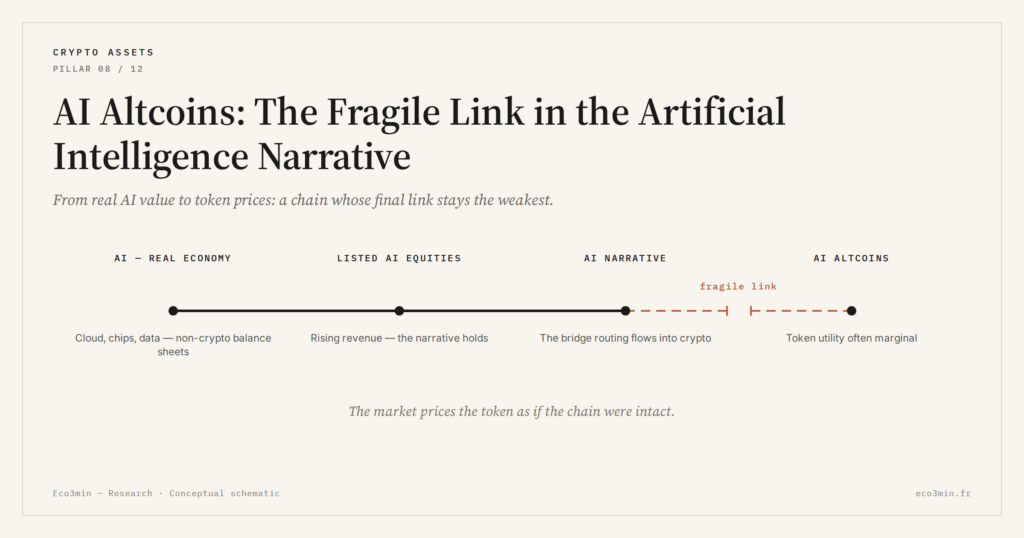
The quiet but central issue is the following: what AI altcoin prices imperfectly absorb is not the potential growth of AI, but the fragility of the economic chain that genuinely links these projects to that growth.
Trigger Event: An AI Crypto Rally Sharper Than the Rest of the Market
Since late October 2025, several indicators have converged:
- mid-cap AI altcoins saw daily volumes multiplied by 4 to 6 in less than 30 days;
- aggregate market capitalisation of tokens labelled AI exceeded ≈$35bn in early December 2025, against ≈$20bn in July 2025 (estimates from leading crypto-data aggregators);
- bitcoin dominance nonetheless remained stable around 50–52%, suggesting that flows into these tokens come not only from new entrants but also from internal arbitrages within the crypto market.
Part of the consensus reads this move as a simple “catch-up” of altcoins versus the bitcoin–Ethereum duo. The reading here is different: the specific surge in AI altcoins resembles narrative leverage on AI more than a fundamental revaluation.
How an AI Altcoin Actually Works Economically
The term “AI altcoin” in practice covers three different economic models, with distinct risks:
1. Decentralised AI Infrastructure Tokens
These projects aim to fund or coordinate compute, storage or data resources for AI applications. The token can be used to:
- pay for compute power or bandwidth;
- reward resource providers (GPUs, servers, datasets);
- govern the protocol (votes on the network’s direction).
On paper, the more AI compute demand grows, the higher the token’s utility. In practice, two questions remain open: how much of that demand is genuinely decentralised, and whether these networks can compete on cost with major centralised providers.
2. Utility Tokens Tied to AI Applications
Here the token grants access to a service: AI APIs, analytics tools, specialised conversational assistants, etc. The economic link rests on:
- service usage volume;
- the team’s ability to convert paying users from outside crypto;
- users’ price elasticity in the face of token volatility.
When the service price is denominated in tokens, a price surge can make the offering less competitive against fiat subscriptions or stablecoin credits. The risk is that speculative success undermines the economic model.
3. Purely Narrative Tokens
The last category: tokens whose link to AI essentially amounts to marketing (name, visuals, storytelling). These assets rely almost entirely on anticipated speculative flows and the community’s ability to maintain attention. The token’s actual purchasing power within a concrete AI service is often marginal or non-existent.
For these AI altcoins, macro leverage comes mainly from perception: as long as listed AI majors continue to post double-digit revenue growth (some AI champions still showed +25% to +40% over 12 months at end-Q3 2025), the theme remains bankable and these tokens can ride the narrative without necessarily delivering tangible economic value.
Macro, AI and Crypto: Three Overlapping Flows
To understand the current dynamics, three layers must be combined:
- Macro: after a tightening cycle, real policy rates remain slightly positive in most advanced economies at end-2025. This keeps the cost of capital meaningful and reduces tolerance for unprofitable projects. Yet speculative liquidity returns in waves to peripheral segments such as AI altcoins.
- Equity markets: high valuations on several listed AI players sustain the narrative of a “new productivity wave”. As long as these companies keep reporting rising margins or productivity gains, AI remains a central theme for capital flows.
- Crypto market: with the return of crypto ETFs, new derivatives and renewed institutional interest, the asset class draws flows again. But these flows concentrate first on major assets (bitcoin, Ethereum). Only in a second stage does part of this capital rotate into riskier segments, including AI altcoins.
What is shifting quietly is how these three layers connect: AI acts as a narrative bridge between equity markets and crypto, easing the move of investors already exposed to AI on the equity side toward more speculative bets on the token side.
What Readers Are Really Looking For Behind the “AI Altcoins” Keyword
Behind interest in AI altcoins, the implicit question is rarely “how does the tokenomics work?”. What many are really trying to figure out is whether the segment offers “amplified” exposure to the AI theme or whether it is mostly an additional and poorly compensated risk. The real question is twofold: is the timing already too late in the narrative cycle? And how far could a correction go without invalidating the underlying AI trend?
Common Reading Errors on AI Altcoins
Conflating macro AI with on-chain AI. Many project the real growth of AI (rising cloud spend, data explosion, productivity) directly onto the value of AI tokens. This equation is misleading: most AI flows remain on the balance sheets of non-crypto companies.
Over-interpreting a short-term volume spike. A volume multiplied by 5 over 72 hours can signal the arrival of leveraged traders, not necessarily a structural shift in protocol usage demand.
Ignoring the impact of real interest rates. In an environment of slightly positive real rates, the premium required to hold highly volatile assets rises. Overlooking this is equivalent to valuing AI altcoins as if the cost of capital were zero.
Why Consensus May Be Underestimating the Specific Risk of This Segment
Mainstream scenarios today consider that:
- AI will remain a durable investment theme;
- the tokenisation of AI services is often viewed as carrying long-term potential, regardless of actual adoption or economic viability;
- network effects will justify the survival of a meaningful number of AI tokens.
The analysis here does not contradict these three assumptions, but emphasises a mismatch: the speed at which the AI narrative is priced into AI altcoins is not aligned with the speed of effective adoption of their services. This suggests that the most fragile part of the AI theme is precisely concentrated in this crypto segment.
This reading rests on the assumption that the cost of capital will remain elevated relative to the 2010–2019 decade and that liquidity cycles will continue to alternate between compression and reopening phases. Within that framework, tokens with uncertain underlying cash flow remain particularly exposed.
A Simple Allocation Framework to Bound the Risk
Without constituting a personalised recommendation, an approach frequently referenced by practitioners is to treat AI altcoins as a peripheral layer within a broader crypto allocation. One illustrative grid sometimes cited:
- ≈60% of the crypto segment on major assets (bitcoin, Ethereum);
- ≈30% on projects with clear utility and an execution track record (base protocols, established decentralised finance, infrastructure);
- ≈10% maximum on narrative themes such as AI altcoins.
The point is not the precision of these percentages but the underlying logic of risk hierarchy: placing AI altcoins at the tail end rather than at the centre. A portfolio allocation simulator such as the one offered in the financial tools section can help visualise how the volatility of a thematic sleeve affects an entire portfolio.
An Indicator to Watch: The Trading Volume / Real Activity Ratio
To track AI altcoins more rationally, a simple indicator can be useful: the ratio between:
- daily token trading volumes (in dollars);
- and a proxy for real protocol activity (number of AI queries, compute tasks executed, paying active users, depending on the economic model).
When this ratio stretches sharply (for example a volume 20 to 30 times the estimated value of usage transactions over 24 hours), it suggests that dynamics are dominated by speculative flows. If this situation persists for several weeks while the macro context stays uncertain, the segment becomes more vulnerable to a liquidity reversal.
Three Plausible Scenarios for AI Altcoins
1. Soft-Landing Scenario
Policy rates stabilise, global growth stays moderate but positive, and the AI theme on the equity side keeps delivering. In this case, the AI altcoins segment can enter a consolidation phase: lower volatility, internal rotation toward projects with recurring revenues, gradual disappearance of purely narrative tokens.
2. Liquidity Shock Scenario
Sharper-than-expected monetary tightening or a global credit event triggers a widening of spreads and a retreat of capital from risk assets. Historically, in stress phases (for example in 2022), some altcoins lost 70–90% in a few months. AI altcoins could then act as the adjustment variable, in the absence of solid cash flows to support them.
3. Sharp Selection Scenario
With no major macro shock but a fading narrative, investors become more selective. Tokens backed by AI services that are actually used keep part of their relative value, while a majority of less-used projects gradually fade. This is not the central scenario embedded in current flows, but it deserves attention as it can unfold slowly and quietly.
Counter-Arguments and What Could Invalidate These Scenarios
Several factors can reduce the perceived risk on AI altcoins:
- an unexpected acceleration in demand for decentralised AI services, for instance under regulatory constraints on large centralised players;
- partnerships between on-chain AI projects and established companies, which would anchor revenue flows more solidly;
- a durably less restrictive rate environment, making capital more tolerant to still-experimental models.
Conversely, an unfavourable regulatory shift on certain AI uses or on crypto exchanges could amplify the risks outlined. The trajectory therefore remains conditional on macro, regulatory and technological parameters that are difficult to forecast.
Practical Implications for Three Profiles
Investors Exposed to Financial Markets
For portfolios already heavily oriented toward AI on the equity side, adding a significant layer of AI altcoins stacks correlated exposures to the same narrative, with higher volatility. A cautious way to approach this segment can include:
- capping the total weight of the AI theme (equities + crypto) at a defined threshold;
- diversifying within the theme (infrastructure, software, data, not only narrative tokens);
- regularly tracking the volume / real activity indicator outlined above.
Companies Exposed to AI
For companies that develop or use AI intensively, AI altcoins can serve mainly as a market signal. A surge in these tokens can indicate that some client or investor expectations are shifting toward “on-chain” solutions. Conversely, a sharp correction can make capital raising in the crypto ecosystem more difficult, while strengthening the credibility of more traditional offerings. Related framing: our analysis of AI investment access.
Households Interested in Crypto
For an individual discovering AI altcoins through social media, the key question is not “how much can it rise?” but “what impact would a 50–80% loss have on my overall finances?”. A simple rule is to size this thematic sleeve as a marginal share of total wealth, consistent with other objectives (precautionary savings, medium-term projects, retirement).
Questions Readers Often Ask
Do AI altcoins offer better exposure to AI than shares of major tech companies?
Not necessarily. Major AI companies today capture most actual spending (cloud, chips, software). AI altcoins offer a more speculative exposure, more concentrated on emerging projects, with a more indirect link to overall AI revenue.
How can one tell an infrastructure AI altcoin from a purely narrative token?
A first filter is whether the project clearly describes the AI service provided, the targeted users and the usage metrics (queries, tasks, data). The vaguer or more absent these elements are, the closer the token is to a narrative bet.
Do AI altcoins always move more than bitcoin in stress periods?
Historically, during crypto market stress, the most speculative thematic altcoins have often corrected more than bitcoin. This is not a mechanical rule, but the absence of “store of value” status leaves these tokens more vulnerable to defensive arbitrages.
Is it too late to look at AI altcoins after the recent rally?
The issue is not only timing, but the ability to bound the risk. A rapid rise makes a correction more likely, but some projects can continue to evolve if their real usage progresses. The key is to size the position carefully and to track a few simple indicators rather than reasoning in all-or-nothing terms.
Conclusion: A Segment to Watch, Not an Automatic Shortcut to AI
AI altcoins embody an extreme form of the artificial intelligence narrative: they concentrate both still-largely-speculative technological promises and a high sensitivity to liquidity conditions, financing cycles and market confidence.
The market does not yet fully price the fragility of this link between AI and crypto. That is precisely what makes it a strategic topic to follow: not as a performance promise, but as a leading barometer of how investors arbitrate between technological narrative, macro constraints and risk tolerance.
- Key takeaways
- AI altcoins amplify the artificial intelligence narrative but often rest on still weak or uncertain economic flows, particularly in a positive real-rate environment.
- A simple indicator — the trading volume / real activity ratio — helps spot when speculation clearly dominates usage.
- Treating AI altcoins as a peripheral sleeve (≈10% of the crypto segment) helps limit the impact of a sharp correction on the overall portfolio.
Last updated — 12 July 2026
Disclaimer – Financial Information: The analyses, commentary, and content published on eco3min.fr are provided for informational and educational purposes only. They do not constitute investment advice or a solicitation to buy or sell financial instruments. Past performance is not indicative of future results. All investment decisions involve risk and are the sole responsibility of the reader.
Read next
Full pillar →Crypto Seasonality: Why the Signal Is Weaker Than It Looks
Crypto’s cyclical regularities, monthly seasonality or the four-year cycle, rest on a very small number of observations. That…
Bitcoin Halving: How the Programmed Supply Cut Works
The halving writes bitcoin’s scarcity into an immutable rule, applied without exception since 2012. It shapes the pace…
Crypto Cycles: Why Their Amplitude Dwarfs Equity Swings
Crypto cycles post drawdowns two to four times deeper than equity markets. The asymmetry stems from market microstructure,…