
New Economic Cycle: A Slow but Structural Regime Shift
The current economic cycle is not a classic late-cycle phase. Slower growth, productivity, AI and fiscal constraints redefine the regime taking shape.

The current economic slowdown looks less like a classic late-cycle phase than the entry into a new growth regime: slower, but structurally different.
TL;DR
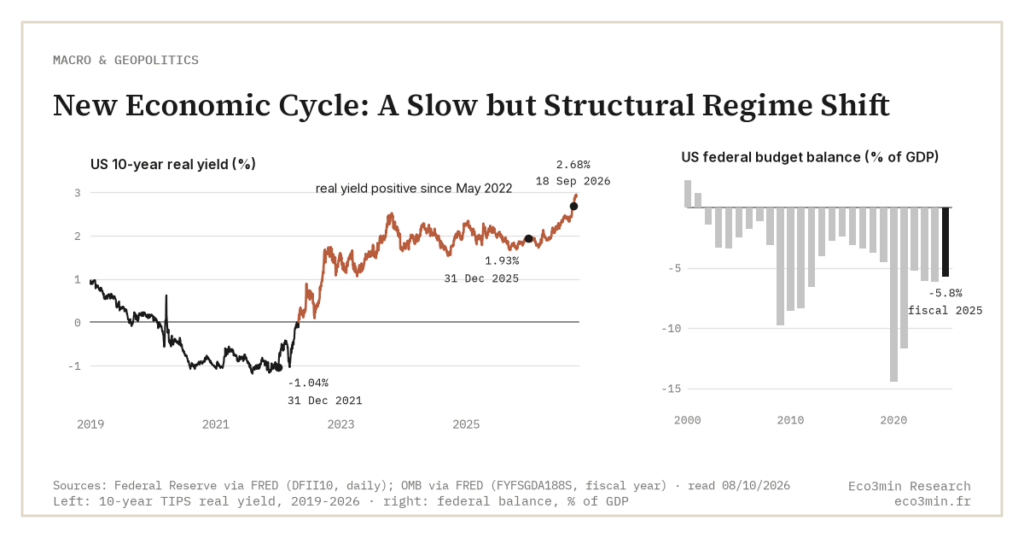
Real interest rates have turned positive again, pushing the 2025–2028 cycle to draw growth from productivity and AI rather than credit, with a discriminating effect across firms.
- Headline unemployment stays historically low, but short contracts, constrained self-employment and multi-jobholding prop up consumption, masking a fragility that leaves the cycle exposed to external shocks.
- Elevated deficits and government debt cap the room for fiscal support: the post-2020 stimulus playbook is unlikely to repeat, leaving adjustment to run through markets rather than public spending.
- The pattern fits a mild-stagflation backdrop, growth slowing without collapsing and inflation moderate but persistent, unlike the overheating-then-recession arc of a classic late cycle.
Since mid-2024, the same question keeps resurfacing: are we witnessing a classic late-cycle ending or the emergence of a new economic cycle? Growth figures are slowing, inflation is receding without disappearing, and central banks are moving cautiously. Yet several indicators suggest that the 2025–2028 cycle no longer follows the rules observed between 2010 and 2019. Directly related: Our breakdown of the signals that mark each phase of the economic cycle.
Understanding this shift requires looking beyond quarterly GDP and analyzing deeper drivers: productivity, AI investment, a fragmented labor market, and fiscal constraints. It is precisely this gap between perception and reality that makes the new cycle hard to read.
This shift toward a new economic cycle cannot be properly interpreted without placing it in the broader macroeconomic framework, where monetary policy, fiscal constraints, and structural transformations redefine growth trajectories, as analyzed in the page dedicated to macroeconomics and geopolitics.
Why the Current Cycle Differs from a Classic Late-Cycle Pattern
In a traditional pattern, a late cycle is characterized by overheating, uncontrolled inflation, then a sharp recession. Today’s context is different:
- growth is slowing without collapsing,
- inflation remains moderate but persistent,
- headline employment holds up despite underlying fragilities.
This pattern echoes the analysis already developed on hidden unemployment, where the apparent strength of the labor market masks a rise in involuntary part-time work and multi-jobholding.
A New Cycle Driven by Productivity Rather Than Credit
The major shift in this cycle lies in the cost of capital. Unlike the 2010s, real interest rates have turned positive again. This means growth can no longer be artificially supported by credit: it must come from a genuine improvement in productivity.
This is where investment in artificial intelligence and automation plays a central role. Large corporates are reallocating spending massively toward technologies capable of lifting productivity, while less-capitalized players struggle to keep pace. This mechanism produces a slow but highly discriminating cycle.
This logic explains why some sectors outperform while others stagnate, a phenomenon already visible in ETF flows, which are increasingly polarized.
Labor Market: Apparent Stability, Quiet Adjustment
Unemployment rates remain historically low across many developed economies. Yet that stability is partly illusory. The proliferation of short contracts, constrained self-employment, and multi-jobholding artificially sustains consumption.
This phenomenon limits the risk of immediate recession but makes the cycle more vulnerable to an external shock. It fits within a context close to mild stagflation, where growth is weak but tensions on certain prices persist.
Fiscal Constraints: A Structural Brake on the Next Cycle
Another major difference with past cycles: the state of public finances. Deficits remain elevated and government debt limits the capacity of states to support the economy if the slowdown deepens.
In this context, the massive fiscal support seen after 2020 is unlikely to be repeated. This reinforces the case for a slower but more disciplined new cycle, where adjustments happen more through markets than through public intervention.
Practical Implications for Economic and Financial Decisions
In a cycle of this type, strategies have evolved:
- for investors, a higher cost of capital weighs mechanically more on companies whose valuation rests on distant cash flows, a discounting effect whose magnitude varies from one episode to the next;
- for companies, productivity investment has become a central determinant of the ability to defend margins under a higher cost of capital;
- for households, recognizing that apparent stability can mask slower but more durable adjustments.
In this context, approaches such as the barbell strategy take on their full meaning, combining safety with targeted exposure to structural winners.
Conclusion: A Slow Cycle, but Not a Dead End
The 2025–2028 economic cycle matches neither a classic expansion nor an outright recession. This difficulty in reading the cycle through standard indicators is precisely the subject of our framework on the real economic cycle beyond cyclical figures. It looks more like a new regime of slow growth, marked by uneven productivity gains and strong selection between economic actors.
Reading this cycle through past playbooks invites symmetrical errors: waiting for a recession that does not arrive, or expecting a cyclical rebound that never shows up in margins. The dividing line runs between firms able to absorb a higher cost of capital and those structurally dependent on cheap credit.
Last updated — 8 October 2026
Disclaimer – Financial and Legal Information: The analyses, commentary, and content published on eco3min.fr are provided for informational and educational purposes only. They do not constitute investment advice or a solicitation to buy or sell financial instruments. Past performance is not indicative of future results. All investment decisions involve risk and are the sole responsibility of the reader. Data, charts and calculated series are provided as is and may contain errors or lag behind their source: check any figure against the primary source cited before relying on it. Content describing laws, regulations or contracts reflects the law as of its publication date and does not constitute legal or tax advice; applying it to a specific situation requires a qualified legal or tax professional.
Read next
Full pillar →The Real Economic Cycle: Investment, Productivity and the Hidden Drivers of Growth
Ahead of each of the six US recessions since 1980, investment growth peaked 4 to 12 quarters in…
US–China Semiconductor War: The Real 2026 Battlefield
Late-2025 US restrictions still target ≈40% of China's advanced AI compute capacity, while Beijing tightens critical-mineral exports. The…
Hidden Unemployment: What Labor Slack Says Beyond the Jobless Rate
The gap between US broad and official unemployment, 3.4 points in September 2026, is practically where it stood…