Economic Signal vs Media Noise: Three Filters That Work
An isolated figure is never a signal. Three filters separate cyclical information from ambient noise: persistence over time, sectoral diffusion, and consistency across independent sources. Any indicator that fails all three is noise, regardless of how loud the coverage.

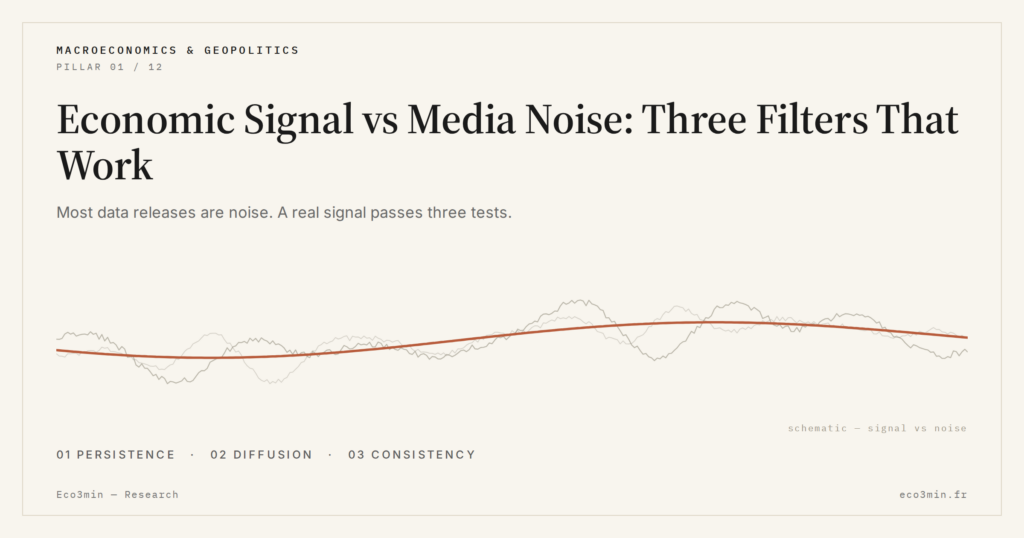
Three filters separate a genuine economic signal from media noise: persistence, sectoral diffusion, and consistency across independent sources.
TL;DR
When 65% of euro-area industrial sectors contract, up from 40% six months earlier, the breadth itself separates a genuine cyclical turn from one sector's isolated slump.
- Persistence is the first filter: a move confirmed over at least 2 to 3 consecutive months earns attention, while an isolated monthly print earns a footnote and little more.
- Consistency across independent sources is the third filter: a fall in industrial orders gains weight only when corroborated by deteriorating business-confidence surveys and a credit slowdown, never from one series alone.
Economic information circulates without pause, blending official data, sell-side commentary, and media framing. The volume itself is the problem: a single isolated figure, taken out of context, can move markets and shape narratives that take weeks to unwind. Building an analytical filter is no longer optional — it is the precondition for reading the cycle without being destabilised by every Tuesday release. The tools needed are not sophisticated. They are three explicit criteria, applied before any indicator enters the diagnosis.
The problem has worsened in recent years with the proliferation of alternative data sources — mobility indices, real-time transaction data, sentiment aggregators. The proliferation, far from clarifying the diagnosis, has added layers of noise that few observers filter effectively. The cost of access has collapsed; the cost of correct interpretation has not.
Three filters that separate signal from noise
The first filter is persistence. An isolated monthly print — a rise in inflation, a drop in production, a surprise in retail sales — does not constitute a signal until confirmed over at least two to three consecutive months. The real cycle is built from sequences of converging data points, not from isolated observations. The structural volatility of monthly releases and the bias introduced by revisions makes single prints unreliable as cyclical evidence. A move that persists for three months earns attention. An isolated point earns a footnote, nothing more.
The second filter is sectoral diffusion. A slowdown confined to one sector — energy, autos, construction — may reflect an idiosyncratic shock with no implication for the broader cycle. The distinction between a local shock and a cycle signal is central to the framework that defines what counts as cyclical evidence. When deceleration affects industry, services, and consumption simultaneously, the probability of a cyclical turn rises sharply. The OECD uses a diffusion indicator in its Economic Outlook: in November 2025, 65% of euro-area industrial sectors were in contraction, against 40% six months earlier — a broadening that confirmed propagation beyond any single sector.
The third filter is consistency across independent sources. A signal is reliable when corroborated by data of different nature — for instance, a fall in industrial orders confirmed by deteriorating business confidence surveys and a slowdown in credit. The cycle confirms itself through convergence of multiple indicators, never through one standalone series, however prestigious the source.
What amplifies the noise and blurs the diagnosis
Several mechanisms structurally amplify media noise at the expense of signal. The first is selection bias: media outlets cover the spectacular figures — record highs and lows — which are, by construction, the most likely to be revised or to constitute statistical aberrations. A record print is more newsworthy than a stable one. It is also more likely to disappear in the next revision. Directly related: Sahm Rule history: every US recession signal since 1970.
The second mechanism is the framing effect: the same figure can be presented as alarming or reassuring depending on the narrative context chosen by the source. A 3% growth print can headline as “above consensus” or as “decelerating from prior quarter” with strictly identical data underneath.
Common errors in reading economic data become more dangerous when social platforms accelerate the diffusion of interpretations before the data can be verified. A viral thread on a misunderstood statistic can shift market sentiment faster than the next institutional release. The asymmetry between the speed of narrative and the speed of correction is the defining feature of the current information environment.
Reacting to a single figure without checking its persistence, its sectoral diffusion, and its consistency with other indicators. An isolated print never constitutes a diagnosis — it becomes informative only when it slots into a converging cluster of independent signals. Without those checks, every Tuesday is a turning point.
Vigilance against noise should not collapse into analytical paralysis. Weak signals — the first divergence in a leading indicator, a discreet reversal in an underlying series — warrant tracking before they are formally confirmed. The point of the three filters is not to ignore them, but to classify them by order of relevance. Structural frameworks for cycle reading exist precisely to integrate weak signals into a running diagnosis without overreacting to each one in isolation.
Last updated — 12 July 2026
Disclaimer – Financial Information: The analyses, commentary, and content published on eco3min.fr are provided for informational and educational purposes only. They do not constitute investment advice or a solicitation to buy or sell financial instruments. Past performance is not indicative of future results. All investment decisions involve risk and are the sole responsibility of the reader.
Read next
Full pillar →Monetary Tightening: How Central Banks Are Reshaping Financial Markets
After more than a decade of ultra-accommodative policy, monetary tightening has reintroduced the real cost of capital as…
Hidden Unemployment: Reading the Real Labor Market in 2026
Headline unemployment is stabilizing while broad underemployment still runs above pre-2020 levels. Reading the gap between official rates…
2026 Economic Outlook: Key Trade-Offs After the End of Cheap Money
2026 ushers in a more constrained macro regime where real rates stay positive, fiscal space narrows and geoeconomic…