Equity Profit Warnings: Risk and Opportunity After the Alert
Profit warnings have become accelerated stress tests in a higher-cost-of-capital regime. How equity risk reconfigures and where structural fragilities show up first.

Profit warnings 2026: how earnings alerts reshape equity risk and reveal the real fragilities of the earnings cycle.
TL;DR
Profit warnings in mid-cap tech, industrials and discretionary names have triggered single-session drops of 15–35% since early 2026, even as major indices sit near their highs. Eco3min places this question within the full account of the gap between equity markets and the real economy.
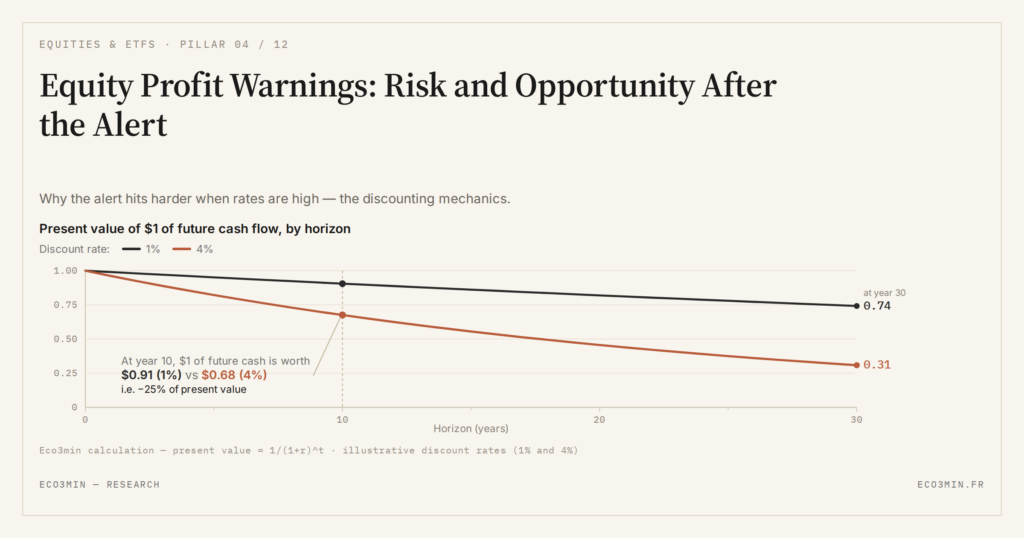
- In the near-zero-rate years of 2010–2019 such alerts were quickly absorbed; with real rates positive and future cash flows discounted harder, a warning now works as an immediate test of the business model.
- On a growth name, an 8–10% cut to expected earnings can justify a roughly 20% price fall once the multiple compresses: a 25× rating does not hold when expected growth drops from 15% to 5% and risk-free rates sit above 3%.
When a profit warning resets valuation in a few hours
Since early 2026, several profit warnings in mid-cap tech, industrials and discretionary consumption have triggered single-session drops of −15% to −35%, while the major indices remain close to their highs.
These alerts are not isolated anomalies. They mark the friction point between:
- moderate global growth;
- real rates durably positive;
- earnings expectations still calibrated on 2021–2023.
To frame them coherently, they should be read inside the broader corporate and sector dynamics, not as one-off accidents.
The discreet but structuring signal: the frequency and, above all, the severity of profit warnings are rising in the segments most sensitive to the cost of capital. These individual alerts fit into a broader reading of earnings-side signals, examined in our analysis of earnings revisions as a discreet signal.
Why these alerts matter more than before
Between 2010 and 2019, in a near-zero-rate environment, a profit warning was often absorbed quickly: long-term growth promises stayed credible and capital remained cheap.
Since monetary normalization and the rise in real rates, the framework has shifted. The mechanisms detailed in the pillar page on monetary policy and interest rates have durably increased:
- debt refinancing costs;
- the discount rate applied to future cash flows;
- market tolerance for distant promises.
A profit warning therefore becomes an immediate test of the robustness of the business model.
What actually happens during a profit warning
1. Expected cash-flow revision
Analysts adjust revenue, margins and free cash flow. On a growth name, an 8–10% cut in expected earnings can mechanically justify a −20% move in the share price if the multiple compresses simultaneously. A related question: why cash flow matters more than profits.
2. Sector re-pricing
The market extrapolates: when one company suffers in a segment, peers are re-rated. This generates indiscriminate selling — and sometimes overshoots.
3. Multiple compression
A stock priced at 25x earnings with expected growth of 15% does not retain that multiple if growth falls to 5%. With risk-free rates above 3%, the premium granted to distant cash flows shrinks.
What consensus underestimates
The dominant assumption remains a gradual digestion: soft but positive growth, stabilized margins, gradual normalization.
The more cautious angle observes:
- wage and energy costs that are sticky on the way down;
- gradual refinancings at higher rates;
- pricing power eroding at the margin.
This trio points to a 2027–2028 earnings trajectory below the level still embedded in some valuations.
Common mistake: equating a sharp drop with an automatic opportunity
- Mistake 1: systematically buying −30% drawdowns assuming the market always overshoots.
- Mistake 2: generalizing to an entire sector without distinguishing execution issues from structural problems.
- Mistake 3: judging on the next quarter rather than the three-year trajectory.
The key question is not “will the stock bounce?” but: does the future return on capital still cover its cost of capital?
Three operational filters
1. Maximum exposure to names under warning
A prudent rule is to cap aggregate positions in companies that have issued profit warnings at 10–15% of the equity sleeve, adjusted for the risk profile.
2. Examine three ratios
- Net debt / EBITDA: >3x = increased vulnerability if the weakness lasts.
- ROCE vs cost of capital: a sustained positive gap of 3–4 points still signals value creation.
- Adjusted free cash flow: if it remains solid despite the drop in accounting earnings, the punishment may be excessive.
3. Read warnings as a macro thermometer
- Concentration in consumption → pressure on purchasing power.
- Concentration in investment → capex slowdown.
- Spread to defensive names → more systemic signal.
Articulating these signals with the broader reading of financial markets (credit spreads, yield curve, volatility) avoids emotional decisions.
Two trajectories for 2026–2027
Central scenario: digestion without crisis
- Multiplication of sector-specific alerts but no broad-based wave.
- Indices supported by a few solid large caps.
- Higher premium granted to capital discipline.
Risk scenario: broad-based revision wave
- More marked demand slowdown.
- Widening of credit spreads.
- Warnings spreading to several sectors simultaneously.
In this framework, already weakened names would be over-penalized.
What would invalidate this diagnosis
- Rapid policy rate cuts.
- Measurable productivity acceleration (AI, automation).
- Cost-cutting plans more effective than expected.
Implications by profile
Retail investors: formalize a process before acting (balance sheet, FCF, debt review) and avoid exceeding 10% cumulative exposure to names under warning.
Companies: treat guidance as a strategic asset. Credibility lowers the future cost of capital.
Executives and professionals: when compensation depends on shares, monitor the sector frequency of warnings and gradually diversify through diversified equity and ETF instruments.
In 3 sentences
- Profit warnings have become accelerated stress tests in a world of more expensive capital.
- The key is not the technical bounce but the ability to generate cash above the cost of capital.
- This risk is diffuse, less spectacular than a global crisis, but structuring for 2026–2027 equity performance.
Last updated — 12 July 2026
Disclaimer – Financial Information: The analyses, commentary, and content published on eco3min.fr are provided for informational and educational purposes only. They do not constitute investment advice or a solicitation to buy or sell financial instruments. Past performance is not indicative of future results. All investment decisions involve risk and are the sole responsibility of the reader.
Read next
Full pillar →Reading Earnings Surprises: Cash Flow, Margins, Guidance
How to analyze an earnings surprise beyond the simple beat or miss: cash flow, margins, guidance, and weak…
Equal-Weight ETFs: The Quiet Signal Behind Rising Indices
Equal-weight ETFs reveal the true health of the equity market behind mega-cap-driven indices. Their gap with cap-weighted ETFs…
Smart Beta ETFs: The Hidden Risk Behind Factor Performance
Smart beta ETFs now hold ~15-20% of global equity ETF assets. Stacking factor exposures often rebuilds hidden concentration…