Reading Earnings Surprises: Cash Flow, Margins, Guidance
How to analyze an earnings surprise beyond the simple beat or miss: cash flow, margins, guidance, and weak signals separating noise from value creation.

Beyond “above or below expectations,” how to read an earnings surprise: cash flow, guidance, margins, and weak signals — how deviations from consensus reveal the true health of companies and the investment opportunities they create.
TL;DR
Late-2025 beats fell to ~68% of US large-caps from ~75% in 2023, while markets increasingly reward cash-flow quality over a simple EPS beat.
- Beat rate falling: ~68% of US large-caps topped consensus in Q3 2025 versus ~75% in 2023, making reactions to surprises more selective.
- Cash-flow premium: stocks combining over 10% twelve-month free-cash-flow growth with a positive beat outperformed the index by ~3–4% the following month.
- Guidance now decisive: a company that beats but cuts its 2026 outlook is penalized more sharply than in 2021–2022, as markets price the next cycle.
- Sector split: tech, healthcare and AI software still earn surprise bonuses while consumer discretionary is punished even on slight outperformance.
Each earnings season accelerates, alert flows explode… and most investors retain only “above” or “below expectations.” Wrong reflex. Late-2025 earnings surprises actually draw a precise map of the new cycle’s winners and losers — far more useful than headline indices or the ETF flow lens. Behind the figures, a quiet message: markets are starting to reward cash-flow quality more than top-line growth.
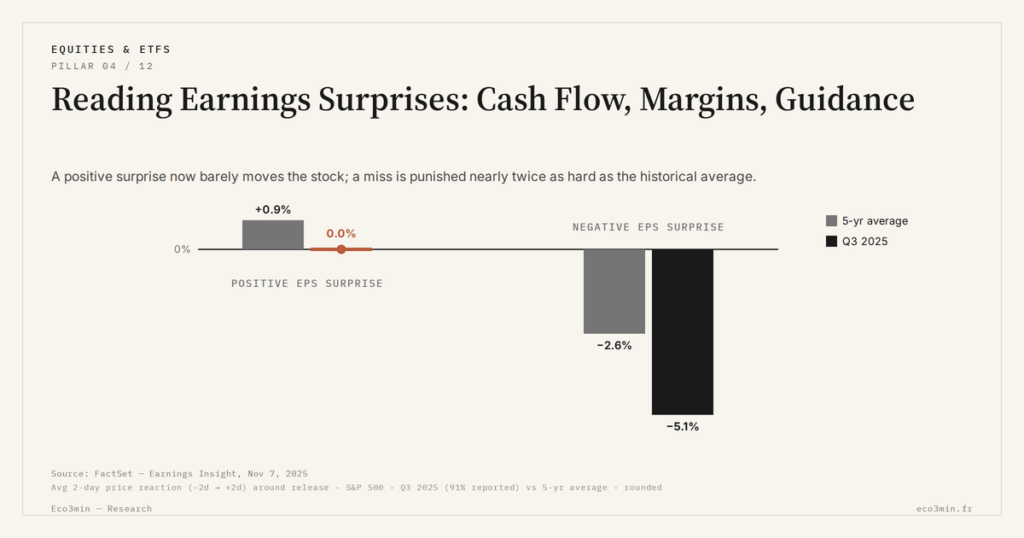
What is shifting without much noise: earnings beats no longer produce the same equity reaction depending on whether they come from pricing power, productivity (often AI-driven), or simple cost-cutting.
Strong signals of the moment
- Beat rate falling: in Q3 2025, ≈68% of US large-caps topped consensus, versus ≈75% in 2023 (aggregated estimates). → More selective reaction to surprises.
- Cash flow > EPS: stocks reporting free cash-flow growth above 10% on a 12-month basis alongside a positive earnings beat have outperformed the index by ≈3–4% in the following month. → Premium to durable quality.
- Guidance becomes central again: a company that beats but cuts its 2026 outlook is now penalized more sharply than in 2021–2022. → Markets are already looking at the next cycle.
- Sector dispersion: tech, healthcare and AI software still receive “surprise bonuses,” while consumer discretionary is punished even on slight outperformance. → Direct translation of macro trade-offs in the cycle phase.
Decoding: what current data reveal
On paper, an earnings surprise is simple: reported EPS deviates from a mean estimate. In practice, macro weighs heavily. With policy rates still elevated after the 2022–2024 hiking cycle (Fed and ECB around 3.5–4.5% at end-2025 per the latest monetary decisions), each point of future growth is discounted more harshly. Markets therefore distinguish far more finely between recurring earnings and accounting one-offs.
Part of the consensus still focuses on the percentage of companies that “beat” expectations as a proxy for overall health. The whole is set in perspective in our note on how real rates, multiples and earnings shape equity valuation. The analysis here diverges: the relevant variable is not the beat rate, but the quality of the surprise. A company that lifts ROIC by 2 points in a year through AI-related productivity gains, while leaving operating margins stable, sends a very different signal than a group that beats consensus by sharply cutting R&D.
This distinction between accounting surprise and durable value creation is central to understanding how markets currently arbitrate between individual stocks and broader exposures, notably via ETFs, in an environment of rising performance dispersion within indices — as detailed in the cross-cutting reading on equities and ETFs.
The earnings beat rate, often presented as a sign of economic robustness, is in fact a partial indicator that can become misleading when it masks deteriorating cash flow, margins or earnings sustainability — as illustrated in this reading of misleading economic indicators.
A notable point: markets, already conditioned by macro narratives on soft stagflation and slowdown, react increasingly to management commentary. Cautious but precise guidance, paired with credible operating KPIs (customer renewal rates, order book, recurrence), is better received than vague optimism. This reflects a form of “credibility premium” after the 2020–2022 years when forward guidance often proved erratic.
Equating an earnings surprise with a simple consensus beat ignores cash-flow quality, margin sustainability, and the actual trajectory of value creation.
Concrete impact: what changes now
What many are trying to understand is simple: is it still useful to follow individual releases in detail, or is it enough to stick to macro and index ETFs? Over the last few quarters, ignoring micro has meant missing a growing share of performance.
- For a diversified equity portfolio: a sleeve of around 20–30% dedicated to names capable of generating recurring earnings surprises (both earnings and cash flow) has historically been associated with an improved return/risk ratio. The remainder can stay in large caps or broad ETFs.
- Tactical timing: on individual names, opening new positions in the 5–7 days before a release has been historically associated with elevated risk, absent a real edge on expectations. Reactions are sharper in 2025, with ±8–15% gaps frequent.
- Granular release reading: prioritizing three lines — operating margin trajectory, free cash-flow generation, and demand commentary for 2026 (notably in tech and industrials). EPS rising while free cash flow falls is a flag.
- Style-based sleeves: in a simplified analytical framing, a 50/30/20 split (broad global ETFs / quality large-caps with historically positive surprises / specific post-release opportunities) has been a typical reference allocation, allowing exposure to surprise dynamics without turning the portfolio into a casino.
Weak signals to monitor
One under-interpreted parameter sits in the earnings appendices. Rushed investors overlook it, even though it lights up the real trajectory.
- Intra-quarter revisions: the frequency with which management adjusts guidance during the quarter. A discreet, even marginal, upward revision often carries more information than a single big annual beat.
- Debt structure: with sovereign long-end yields back around 3–4% since mid-2024 (per major central-bank data), monitoring the refinancing schedule and net debt/EBITDA matters. A credit spread widening 100–150 basis points over six months is a yellow flag.
- Capex vs R&D: companies cutting both physical investment and innovation simultaneously to preserve EPS create a hidden “peak earnings” risk. If this dynamic lasts more than three quarters, downward pressure on the multiple is likely.
- Recurring revenue share: in software, real health is read in subscription revenue growth and churn, more than in total sales. ARR rising 15% with churn capped under 5% annually signals a resilient profile.
3–12 month outlook
Dominant scenarios point to gradual margin normalization in 2026, with earnings growing modestly (≈4–6% per year in developed economies). Beyond this baseline, three trajectories warrant attention.
Earnings surprises constitute a relevant macro-micro signal only when they reflect a durable improvement in cash flow, ROIC, and the credibility of the future trajectory.
If policy rates remain near current levels through 2026 and global growth stabilizes around 2.5% (IMF/OECD-type projections), markets could continue to overpay for profiles combining high ROIC (>12%) and rising free cash flow. Earnings surprises then become the key filter to identify structural winners.
Scenario 2: return of risk tolerance
Alternative hypothesis: faster monetary easing restores value to long-duration growth stories, even with more fragile cash flows. In that case, reactions to quarterly surprises smooth out, and macro (rates, inflation, cycle) regains primacy over micro. Investors heavily focused on releases risk over-trading.
Scenario 3: macro shock and abrupt skimming
In the event of a demand shock (an unanticipated US or European recession), markets could shift to a defensive reading: only companies with strong balance sheets, low refinancing needs, and visible cash flows would survive without significant dilution. Earnings surprises would then act as a fragility revealer rather than a catalyst for upside, as observed in the stress episodes analyzed in our coverage of abrupt volatility resurgences or monetary tensions.
In all cases, markets are not pricing in full the distinction between accounting surprise and cash-flow surprise. That is precisely where part of the potential alpha resides.
For investors, the issue is not to forecast each quarter, but to identify companies capable of delivering quality earnings surprises across multiple years. For companies, priority is transparency on operating KPIs over short-term EPS optimization. For individuals, focusing on a few simple indicators (free cash-flow growth, net debt evolution, margin regularity) avoids getting lost in the release noise. We will revisit this with a possibly different market.
Frequently asked questions on earnings surprises
Do earnings surprises really predict long-term equity performance?
No, not in isolation. A series of positive surprises across 3–4 quarters can indicate structural momentum, but if it rests on unsustainable cost cuts, the effect erodes. This sequential reading of surprises fits within our framework on earnings surprises as regime signals. The key is consistency between earnings, cash flow, and investment.
Is it appropriate to systematically buy a stock after a large positive surprise?
Not necessarily. Upward gaps of +10–15% often already incorporate most of the good news. The useful information is whether the surprise is recurring and whether the business justifies a higher multiple. Waiting a few sessions for volatility to fade has historically reduced risk.
How can a “low-quality” surprise be spotted in an earnings release?
Three simple signals: rising EPS while free cash flow declines, a profit increase tied to non-recurring items (disposals, exceptional tax credits), and vague or cautious guidance despite the beat. When these elements stack up, the surprise is fragile.
Do earnings surprises matter as much for ETFs as for individual stocks?
For a broad ETF, the impact of an isolated release is diluted. But a concentration of negative surprises in a single sector or style (for example, cyclical consumer) eventually weighs on the corresponding ETF. Tracking aggregated trends by sector remains useful.
Is it too late to integrate an earnings-surprise-based strategy in 2026?
No, because intra-sector dispersion remains elevated. The point is not to over-react in the short term and to integrate surprises into a broader grid including valuation, balance sheet, and sector positioning.
Common mistakes when reading earnings surprises
- Confusing “beat” with value creation: earnings above expectations do not automatically mean ROIC improvement. The evolution of invested capital must be examined.
- Over-interpreting an isolated quarter: a single good (or bad) quarter can be noisy due to non-recurring items. The 4–6-quarter trend is more reliable.
- Ignoring base effects: comparing earnings growth without accounting for an exceptionally strong or weak prior year leads to misleading conclusions.
Priority indicators to monitor: aggregate sector surprise rate, operating margin trajectory, free cash flow / net income ratio, and net debt/EBITDA dynamics. These data link micro releases to the broader macro balance described in market-trend analyses and monetary policy coverage.
3 takeaways
- The most rewarding earnings surprises in 2025 came from recurring cash flow, not one-off accounting effects.
- Ignoring surprise quality means underexploiting a key medium-term stock-selection signal.
- The quiet risk of the coming quarters: confusing EPS resilience with companies’ actual ability to invest in the 2026 cycle.
Last updated — 10 July 2026
Disclaimer – Financial Information: The analyses, commentary, and content published on eco3min.fr are provided for informational and educational purposes only. They do not constitute investment advice or a solicitation to buy or sell financial instruments. Past performance is not indicative of future results. All investment decisions involve risk and are the sole responsibility of the reader.
Read next
Full pillar →Equal-Weight ETFs: The Quiet Signal Behind Rising Indices
Equal-weight ETFs reveal the true health of the equity market behind mega-cap-driven indices. Their gap with cap-weighted ETFs…
Smart Beta ETFs: The Hidden Risk Behind Factor Performance
Smart beta ETFs now hold ~15-20% of global equity ETF assets. Stacking factor exposures often rebuilds hidden concentration…
Equity Profit Warnings: Risk and Opportunity After the Alert
Profit warnings have become accelerated stress tests in a higher-cost-of-capital regime. How equity risk reconfigures and where structural…