EUR/JPY: The Quiet Threshold Reshuffling the Carry Trade
EUR/JPY: rising implied volatility and a narrowing rate differential are reshaping the risk/return profile of the carry trade for investors and corporates.

EUR/JPY: how the rate and volatility regime shift is reshaping the risk/return profile of the carry trade for investors and corporates.
TL;DR
On EUR/JPY the carry trade's return/risk is quietly reversing: the rate gap has narrowed while implied volatility has climbed back toward its 2015–2019 average.
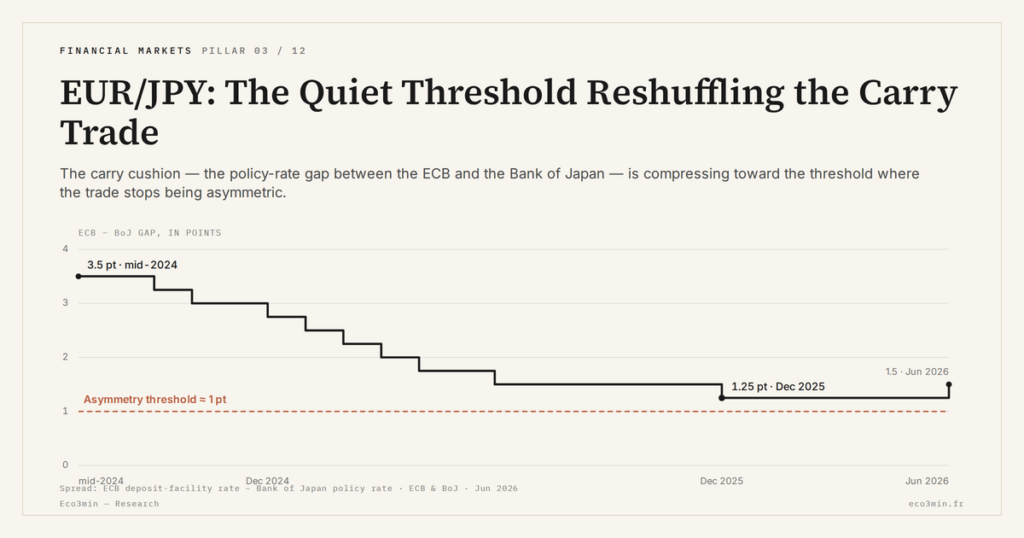
- Since summer 2024 the euro-area–Japan short-term rate gap has fallen from about 2 points to ~1.2 points by end-2025, as ECB rates eased from a 4.5% peak toward ~3.25%.
- EUR/JPY traded in a wide 150–165 range across 2024–2025, after a rally from levels near 120 in 2020.
- Long treated as a near-free carry play, the cross is reverting to a full macro FX risk for investors and for firms borrowing or invoicing in yen.
Key fact: since the summer of 2024, the short-term rate gap between the euro area and Japan has narrowed from around 2 points to ~1.2 points at end-2025, while implied volatility on EUR/JPY has climbed back toward levels closer to its 2015-2019 average.
Plain reading: the return/risk profile of the EUR/JPY carry trade is quietly reversing. It is no longer a “near-free” position for investors, nor mere background noise for corporates that borrow or invoice in yen.
Between these rate and volatility moves, a gradual but real shift is underway: this cross, long traded as a simple carry play, is reverting to a full macro FX risk in its own right.
Starting point: what has changed on EUR/JPY
EUR/JPY traded within a wide 150-165 range between early 2024 and late 2025, after a spectacular rally from levels near 120 in 2020. In parallel:
- ECB policy rates moved from a 4.5% peak in 2024 to ~3.25% in December 2025.
- The Bank of Japan, after years of negative rates, has kept its policy rate close to 0% but progressively raised the implicit ceiling on 10-year yields toward ~1.5%.
- Three-month implied volatility on EUR/JPY has risen from a floor near 6% in 2023 to ~9-10% at end-2025.
Immediate consequence: the carry “cushion” (rate differential) is compressing while the FX risk is rising.
To gauge how far this can go, EUR/JPY has to be placed within the broader frame of international FX market mechanics, where monetary policy gaps act as the primary engine.
The mechanics of the EUR/JPY carry trade, without jargon
The classic EUR/JPY carry trade involves:
- borrowing in yen, the very low-yielding currency,
- converting into euros,
- investing in higher-yielding euro-denominated assets (bonds, deposits, structured products),
- capturing the rate differential as long as the exchange rate does not move too far against the position.
From 2022 to mid-2024, the short-term rate gap between euro and yen could exceed 3 points. With moderate volatility, the dominant scenario was: “paid to wait.”
In 2025, the frame shifts:
- Compressing rate differential: ECB in normalization mode, BoJ tolerating higher yields along its curve.
- Political and macro risk: real growth around 1-1.2% in the euro area, slightly above 1% in Japan, with inflation realigning toward 2% on both sides.
- Rising FX volatility: geopolitical tensions, global portfolio repositioning, sharp adjustments along long-end rates.
What was an “automatic bonus” becomes a demanding arbitrage: the carry yield no longer systematically covers FX risk, especially in stress periods.
The overlooked angle: where the carry trade stops being asymmetric
Part of the consensus expects EUR/JPY to remain stuck in a wide range, with carry still moderately positive in favor of the euro. The implicit reasoning: as long as the ECB stays above 2% and the BoJ near 0%, the historical logic continues. Related analysis: our beginner’s guide to euro-dollar.
The alternative hypothesis developed in this analysis rests on a precise mechanism: the parity threshold between carry income and the expected value of FX risk. When:
- the short-term rate gap falls toward ~1 point,
- implied volatility durably exceeds 10%,
- and correlations with risk assets rise,
the EUR/JPY carry trade ceases to be structurally “asymmetric” (winning a little often, rarely losing big), and becomes a much more conventional directional FX bet.
Concretely, this means stress episodes — sharp rate moves, geopolitical shocks, equity corrections — can erase several months of carry in a few sessions.
What readers really want to know
What many readers are really trying to assess is not whether the euro will “rise or fall” against the yen, but whether FX risk has become high enough to justify hedging costs, or conversely an explicit risk-taking stance. The underlying question: “Is exposing my portfolio — or my company — to EUR/JPY still attractive, and at what level should the strategy change?”
Historical perspective: when EUR/JPY actually changes regime
Historically, EUR/JPY alternates between long phases of strong trends (uptrend 2012-2014, downtrend 2015-2016, fresh uptrend since 2020) and “range” periods
where carry dominates.
Two useful reference points:
- 2012-2014: ultra-accommodative BoJ policy versus gradual euro area tightening. The cross moved from around 100 to nearly 145, in an environment where carry and trend aligned.
- 2015-2016: volatility shock and a return of unconventional policies in Europe. The euro retreated toward 115-120 against the yen, and unhedged carry strategies suffered marked losses despite a still-favorable rate differential.
The current period looks more like a hinge zone: monetary policy gaps are normalizing, inflation is realigning, and the yen is partially regaining its role as conditional safe haven. The level of EUR/JPY matters less than its sensitivity to global shocks.
Common reading mistakes on EUR/JPY
- Confusing long-term trend with short-term comfort: seeing EUR/JPY “high” leads some to believe the main risk is still further upside. For a carry holder, the real risk is a sharp 5-10% reversal, even if the underlying trend remains intact.
- Overinterpreting nominal rate differentials: focusing on ECB vs BoJ policy rates obscures the importance of real rates, the 5-10 year curve and inflation expectations. Real rates drive flows, not only nominal ones.
- Ignoring implicit leverage: many EUR/JPY strategies rely on leverage (derivatives, margin). A simple uptick in volatility can then turn comfortable carry into margin calls, even without major changes in fundamentals.
Three plausible configurations for EUR/JPY
1. Unstable balance scenario (central case)
Hypothesis: soft but positive growth in Europe and Japan, inflation converging toward 2%, ECB still slightly above the BoJ in real-rate terms.
In this case, EUR/JPY oscillates within a wide 150-165 band with sharp but brief volatility episodes. Carry remains modestly positive for long-euro positions, but requires more moderate leverage and tighter stop-losses. This is the implicit scenario behind many current estimates.
2. Yen returning as a conditional safe haven
Hypothesis: a global risk shock (additional geopolitical tensions, equity correction, sovereign debt strains). Flows shift toward assets perceived as safer, including the yen.
A pullback in EUR/JPY toward 140-145, even temporarily, could erase ~12 months of carry on unhedged positions. This is not the central scenario today, but the market does not fully price this possibility, particularly in portfolios using the yen as a funding source.
3. BoJ hawkish surprise
Hypothesis: the Bank of Japan raises rates more decisively or formally anchors a higher long-end target, for example around 2%. This would strengthen the yen and further reduce the carry differential.
Even without a dramatic EUR/JPY drop, simple stabilization below 150 combined with a real rate differential close to zero would render the EUR/JPY carry near-neutral. The interest of the strategy would then shift toward more sophisticated structures (options, exotic products), out of reach for most retail investors.
Practical points for investors and corporates
For individual investors
- Cautious sizing: keeping net EUR/JPY exposure around ~2-4% of a diversified portfolio, including via derivatives or leveraged ETFs.
- Time horizon: a carry trade only makes sense over at least a 6-12 month horizon. Below that, market noise dominates carry.
- Entry/exit signals: monitoring monetary policy announcements and the reaction along the yield curve, rather than spot EUR/JPY alone. A simultaneous rise in 10-year Japanese yields and implied volatility should be read as a warning.
For corporates exposed to the yen
- Partial hedging: targeting 50-70% coverage of predictable yen flows (purchases, sales, debt) rather than all-or-nothing. The aim: smoothing P&L, not betting on FX.
- Hedge tenor: favoring staggered maturities (3, 6, 12 months) to avoid being trapped at a single FX level.
- KPI to track: integrating into internal reporting a simple indicator: “hedging cost as % of operating margin.” Once this cost exceeds 10-15% of the margin on a product line, the FX strategy warrants review.
For individuals with no professional yen exposure
Without revenues, expenses or projects directly indexed to the yen, EUR/JPY exposure is best read as a speculative position, not natural diversification. The learning effort is better spent on the broader principles of asset allocation before engaging with complex FX strategies.
Concrete indicators to watch
- 2-year rate differential euro – Japan: if it falls below 1 point and stays low, the carry premium becomes marginal.
- 3-month implied volatility on EUR/JPY: above 10-11%, the carry/risk ratio deteriorates clearly for unhedged strategies.
- Behavior of the yen during stress episodes: if, during an equity correction or a global volatility spike, the yen no longer strengthens meaningfully, its safe-haven status becomes questionable, altering flow dynamics.
If this dynamic persists, EUR/JPY could shift from a “carry cross” to a leading indicator of confidence in the global cycle, alongside certain credit indices.
Risk section: what could invalidate this reading
Several elements could make this analysis too cautious:
- More restrictive ECB than expected: if euro-area inflation re-accelerated, forcing the central bank to keep rates higher for longer, the carry differential against the yen would stay attractive despite rising volatility.
- Stronger European growth rebound: real growth above 1.5-2% in Europe, without a comparable acceleration in Japan, would structurally support the euro.
- More cautious BoJ: if the Bank of Japan delays meaningful normalization further, Japanese rates would stay artificially low, sustaining a positive carry in favor of the euro.
These counter-scenarios show this is not about declaring “the end of the EUR/JPY carry trade,” but recognizing that it is no longer the simple arbitrage it was between 2022 and 2024. Simple it was because the yen slid with no visible reaction from Tokyo — the 2022-2024 episode in which Japan lost control of the yen without a crisis.
Conclusion: how to position intelligently on EUR/JPY
The real question is not whether EUR/JPY is “too high” or “too low,” but whether the surrounding risk regime has changed. Today, carry remains positive for long-euro positions, but the safety margin is shrinking as:
- central banks converge toward real rates near zero,
- volatility normalizes,
- and the yen partially regains its role as a funding currency sensitive to shocks.
For investors, a working frame can act as a guardrail: capping total currency-carry exposure around 5% of the portfolio, EUR/JPY included, within a broader equity/bond/cash diversification logic (for example a 60/30/10 framework where, within the 10% sleeve, only 1-3% sits on FX strategies).
This is not the noisiest risk of the moment, but EUR/JPY risk is less visible than others — and therefore easier to ignore. That is precisely what makes it strategic for the coming quarters.
Reader questions
Is the EUR/JPY carry trade still relevant for retail investors?
Only marginally and with caution. The rate differential has narrowed and volatility has risen. Without natural yen exposure, modest sizing (1-2% of the portfolio, no leverage) is a reasonable maximum for a non-professional investor.
Should a European corporate importing from Japan increase its hedging?
If gross margin is low or volatile, yes. Partial hedging (50-70% of predictable flows) smooths the result without betting on FX. The right reflex is to compute the hedging cost as % of margin and integrate it into the pricing policy.
Is early repayment of yen debt advisable?
Not automatically. The decision has to compare: prepayment cost, potential hedging cost and residual FX risk. If overall debt remains manageable and the yen debt is hedged, prepayment is not always optimal.
Are EUR/JPY-exposed ETFs riskier now?
Leveraged ETFs or those with direct FX exposure see their risk profile rise with volatility. For long-term investors, favoring unleveraged products and verifying that the FX risk share remains coherent with global allocation is the more conservative path.
3 ideas to remember
- EUR/JPY is no longer purely a carry play: rising volatility is reshaping the return/risk profile of the carry trade.
- When the euro-Japan rate gap falls toward 1 point, a 5-10% FX move is enough to erase a year of carry.
- Capping FX carry around 5% of the portfolio, while monitoring the 2-year rate spread and implied volatility, allows this risk to be managed rather than absorbed.
Last updated — 18 September 2026
Disclaimer – Financial Information: The analyses, commentary, and content published on eco3min.fr are provided for informational and educational purposes only. They do not constitute investment advice or a solicitation to buy or sell financial instruments. Past performance is not indicative of future results. All investment decisions involve risk and are the sole responsibility of the reader.
Read next
Full pillar →Euro Below Parity in 2022: What Parity Means
In September 2022, the euro fell below parity with the dollar, to around 0.95, a low not seen…
Eurozone Fragmentation: Sovereign Spreads and the Euro
The euro is issued by a monetary union without a complete fiscal union: nineteen sovereign debts coexist under…
The Euro’s Energy Import Bill: the Gas Shock and the Currency
In 2022, the surge in gas prices turned the euro area's historic current-account surplus into a deficit and…